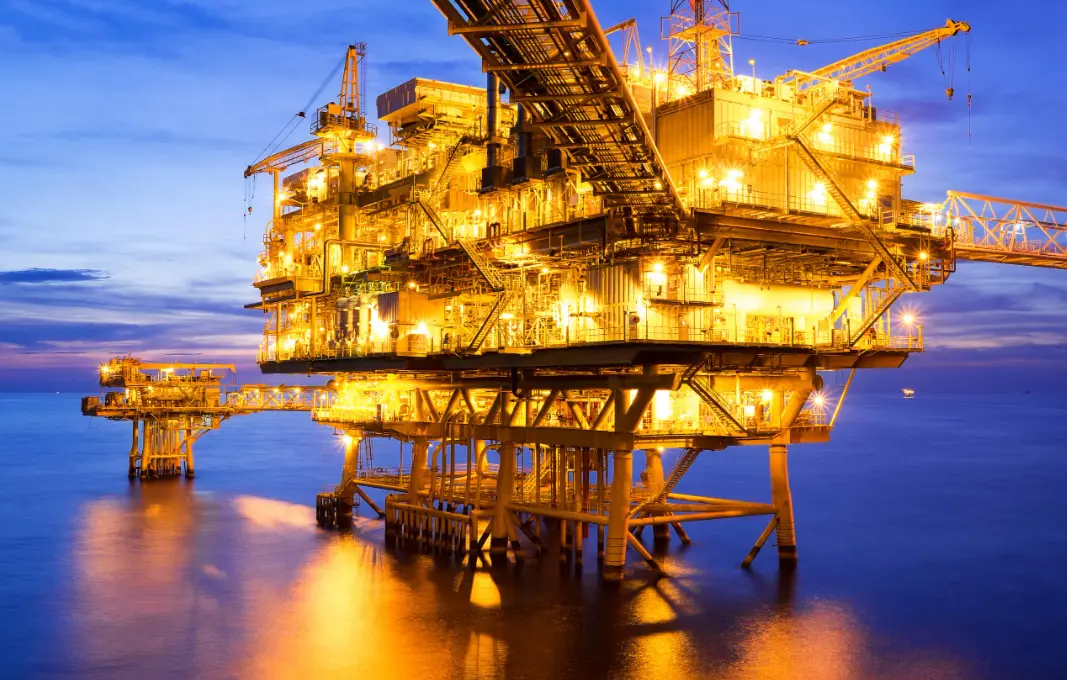
An oil platform stands as a colossal engineering marvel amid the vast ocean, a towering structure of steel and concrete designed to harness the earth’s hidden reserves of crude oil and natural gas. Perched on sturdy legs that plunge deep into the seabed, it defies the relentless waves and winds, often rising hundreds of feet above the waterline. At its core, the platform hosts a bustling array of machinery: massive drilling rigs that bore into the earth’s crust, pipelines that transport extracted resources to shore, and intricate networks of valves, pumps, and separators that process the raw hydrocarbons. Living quarters for the crew—resembling a self-contained city—provide accommodations, dining facilities, and even recreational areas, allowing workers to endure extended shifts in this isolated environment. Safety features, such as flare stacks for burning off excess gas and emergency evacuation systems, underscore the high-stakes operations, where human ingenuity battles the forces of nature to fuel global energy demands. From a distance, it appears as a beacon of industry, its lights flickering against the horizon, symbolizing both progress and the environmental challenges that accompany offshore extraction.
Table of Contents
- Part 1: Create A Oil Platform Quiz in Minutes Using AI with OnlineExamMaker
- Part 2: 20 Oil Platform Quiz Questions & Answers
- Part 3: Try OnlineExamMaker AI Question Generator to Create Quiz Questions
Part 1: Create A Oil Platform Quiz in Minutes Using AI with OnlineExamMaker
When it comes to ease of creating a Oil Platform skills assessment, OnlineExamMaker is one of the best AI-powered quiz making software for your institutions or businesses. With its AI Question Generator, just upload a document or input keywords about your assessment topic, you can generate high-quality quiz questions on any topic, difficulty level, and format.
Overview of its key assessment-related features:
● AI Question Generator to help you save time in creating quiz questions automatically.
● Share your online exam with audiences on social platforms like Facebook, Twitter, Reddit and more.
● Instantly scores objective questions and subjective answers use rubric-based scoring for consistency.
● Simply copy and insert a few lines of embed codes to display your online exams on your website or WordPress blog.
Automatically generate questions using AI
Part 2: 20 Oil Platform Quiz Questions & Answers
or
1. Question: What is the primary function of an oil platform?
Options:
A. To generate electricity
B. To extract and process oil and gas from beneath the seabed
C. To desalinate seawater
D. To conduct marine research
Answer: B
Explanation: Oil platforms are specifically designed structures that drill into the ocean floor to access and extract hydrocarbons, playing a crucial role in the oil and gas industry.
2. Question: Which type of oil platform is fixed to the seabed and suitable for shallow waters?
Options:
A. Semi-submersible platform
B. Jack-up rig
C. Tension leg platform
D. Floating production system
Answer: B
Explanation: Jack-up rigs have extendable legs that can be lowered to the seabed, making them stable for operations in waters up to about 500 feet deep.
3. Question: What material is commonly used in the construction of oil platforms to withstand harsh marine environments?
Options:
A. Wood
B. Steel
C. Plastic
D. Concrete
Answer: B
Explanation: Steel is favored for its strength, durability, and resistance to corrosion, which is essential for withstanding waves, winds, and corrosive seawater.
4. Question: How do floating oil platforms maintain their position over a drilling site?
Options:
A. Anchors and mooring lines
B. Propellers for constant movement
C. Balloons for buoyancy
D. Submerged weights
Answer: A
Explanation: Floating platforms use a system of anchors and mooring lines connected to the seabed to stay in place, ensuring stability during drilling operations.
5. Question: What is the main environmental risk associated with oil platforms?
Options:
A. Overfishing
B. Oil spills
C. Air pollution from ships
D. Noise pollution from waves
Answer: B
Explanation: Oil spills from platforms can lead to severe ecological damage, affecting marine life, coastlines, and water quality, as seen in historical incidents like the Deepwater Horizon disaster.
6. Question: Which organization regulates safety standards for oil platforms in the United States?
Options:
A. EPA
B. OSHA
C. BSEE
D. FDA
Answer: C
Explanation: The Bureau of Safety and Environmental Enforcement (BSEE) oversees the safety of offshore energy operations, including oil platforms, to prevent accidents and protect the environment.
7. Question: What process is used on oil platforms to separate oil from water and gas?
Options:
A. Filtration
B. Separation
C. Distillation
D. Combustion
Answer: B
Explanation: Separation equipment on platforms uses gravity and other methods to divide crude oil from associated water and gas, allowing for efficient processing and transport.
8. Question: Which factor primarily determines the location of an oil platform?
Options:
A. Proximity to shipping routes
B. Presence of oil reserves
C. Tourist attractions nearby
D. Weather patterns
Answer: B
Explanation: Oil platforms are built where geological surveys indicate substantial oil and gas reserves, ensuring economic viability for extraction.
9. Question: What is a tension leg platform (TLP)?
Options:
A. A platform anchored by chains
B. A floating platform held by vertical tendons
C. A submersible rig
D. A fixed jacket structure
Answer: B
Explanation: A TLP is a floating structure moored to the seabed with taut tendons, which minimize vertical motion and make it ideal for deep-water drilling.
10. Question: Why are helicopters commonly used for transportation to oil platforms?
Options:
A. For entertainment
B. To avoid sea travel in rough waters
C. To transport heavy equipment
D. For routine maintenance only
Answer: B
Explanation: Helicopters provide safe and efficient access to offshore platforms, especially in adverse weather conditions where boats might be impractical.
11. Question: What safety measure is mandatory on oil platforms to prevent fires?
Options:
A. Fire drills
B. Explosion-proof equipment
C. Open flames
D. Unsupervised welding
Answer: B
Explanation: Explosion-proof equipment is required to minimize the risk of sparks igniting flammable gases, a common hazard in oil extraction environments.
12. Question: How do oil platforms contribute to global energy supply?
Options:
A. By producing renewable energy
B. By supplying a significant portion of the world’s oil and gas
C. By recycling waste
D. By generating hydrogen
Answer: B
Explanation: Oil platforms are key to extracting fossil fuels that meet a large part of global energy demands, although they are non-renewable resources.
13. Question: What is the typical lifespan of a fixed oil platform?
Options:
A. 5-10 years
B. 20-30 years
C. 50-100 years
D. 1-2 years
Answer: B
Explanation: With proper maintenance, fixed platforms can operate for 20-30 years before requiring decommissioning or upgrades due to structural wear.
14. Question: Which technology is used for remote monitoring of oil platforms?
Options:
A. Satellite imagery
B. SCADA systems
C. Manual inspections
D. Radio signals
Answer: B
Explanation: Supervisory Control and Data Acquisition (SCADA) systems allow for real-time monitoring of platform operations, enhancing safety and efficiency from onshore locations.
15. Question: What is the purpose of a blowout preventer on an oil platform?
Options:
A. To control pressure during drilling
B. To store oil reserves
C. To generate power
D. To clean equipment
Answer: A
Explanation: A blowout preventer is a critical safety device that seals, controls, and monitors the well to prevent uncontrolled releases of oil or gas.
16. Question: Which country has the largest number of offshore oil platforms?
Options:
A. United States
B. Saudi Arabia
C. Norway
D. Brazil
Answer: A
Explanation: The United States, particularly in the Gulf of Mexico, hosts the most offshore platforms due to its extensive oil reserves and long history of offshore drilling.
17. Question: What environmental initiative is often implemented around oil platforms to protect marine life?
Options:
A. Artificial reefs
B. Dumping waste
C. Ignoring habitats
D. Overdrilling
Answer: A
Explanation: Some decommissioned platforms are converted into artificial reefs to promote marine biodiversity, offsetting some environmental impacts.
18. Question: How does deep-water drilling differ from shallow-water drilling?
Options:
A. It uses less technology
B. It requires advanced subsea equipment
C. It is cheaper
D. It has no risks
Answer: B
Explanation: Deep-water drilling involves sophisticated subsea systems and remotely operated vehicles due to the greater depths and pressures involved.
19. Question: What is the economic impact of oil platforms on local communities?
Options:
A. Increased unemployment
B. Job creation and revenue generation
C. Decreased trade
D. Environmental benefits only
Answer: B
Explanation: Oil platforms create jobs in extraction, maintenance, and support services, boosting local economies through employment and related industries.
20. Question: What is the first step in decommissioning an oil platform?
Options:
A. Immediate removal
B. Planning and environmental assessment
C. Selling the structure
D. Continuing operations
Answer: B
Explanation: Decommissioning begins with thorough planning and environmental impact assessments to ensure safe removal and minimize ecological harm.
or
Part 3: Try OnlineExamMaker AI Question Generator to Create Quiz Questions
Automatically generate questions using AI