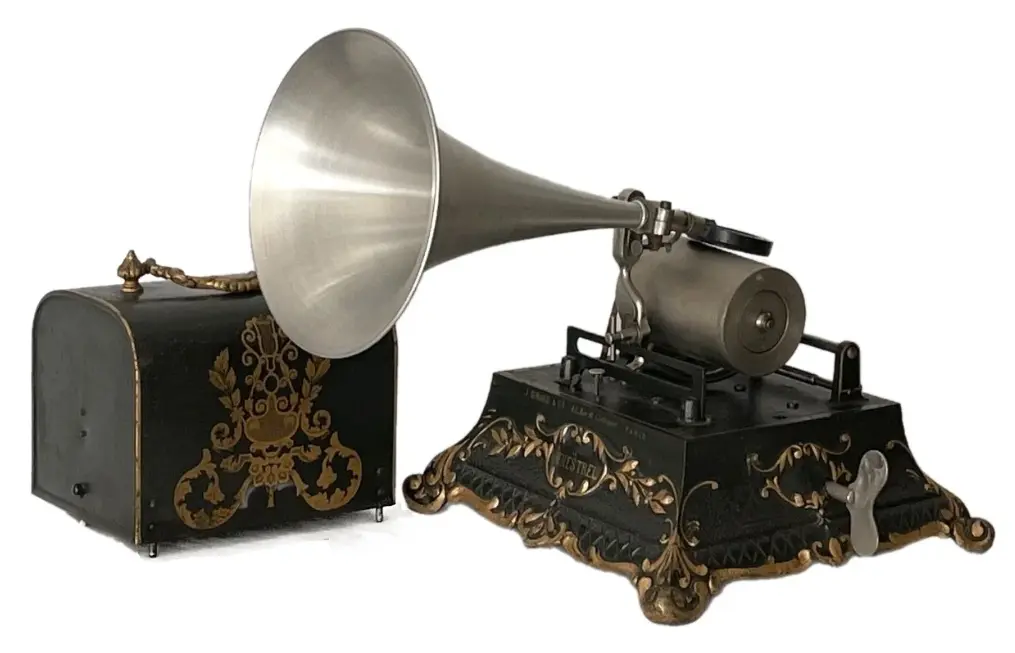
The phonograph, an ingenious invention by Thomas Edison in 1877, marked a revolutionary leap in sound recording technology. This device features a rotating cylinder or disc coated with a material like wax or metal, where sound waves are etched as fine grooves by a vibrating diaphragm connected to a stylus. When played, a needle follows these grooves, causing vibrations that amplify through a horn or speaker, transforming mechanical energy back into audible music or speech. Its compact design and portability made it a household marvel, preserving voices and performances for future generations and paving the way for modern audio devices like record players and digital recorders. With its blend of simplicity and innovation, the phonograph forever changed how we experience and archive the world’s sounds.
Table of Contents
- Part 1: Create An Amazing Phonographs Quiz Using AI Instantly in OnlineExamMaker
- Part 2: 20 Phonographs Quiz Questions & Answers
- Part 3: Save Time and Energy: Generate Quiz Questions with AI Technology
Part 1: Create An Amazing Phonographs Quiz Using AI Instantly in OnlineExamMaker
The quickest way to assess the Phonographs knowledge of candidates is using an AI assessment platform like OnlineExamMaker. With OnlineExamMaker AI Question Generator, you are able to input content—like text, documents, or topics—and then automatically generate questions in various formats (multiple-choice, true/false, short answer). Its AI Exam Grader can automatically grade the exam and generate insightful reports after your candidate submit the assessment.
Overview of its key assessment-related features:
● Create up to 10 question types, including multiple-choice, true/false, fill-in-the-blank, matching, short answer, and essay questions.
● Automatically generates detailed reports—individual scores, question report, and group performance.
● Instantly scores objective questions and subjective answers use rubric-based scoring for consistency.
● API and SSO help trainers integrate OnlineExamMaker with Google Classroom, Microsoft Teams, CRM and more.
Automatically generate questions using AI
Part 2: 20 Phonographs Quiz Questions & Answers
or
1. Question: Who invented the phonograph?
Options: A) Alexander Graham Bell
B) Thomas Edison
C) Nikola Tesla
D) Guglielmo Marconi
Answer: B) Thomas Edison
Explanation: Thomas Edison patented the phonograph in 1877, making it the first device capable of recording and reproducing sound.
2. Question: What was the primary material used for early phonograph cylinders?
Options: A) Wax
B) Metal
C) Glass
D) Plastic
Answer: A) Wax
Explanation: Early phonograph cylinders were made of wax, which allowed for the grooves to be etched and played back using a stylus.
3. Question: In what year was the phonograph first demonstrated publicly?
Options: A) 1876
B) 1877
C) 1880
D) 1890
Answer: B) 1877
Explanation: Thomas Edison demonstrated the phonograph in 1877, showcasing its ability to record and playback the human voice.
4. Question: What component of the phonograph converts vibrations into sound?
Options: A) Stylus
B) Diaphragm
C) Turntable
D) Amplifier
Answer: B) Diaphragm
Explanation: The diaphragm in a phonograph vibrates in response to the grooves on the cylinder or disc, producing audible sound waves.
5. Question: Which of these is a type of phonograph record?
Options: A) Cassette tape
B) Vinyl disc
C) CD
D) MP3 file
Answer: B) Vinyl disc
Explanation: Vinyl discs, also known as records, were a common format for phonographs, featuring spiral grooves that the stylus follows.
6. Question: What was the speed of early Edison phonograph cylinders?
Options: A) 16 RPM
B) 33 RPM
C) 45 RPM
D) 78 RPM
Answer: D) 78 RPM
Explanation: Early phonograph cylinders, particularly those by Edison, typically played at 78 revolutions per minute.
7. Question: Who improved the phonograph by introducing the lateral-cut disc?
Options: A) Thomas Edison
B) Emile Berliner
C) Alexander Graham Bell
D) John Logie Baird
Answer: B) Emile Berliner
Explanation: Emile Berliner invented the gramophone, which used lateral-cut discs, improving upon Edison’s cylinder-based phonograph.
8. Question: What is the function of the stylus in a phonograph?
Options: A) To amplify sound
B) To read the grooves
C) To rotate the disc
D) To record sound
Answer: B) To read the grooves
Explanation: The stylus, or needle, traces the grooves on the phonograph record, converting physical indentations into electrical signals for sound reproduction.
9. Question: Which material replaced wax for phonograph records in the early 20th century?
Options: A) Shellac
B) Rubber
C) Wood
D) Ceramic
Answer: A) Shellac
Explanation: Shellac was used to make more durable phonograph records, replacing wax cylinders around the turn of the 20th century.
10. Question: How did the phonograph impact society in the late 19th century?
Options: A) It revolutionized home entertainment
B) It was primarily used for scientific research
C) It had no significant impact
D) It was only for military communication
Answer: A) It revolutionized home entertainment
Explanation: The phonograph allowed people to listen to music and speeches at home, transforming entertainment and media consumption.
11. Question: What invention directly evolved from the phonograph?
Options: A) Telephone
B) Radio
C) Gramophone
D) Television
Answer: C) Gramophone
Explanation: The gramophone was a direct evolution of the phonograph, featuring flat discs instead of cylinders for better sound quality.
12. Question: What is the typical shape of early phonograph records?
Options: A) Square
B) Circular
C) Rectangular
D) Triangular
Answer: B) Circular
Explanation: Phonograph records are circular to allow for even rotation and consistent playback of the spiral grooves.
13. Question: Who was a major competitor to Edison in phonograph development?
Options: A) Albert Einstein
B) Emile Berliner
C) Isaac Newton
D) Marie Curie
Answer: B) Emile Berliner
Explanation: Emile Berliner competed with Edison by developing the gramophone, which used discs and became a popular alternative.
14. Question: What does RPM stand for in the context of phonographs?
Options: A) Records Per Minute
B) Revolutions Per Minute
C) Rotations Per Meter
D) Records Play Mechanism
Answer: B) Revolutions Per Minute
Explanation: RPM refers to the speed at which the phonograph disc rotates, such as 78 RPM for early records.
15. Question: Which phonograph format allowed for longer playtime?
Options: A) Cylinders
B) 78 RPM discs
C) 33 RPM discs
D) 45 RPM singles
Answer: C) 33 RPM discs
Explanation: 33 RPM discs, introduced later, allowed for longer recordings compared to 78 RPM discs due to their slower speed.
16. Question: What was the phonograph’s original intended use according to Edison?
Options: A) Entertainment
B) Dictation and business
C) Education
D) Military signaling
Answer: B) Dictation and business
Explanation: Edison initially envisioned the phonograph as a device for business dictation and letter writing, not primarily for music.
17. Question: How many sound channels did early phonographs have?
Options: A) Mono
B) Stereo
C) Surround
D) Quadraphonic
Answer: A) Mono
Explanation: Early phonographs produced monaural sound, meaning a single channel, unlike modern stereo systems.
18. Question: What advancement made phonographs more portable?
Options: A) Electric motors
B) Hand-crank mechanisms
C) Solar power
D) Battery operation
Answer: B) Hand-crank mechanisms
Explanation: Hand-crank mechanisms allowed phonographs to be portable and functional without electricity, popular in the late 19th century.
19. Question: Which company was associated with the production of phonographs in the early 1900s?
Options: A) Apple
B) Victor Talking Machine Company
C) Sony
D) Microsoft
Answer: B) Victor Talking Machine Company
Explanation: The Victor Talking Machine Company was a leading manufacturer of phonographs and records in the early 20th century.
20. Question: What eventually replaced phonographs as the dominant music format?
Options: A) Cassette tapes
B) CDs
C) Streaming services
D) All of the above
Answer: D) All of the above
Explanation: Phonographs were succeeded by cassette tapes, CDs, and later digital streaming, each offering improvements in convenience and quality.
or
Part 3: Save Time and Energy: Generate Quiz Questions with AI Technology
Automatically generate questions using AI