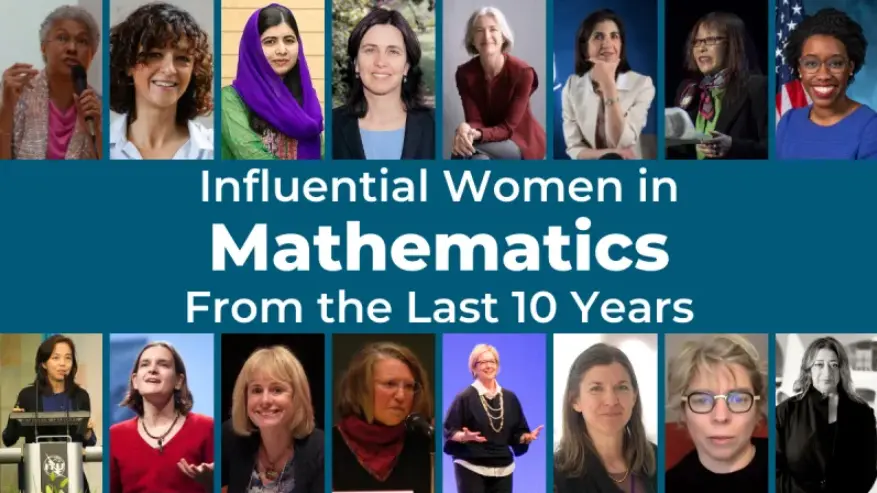
Women mathematicians have made profound contributions to the field throughout history, often overcoming significant barriers in a male-dominated discipline. From ancient times to the modern era, their work has advanced areas such as algebra, geometry, and computer science.
One of the earliest known figures is Hypatia of Alexandria (c. 370–415 AD), a philosopher and mathematician who taught in the Library of Alexandria and wrote influential texts on algebra and astronomy. In the 19th century, Ada Lovelace (1815–1852) is celebrated as the world’s first computer programmer, having developed algorithms for Charles Babbage’s early mechanical computer.
In the 20th century, Emmy Noether (1882–1935) revolutionized abstract algebra and theoretical physics with her theorems on symmetry and conservation laws, influencing figures like Albert Einstein. Similarly, Maryam Mirzakhani (1977–2017), the first woman to win the Fields Medal in 2014, advanced the study of Riemann surfaces and dynamical systems.
Despite historical challenges, women like Katherine Johnson (1918–2020), whose calculations were crucial for NASA’s space missions, and current leaders such as Ingrid Daubechies, a pioneer in wavelet theory, continue to inspire. Today, initiatives promoting gender equality in STEM fields are helping more women thrive in mathematics, ensuring their voices shape the future of the discipline.
Table of Contents
- Part 1: OnlineExamMaker AI Quiz Generator – Save Time and Efforts
- Part 2: 20 Woman Mathematician Quiz Questions & Answers
- Part 3: Save Time and Energy: Generate Quiz Questions with AI Technology
Part 1: OnlineExamMaker AI Quiz Generator – Save Time and Efforts
What’s the best way to create a Woman Mathematician quiz online? OnlineExamMaker is the best AI quiz making software for you. No coding, and no design skills required. If you don’t have the time to create your online quiz from scratch, you are able to use OnlineExamMaker AI Question Generator to create question automatically, then add them into your online assessment. What is more, the platform leverages AI proctoring and AI grading features to streamline the process while ensuring exam integrity.
Key features of OnlineExamMaker:
● Combines AI webcam monitoring to capture cheating activities during online exam.
● Allow the quiz taker to answer by uploading video or a Word document, adding an image, and recording an audio file.
● Automatically scores multiple-choice, true/false, and even open-ended/audio responses using AI, reducing manual work.
● OnlineExamMaker API offers private access for developers to extract your exam data back into your system automatically.
Automatically generate questions using AI
Part 2: 20 Woman Mathematician Quiz Questions & Answers
or
Question 1:
Who is credited with writing the first algorithm intended for use by a machine?
A) Marie Curie
B) Ada Lovelace
C) Marie-Sophie Germain
D) Hypatia of Alexandria
Answer: B
Explanation: Ada Lovelace is recognized for her work on Charles Babbage’s early mechanical general-purpose computer, the Analytical Engine, where she wrote an algorithm for Bernoulli numbers, making her the first to conceptualize a computer program.
Question 2:
Which mathematician developed Noether’s theorem, a fundamental result in physics relating symmetries to conservation laws?
A) Emmy Noether
B) Sofia Kovalevskaya
C) Maryam Mirzakhani
D) Florence Nightingale
Answer: A
Explanation: Emmy Noether formulated Noether’s theorem, which connects symmetries in physical systems to conserved quantities, profoundly influencing modern physics and abstract algebra.
Question 3:
Who proved that there are infinitely many prime numbers of the form 4k + 1?
A) Hypatia
B) Sophie Germain
C) Ada Lovelace
D) Katherine Johnson
Answer: B
Explanation: Sophie Germain demonstrated the infinitude of primes of the form 4k + 1 through her work in number theory, contributing significantly to Fermat’s Last Theorem and modular arithmetic.
Question 4:
Which ancient mathematician was the head of the Neoplatonic school in Alexandria and wrote on geometry and algebra?
A) Mary Cartwright
B) Hypatia
C) Evelyn Boyd Granville
D) Julia Robinson
Answer: B
Explanation: Hypatia was a prominent scholar in mathematics and philosophy, authoring texts on conic sections and algebra, and she played a key role in advancing geometric concepts in the ancient world.
Question 5:
Who was the first woman to win the Fields Medal for her work on the dynamics and geometry of Riemann surfaces?
A) Karen Uhlenbeck
B) Maryam Mirzakhani
C) Olga Ladyzhenskaya
D) Ruth Lawrence
Answer: B
Explanation: Maryam Mirzakhani received the Fields Medal in 2014 for her groundbreaking contributions to the understanding of the symmetry, structure, and complexity of curved surfaces.
Question 6:
Which NASA mathematician calculated the trajectories for the Apollo 11 moon landing?
A) Dorothy Vaughan
B) Katherine Johnson
C) Margaret Hamilton
D) Grace Hopper
Answer: B
Explanation: Katherine Johnson performed the orbital mechanics calculations that ensured the safe trajectory and return of the Apollo missions, including Apollo 11.
Question 7:
Who was the first woman to obtain a doctorate in mathematics and made contributions to partial differential equations?
A) Sofia Kovalevskaya
B) Joan Birman
C) Ingrid Daubechies
D) Alicia Boole Stott
Answer: A
Explanation: Sofia Kovalevskaya earned her doctorate from the University of Göttingen and advanced the study of partial differential equations, particularly in the rotation of solid bodies.
Question 8:
Which statistician used data visualization to improve medical and sanitation practices during the Crimean War?
A) Florence Nightingale
B) Evelyn Boyd Granville
C) Mary Cartwright
D) Julia Robinson
Answer: A
Explanation: Florence Nightingale pioneered the use of statistical graphics, such as pie charts and coxcombs, to analyze and reform hospital mortality rates.
Question 9:
Who contributed to the development of the COBOL programming language and was a pioneer in computer science?
A) Grace Hopper
B) Dorothy Vaughan
C) Margaret Hamilton
D) Ruth Lawrence
Answer: A
Explanation: Grace Hopper invented the first compiler for computer programming and played a key role in creating COBOL, influencing modern software development.
Question 10:
Which mathematician solved the 10th and 23rd Hilbert problems related to the foundations of mathematics?
A) Julia Robinson
B) Karen Uhlenbeck
C) Olga Ladyzhenskaya
D) Joan Birman
Answer: A
Explanation: Julia Robinson’s work on decision problems, including her contributions to Hilbert’s problems, advanced the field of mathematical logic and computability.
Question 11:
Who received the Abel Prize for her work on geometric partial differential equations and gauge theory?
A) Karen Uhlenbeck
B) Ingrid Daubechies
C) Mary Cartwright
D) Alicia Boole Stott
Answer: A
Explanation: Karen Uhlenbeck was awarded the Abel Prize in 2019 for her foundational analyses in geometric analysis, including minimal surfaces and Yang-Mills theory.
Question 12:
Which Soviet mathematician advanced the theory of partial differential equations, particularly Navier-Stokes equations?
A) Olga Ladyzhenskaya
B) Evelyn Boyd Granville
C) Ruth Lawrence
D) Joan Birman
Answer: A
Explanation: Olga Ladyzhenskaya developed key theorems for the existence and uniqueness of solutions to fluid dynamics equations, impacting modern applied mathematics.
Question 13:
Who was one of the first African-American women to earn a Ph.D. in mathematics and worked on early space programs?
A) Evelyn Boyd Granville
B) Dorothy Vaughan
C) Margaret Hamilton
D) Grace Hopper
Answer: A
Explanation: Evelyn Boyd Granville contributed to NASA’s Mercury and Apollo programs, applying her expertise in mathematics to orbital calculations and computer programming.
Question 14:
Which mathematician specialized in knot theory and low-dimensional topology?
A) Joan Birman
B) Sofia Kovalevskaya
C) Hypatia
D) Sophie Germain
Answer: A
Explanation: Joan Birman’s research on braid groups and knot invariants has been essential in understanding the topology of three-dimensional spaces.
Question 15:
Who made significant contributions to the theory of functions of a complex variable and nonlinear differential equations?
A) Mary Cartwright
B) Ada Lovelace
C) Katherine Johnson
D) Maryam Mirzakhani
Answer: A
Explanation: Mary Cartwright, along with J.E. Littlewood, worked on the dynamics of nonlinear differential equations, influencing chaos theory and complex analysis.
Question 16:
Which mathematician is known for her work in quantum physics and the representation theory of Lie groups?
A) Ruth Lawrence
B) Ingrid Daubechies
C) Emmy Noether
D) Florence Nightingale
Answer: A
Explanation: Ruth Lawrence developed topological quantum field theory and modular representations, bridging mathematics and theoretical physics.
Question 17:
Who pioneered the development of wavelets, which are used in signal processing and data compression?
A) Ingrid Daubechies
B) Julia Robinson
C) Karen Uhlenbeck
D) Olga Ladyzhenskaya
Answer: A
Explanation: Ingrid Daubechies created the orthonormal wavelets that bear her name, revolutionizing fields like image processing and time-series analysis.
Question 18:
Which mathematician contributed to the study of four-dimensional geometry through her work on polytopes?
A) Alicia Boole Stott
B) Sophie Germain
C) Hypatia
D) Mary Cartwright
Answer: A
Explanation: Alicia Boole Stott visualized and classified four-dimensional polytopes, providing insights into higher-dimensional geometry without formal training.
Question 19:
Who was instrumental in programming the Apollo Guidance Computer for the moon missions?
A) Margaret Hamilton
B) Dorothy Vaughan
C) Evelyn Boyd Granville
D) Grace Hopper
Answer: A
Explanation: Margaret Hamilton’s software engineering for the Apollo missions, including priority scheduling, was crucial for the success of human spaceflight.
Question 20:
Which mathematician advanced the understanding of dynamical systems and ergodic theory?
A) Maryam Mirzakhani
B) Emmy Noether
C) Sofia Kovalevskaya
D) Florence Nightingale
Answer: A
Explanation: Maryam Mirzakhani’s research on the moduli spaces of Riemann surfaces has deepened the study of dynamical systems and their long-term behavior.
or
Part 3: Save Time and Energy: Generate Quiz Questions with AI Technology
Automatically generate questions using AI