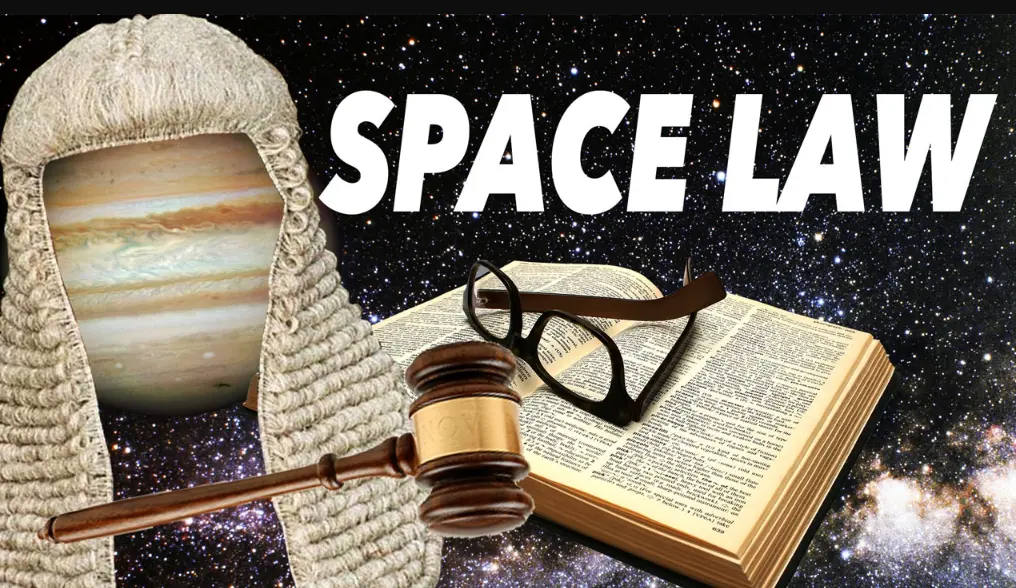
Space Law encompasses the international and national legal frameworks governing activities in outer space, ensuring peaceful exploration, resource use, and environmental protection. It originated in the mid-20th century amid the Space Race, with the United Nations playing a pivotal role.
Key Treaties and Agreements:
– Outer Space Treaty (1967): The cornerstone of Space Law, it prohibits national appropriation of outer space, mandates exploration for peaceful purposes, and bans weapons of mass destruction in space. Ratified by over 110 countries, it establishes that space is the “province of all mankind.”
– Rescue Agreement (1968): Requires states to assist astronauts in distress and return them safely, emphasizing international cooperation.
– Liability Convention (1972): Holds launching states absolutely liable for damage caused by their space objects on Earth or to aircraft.
– Registration Convention (1975): Mandates the registration of space objects to promote transparency and accountability.
– Moon Agreement (1979): Extends principles to the Moon and other celestial bodies, addressing resource exploitation and establishing a regime for equitable benefits, though it has limited ratification.
Core Principles:
– Non-appropriation: No nation can claim sovereignty over outer space, celestial bodies, or orbits.
– Peaceful Use: Activities must be for the benefit of all countries and conducted to avoid harmful interference.
– Freedom of Exploration: All states have equal rights to scientific investigation, subject to international law.
– Responsibility and Liability: Launching states are responsible for national activities in space and must address any damage caused.
– Environmental Protection: Measures must prevent contamination of space and Earth environments.
Governing Bodies and Implementation:
The United Nations Office for Outer Space Affairs (UNOOSA) oversees global Space Law, coordinating through the Committee on the Peaceful Uses of Outer Space (COPUOS). National space agencies, such as NASA and ESA, enforce domestic regulations, while the International Telecommunication Union (ITU) manages orbital slots and frequency allocations for satellites.
Current Challenges and Developments:
– Commercial Spaceflight: The rise of private companies like SpaceX and Blue Origin has prompted new regulations on space tourism, debris management, and resource extraction, as seen in the U.S. Space Act of 2015.
– Space Debris: With over 23,000 objects in orbit, treaties are evolving to address mitigation and removal to prevent the “Kessler Syndrome.”
– Militarization and Cybersecurity: Tensions over anti-satellite weapons and cyber threats have led to discussions on arms control, highlighted by the 2020 Artemis Accords for lunar cooperation.
– Emerging Issues: Debates on asteroid mining, planetary protection, and equitable access for developing nations are shaping future frameworks, including potential updates to existing treaties.
Space Law continues to evolve with technological advancements, promoting sustainable and collaborative space activities for humanity’s benefit.
Table of Contents
- Part 1: OnlineExamMaker AI Quiz Generator – Save Time and Efforts
- Part 2: 20 Space Law Quiz Questions & Answers
- Part 3: Try OnlineExamMaker AI Question Generator to Create Quiz Questions
Part 1: OnlineExamMaker AI Quiz Generator – Save Time and Efforts
What’s the best way to create a Space Law quiz online? OnlineExamMaker is the best AI quiz making software for you. No coding, and no design skills required. If you don’t have the time to create your online quiz from scratch, you are able to use OnlineExamMaker AI Question Generator to create question automatically, then add them into your online assessment. What is more, the platform leverages AI proctoring and AI grading features to streamline the process while ensuring exam integrity.
Key features of OnlineExamMaker:
● Combines AI webcam monitoring to capture cheating activities during online exam.
● Allow the quiz taker to answer by uploading video or a Word document, adding an image, and recording an audio file.
● Automatically scores multiple-choice, true/false, and even open-ended/audio responses using AI, reducing manual work.
● OnlineExamMaker API offers private access for developers to extract your exam data back into your system automatically.
Automatically generate questions using AI
Part 2: 20 Space Law Quiz Questions & Answers
or
1. Question: What is the primary purpose of the Outer Space Treaty of 1967?
A. To regulate commercial space tourism
B. To establish that outer space is free for exploration by all nations
C. To ban all satellite launches
D. To claim ownership of the Moon
Answer: B
Explanation: The Outer Space Treaty declares that outer space is the province of all mankind and is free for exploration and use by all states, prohibiting national appropriation by claim of sovereignty.
2. Question: Which principle of Space Law prohibits the placement of nuclear weapons in orbit?
A. The Moon Agreement
B. The Outer Space Treaty
C. The Rescue Agreement
D. The Liability Convention
Answer: B
Explanation: Article IV of the Outer Space Treaty specifically bans the placement of nuclear weapons or any other weapons of mass destruction in orbit or on celestial bodies.
3. Question: Under the Outer Space Treaty, who is responsible for damage caused by space objects?
A. The launching state’s private companies
B. The international community as a whole
C. The launching state
D. The United Nations
Answer: C
Explanation: The treaty holds the launching state absolutely liable for damage caused by its space objects on the surface of the Earth or to aircraft.
4. Question: What does the Moon Agreement of 1979 primarily address?
A. Commercial mining on asteroids
B. The exploitation of natural resources on the Moon
C. Satellite communications
D. Space station construction
Answer: B
Explanation: The Moon Agreement governs the use of the Moon and other celestial bodies, emphasizing that their resources are the common heritage of mankind and should benefit all countries.
5. Question: Which body is responsible for allocating frequencies for satellite communications?
A. The International Court of Justice
B. The International Telecommunication Union (ITU)
C. NASA
D. The European Space Agency
Answer: B
Explanation: The ITU manages the global spectrum resources, ensuring that satellite communications do not interfere with each other by coordinating frequency allocations.
6. Question: According to Space Law, can a country claim sovereignty over a planet or other celestial body?
A. Yes, if they establish a permanent base
B. Yes, through unanimous UN approval
C. No, under the Outer Space Treaty
D. Yes, for scientific purposes
Answer: C
Explanation: The Outer Space Treaty explicitly states that outer space, including the Moon and other celestial bodies, is not subject to national appropriation by claim of sovereignty.
7. Question: What is the key focus of the Rescue and Return Agreement of 1968?
A. Returning astronauts to their home country
B. Rescuing and returning astronauts and space objects
C. Salvaging space debris
D. Exchanging space technology
Answer: B
Explanation: This agreement obligates states to assist astronauts in distress and return them, as well as any space objects, to the launching authority.
8. Question: Under the Liability Convention, how is liability determined for damage caused in space?
A. Based on fault only
B. Absolutely for damage on Earth, fault-based for damage in space
C. Equally shared among all space-faring nations
D. Determined by the UN Security Council
Answer: B
Explanation: The convention imposes absolute liability for damage on the surface of the Earth and fault-based liability for damage occurring elsewhere in space.
9. Question: Which treaty addresses the registration of space objects?
A. The Outer Space Treaty
B. The Registration Convention
C. The Moon Agreement
D. The Space Debris Mitigation Guidelines
Answer: B
Explanation: The Registration Convention requires launching states to maintain a national registry and furnish information to the UN Secretary-General for a central registry of objects launched into outer space.
10. Question: What does Space Law say about the militarization of space?
A. It is fully permitted for defense purposes
B. It is prohibited except for military personnel conducting scientific research
C. Weapons of mass destruction are banned, but other military uses are allowed
D. All military activities are banned
Answer: C
Explanation: The Outer Space Treaty bans weapons of mass destruction in space but does not prohibit general military activities, such as reconnaissance satellites.
11. Question: Who bears the responsibility for space debris under international law?
A. The country that launched the object
B. All signatories to the Outer Space Treaty equally
C. The International Space Station operators
D. No one, as it is considered natural space matter
Answer: A
Explanation: Launching states are responsible for their space objects, including debris, under the Outer Space Treaty and related guidelines, which encourage mitigation to prevent harm.
12. Question: According to the Outer Space Treaty, what is the status of outer space?
A. A territory for exclusive national use
B. The common heritage of mankind
C. Reserved for scientific research only
D. Open for colonization by private entities
Answer: B
Explanation: The treaty declares outer space as the province of all mankind, to be used for peaceful purposes and for the benefit of all countries.
13. Question: What legal framework governs commercial space activities like satellite launches?
A. National laws only
B. International treaties and national regulations
C. The World Trade Organization agreements
D. Bilateral agreements between companies
Answer: B
Explanation: Commercial activities must comply with international Space Law treaties, such as the Outer Space Treaty, while also adhering to the launching state’s national laws.
14. Question: Under Space Law, can private companies own parts of celestial bodies?
A. Yes, if approved by the UN
B. No, as per the Outer Space Treaty
C. Yes, for mining purposes
D. Yes, but only on Mars
Answer: B
Explanation: The Outer Space Treaty prohibits any national appropriation of outer space, and by extension, private ownership of celestial bodies is not recognized under international law.
15. Question: Which agreement deals with cooperation in the exploration of celestial bodies?
A. The Outer Space Treaty
B. The Artemis Accords
C. The Liability Convention
D. The Rescue Agreement
Answer: A
Explanation: The Outer Space Treaty promotes international cooperation in the exploration and use of outer space, setting the foundation for agreements like the Artemis Accords.
16. Question: What is the main concern addressed by the Space Debris Mitigation Guidelines?
A. Protecting intellectual property in space
B. Reducing the creation and risks of space debris
C. Regulating space tourism
D. Allocating funding for space missions
Answer: B
Explanation: These guidelines, adopted by the UN, aim to minimize the amount of debris generated by space activities to ensure the long-term sustainability of outer space.
17. Question: According to international Space Law, must astronauts be considered envoys of mankind?
A. No, they represent their nation only
B. Yes, under the Outer Space Treaty
C. Only if they are on the Moon
D. Yes, but only for rescue purposes
Answer: B
Explanation: The Outer Space Treaty regards astronauts as envoys of mankind in outer space, emphasizing their role in peaceful exploration and requiring assistance if needed.
18. Question: What does the concept of “peaceful purposes” in Space Law mean?
A. Only non-military activities
B. Activities that are not aggressive or threatening
C. Exclusive use for scientific research
D. Commercial activities only
Answer: B
Explanation: Space Law, particularly the Outer Space Treaty, requires that space activities be carried out for peaceful purposes, meaning they should not involve threats or use of force, though it allows for certain defensive measures.
19. Question: Under the Liability Convention, how is compensation for damage calculated?
A. Based on the market value of the damaged object
B. According to the actual loss incurred
C. Equally divided among all parties
D. Determined by international arbitration
Answer: B
Explanation: Compensation is based on the actual loss suffered, as determined through diplomatic negotiations or claims commissions under the convention.
20. Question: What is the role of the United Nations in Space Law?
A. To enforce Space Law treaties
B. To provide a forum for developing and overseeing Space Law
C. To launch all space missions
D. To resolve all space disputes
Answer: B
Explanation: The UN, through bodies like the Committee on the Peaceful Uses of Outer Space (COPUOS), facilitates the creation of treaties and guidelines, though enforcement relies on member states.
or
Part 3: Try OnlineExamMaker AI Question Generator to Create Quiz Questions
Automatically generate questions using AI