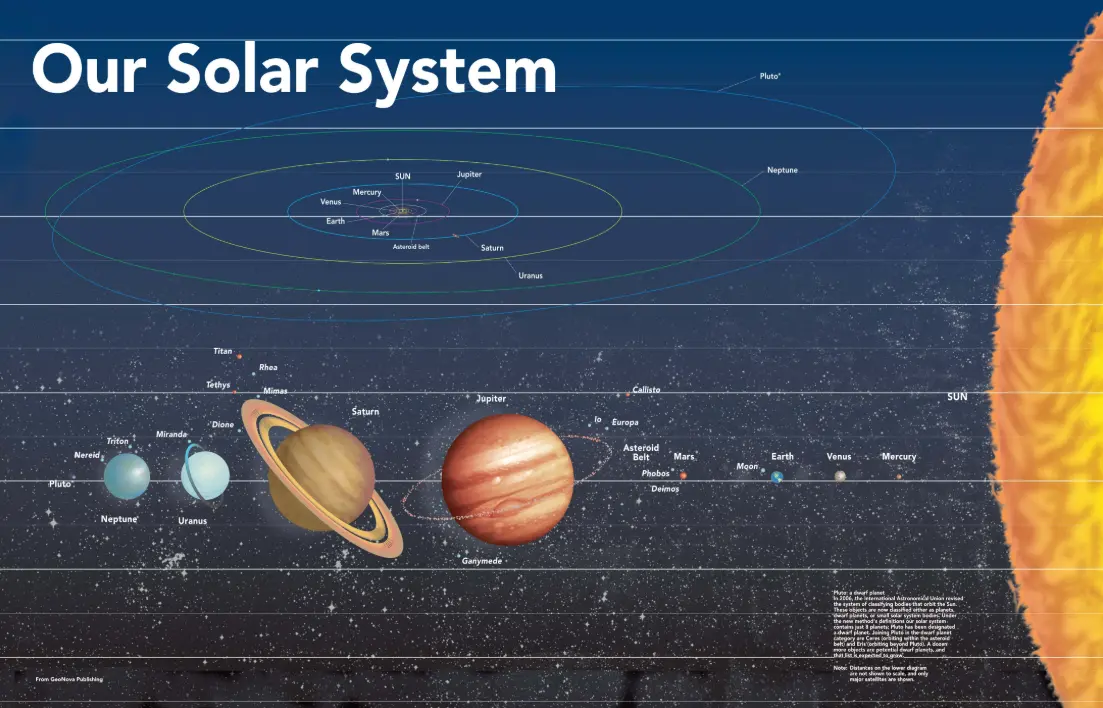
The Solar System is a vast collection of celestial bodies orbiting the Sun, located in the Milky Way galaxy. At its center lies the Sun, a massive star that accounts for about 99.86% of the system’s total mass and provides the energy necessary for life on Earth.
The Solar System consists of eight planets, divided into inner and outer categories. The inner planets, or terrestrial planets, are:
– Mercury: The smallest planet, closest to the Sun, with a rocky surface and extreme temperature variations due to its lack of atmosphere.
– Venus: Known as Earth’s “sister planet” for its similar size, it has a thick, toxic atmosphere that creates a runaway greenhouse effect, making it the hottest planet.
– Earth: The third planet, unique for its liquid water, diverse life forms, and protective atmosphere; it is the only known planet to support life.
– Mars: Often called the “Red Planet” for its iron oxide-rich soil, it features ancient riverbeds, polar ice caps, and ongoing exploration for signs of past life.
The outer planets, or gas giants and ice giants, include:
– Jupiter: The largest planet, a gas giant with a prominent Great Red Spot, a storm larger than Earth, and over 80 known moons.
– Saturn: Famous for its extensive ring system made of ice and rock particles, it is another gas giant with more than 80 moons, including Titan, which has a thick atmosphere.
– Uranus: An ice giant tilted on its side, likely due to a ancient collision, with a blue-green hue from methane in its atmosphere and 27 known moons.
– Neptune: The farthest planet from the Sun, another ice giant with strong winds and a deep blue color, also featuring 14 known moons.
Beyond the planets, the Solar System includes dwarf planets like Pluto, which was reclassified in 2006 and orbits in the Kuiper Belt, a region of icy bodies. Other features include:
– Asteroids: Rocky remnants mostly found in the asteroid belt between Mars and Jupiter.
– Comets: Icy bodies that originate from the Kuiper Belt or Oort Cloud and develop tails when approaching the Sun.
– Moons: Natural satellites orbiting planets, with Earth’s Moon being the most familiar.
– The Kuiper Belt and Oort Cloud: Distant regions containing remnants from the Solar System’s formation.
The Solar System formed approximately 4.6 billion years ago from a giant molecular cloud, and its structure is governed by gravity, with planets following elliptical orbits as described by Kepler’s laws. Exploration via spacecraft, such as Voyager and New Horizons, continues to reveal new insights into its mysteries.
Table of Contents
- Part 1: Create An Amazing Solar System Quiz Using AI Instantly in OnlineExamMaker
- Part 2: 20 Solar System Quiz Questions & Answers
- Part 3: Try OnlineExamMaker AI Question Generator to Create Quiz Questions
Part 1: Create An Amazing Solar System Quiz Using AI Instantly in OnlineExamMaker
The quickest way to assess the Solar System knowledge of candidates is using an AI assessment platform like OnlineExamMaker. With OnlineExamMaker AI Question Generator, you are able to input content—like text, documents, or topics—and then automatically generate questions in various formats (multiple-choice, true/false, short answer). Its AI Exam Grader can automatically grade the exam and generate insightful reports after your candidate submit the assessment.
Overview of its key assessment-related features:
● Create up to 10 question types, including multiple-choice, true/false, fill-in-the-blank, matching, short answer, and essay questions.
● Automatically generates detailed reports—individual scores, question report, and group performance.
● Instantly scores objective questions and subjective answers use rubric-based scoring for consistency.
● API and SSO help trainers integrate OnlineExamMaker with Google Classroom, Microsoft Teams, CRM and more.
Automatically generate questions using AI
Part 2: 20 Solar System Quiz Questions & Answers
or
1. Question: What is the largest planet in the Solar System?
A. Earth
B. Saturn
C. Jupiter
D. Neptune
Answer: C
Explanation: Jupiter is the largest planet, with a diameter of about 143,000 kilometers, due to its massive gas composition and strong gravitational pull.
2. Question: How many planets are officially recognized in the Solar System?
A. 7
B. 8
C. 9
D. 10
Answer: B
Explanation: There are 8 planets: Mercury, Venus, Earth, Mars, Jupiter, Saturn, Uranus, and Neptune, as defined by the International Astronomical Union.
3. Question: Which planet is closest to the Sun?
A. Venus
B. Mercury
C. Mars
D. Earth
Answer: B
Explanation: Mercury is the closest planet to the Sun, at an average distance of about 58 million kilometers, making it the hottest planet in terms of surface temperature.
4. Question: What is the primary gas that makes up most of the Sun’s composition?
A. Oxygen
B. Hydrogen
C. Helium
D. Carbon
Answer: B
Explanation: Hydrogen makes up about 74% of the Sun’s mass, and through nuclear fusion, it converts to helium, releasing the energy that powers the Sun.
5. Question: Which planet is known as the “Red Planet”?
A. Jupiter
B. Mars
C. Venus
D. Uranus
Answer: B
Explanation: Mars is called the Red Planet due to the iron oxide on its surface, which gives it a reddish appearance.
6. Question: How long does it take for Earth to complete one orbit around the Sun?
A. 365 days
B. 29.5 days
C. 24 hours
D. 88 days
Answer: A
Explanation: Earth’s orbital period is approximately 365.25 days, which is the basis for our calendar year.
7. Question: What causes the phases of the Moon?
A. Earth’s shadow
B. The Moon’s rotation
C. Sunlight reflecting off the Moon
D. The Moon’s atmosphere
Answer: C
Explanation: The phases occur as the Moon orbits Earth, with different portions illuminated by the Sun depending on its position relative to Earth.
8. Question: Which planet has the most moons?
A. Mars
B. Jupiter
C. Saturn
D. Uranus
Answer: B
Explanation: Jupiter has at least 95 confirmed moons, many of which are small and irregular, due to its massive gravity capturing objects.
9. Question: What is the asteroid belt located between?
A. Mars and Jupiter
B. Earth and Mars
C. Jupiter and Saturn
D. Venus and Earth
Answer: A
Explanation: The asteroid belt lies between Mars and Jupiter, containing millions of rocky bodies that orbit the Sun.
10. Question: Which dwarf planet was reclassified from being a planet in 2006?
A. Ceres
B. Pluto
C. Eris
D. Haumea
Answer: B
Explanation: Pluto was reclassified as a dwarf planet by the International Astronomical Union because it has not cleared its orbit of other objects.
11. Question: What is the main component of Saturn’s rings?
A. Gas
B. Ice and rock
C. Liquid metal
D. Dust only
Answer: B
Explanation: Saturn’s rings are primarily made of ice particles, rocks, and dust, which reflect sunlight and create their bright appearance.
12. Question: How does the Sun produce energy?
A. Chemical reactions
B. Nuclear fission
C. Nuclear fusion
D. Gravitational collapse
Answer: C
Explanation: The Sun generates energy through nuclear fusion, where hydrogen atoms combine to form helium in its core, releasing vast amounts of heat and light.
13. Question: Which planet is the hottest in the Solar System?
A. Mercury
B. Venus
C. Earth
D. Mars
Answer: B
Explanation: Venus is the hottest due to its thick atmosphere of carbon dioxide, which creates a runaway greenhouse effect, with surface temperatures around 465°C.
14. Question: What is a comet primarily composed of?
A. Rock and metal
B. Ice, dust, and rocky material
C. Gas only
D. Liquid water
Answer: B
Explanation: Comets are made of ice, dust, and rocky particles, which form a glowing coma and tail when they approach the Sun and heat up.
15. Question: Which planet has a tilted axis that causes it to roll on its side?
A. Earth
B. Uranus
C. Neptune
D. Saturn
Answer: B
Explanation: Uranus has an axial tilt of about 98 degrees, causing it to essentially roll around the Sun rather than spin upright.
16. Question: What is the Kuiper Belt?
A. A ring around Saturn
B. A region of comets beyond Neptune
C. The Sun’s core
D. Earth’s atmosphere
Answer: B
Explanation: The Kuiper Belt is a ring of icy bodies beyond Neptune, from which many comets originate, extending from about 30 to 50 astronomical units from the Sun.
17. Question: How old is the Solar System approximately?
A. 4.6 billion years
B. 1 billion years
C. 13.8 billion years
D. 65 million years
Answer: A
Explanation: The Solar System formed about 4.6 billion years ago from a collapsing cloud of gas and dust, based on radiometric dating of meteorites and rocks.
18. Question: What causes a solar eclipse?
A. The Moon blocking the Sun
B. Earth’s shadow on the Moon
C. Alignment of planets
D. Comet passing by
Answer: A
Explanation: A solar eclipse occurs when the Moon passes between Earth and the Sun, casting a shadow on Earth and temporarily blocking sunlight.
19. Question: Which probe was the first to visit Pluto?
A. Voyager 1
B. Curiosity Rover
C. New Horizons
D. Cassini
Answer: C
Explanation: New Horizons was launched in 2006 and flew by Pluto in 2015, providing the first close images and data about the dwarf planet.
20. Question: What is the habitable zone in the Solar System?
A. The area around the Sun with extreme heat
B. The region where liquid water can exist
C. The orbit of Jupiter
D. The asteroid belt
Answer: B
Explanation: The habitable zone, also known as the Goldilocks zone, is the area around the Sun where conditions might allow liquid water to exist on a planet’s surface, such as Earth’s orbit.
or
Part 3: Try OnlineExamMaker AI Question Generator to Create Quiz Questions
Automatically generate questions using AI