Set Theory is a foundational branch of mathematics that studies collections of objects, called sets. A set is a well-defined collection of distinct objects, which can be anything from numbers to abstract concepts, and is denoted by curly braces, e.g., {1, 2, 3}.
Key concepts include:
– Elements and Membership: An element belongs to a set if it is a member, denoted as x ∈ A for element x in set A. If not, x ∉ A.
– Types of Sets: Sets can be finite (e.g., {a, b, c}) or infinite (e.g., the set of all natural numbers, ℕ). The empty set, denoted ∅ or {}, contains no elements.
– Set Operations:
– Union: A ∪ B combines all elements in A or B.
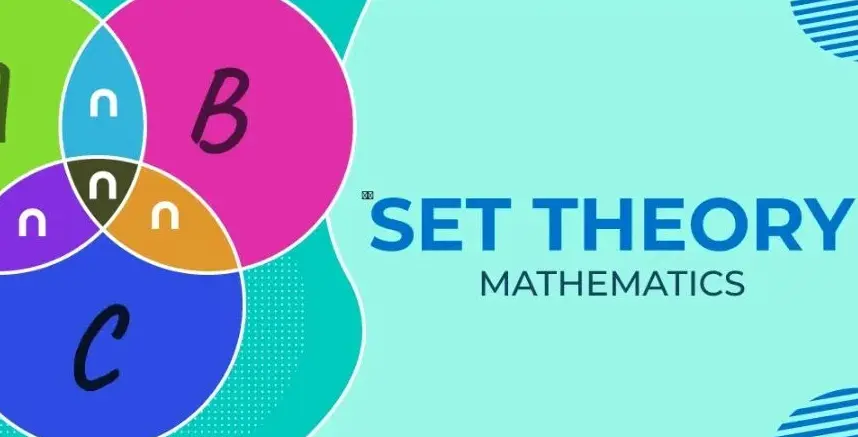
– Intersection: A ∩ B contains elements common to both A and B.
– Difference: A – B includes elements in A but not in B.
– Complement: The complement of A, denoted A’, includes all elements not in A, relative to a universal set.
– Subsets and Power Sets: A subset B of A, denoted B ⊆ A, means every element of B is in A. The power set of A, P(A), is the set of all subsets of A.
– Cardinality: The size of a set; finite sets have a specific number of elements, while infinite sets like ℕ and the real numbers have the same cardinality, known as countably infinite and uncountable, respectively.
Set Theory was formalized by Georg Cantor in the late 19th century and is essential for modern mathematics. It underpins concepts in logic, topology, and computer science. The Zermelo-Fraenkel axioms (ZF) provide a rigorous foundation, including the axiom of extensionality (sets are equal if they have the same elements) and the axiom of infinity (ensures the existence of infinite sets).
Applications include database query languages, probability theory, and the development of axiomatic systems to avoid paradoxes like Russell’s paradox, which arises from naive set comprehension.
In summary, Set Theory provides the abstract framework for organizing and manipulating collections, influencing virtually all areas of mathematics and beyond.
Table of Contents
- Part 1: Best AI Quiz Making Software for Creating A Set Theory Quiz
- Part 2: 20 Set Theory Quiz Questions & Answers
- Part 3: OnlineExamMaker AI Question Generator: Generate Questions for Any Topic
Part 1: Best AI Quiz Making Software for Creating A Set Theory Quiz
OnlineExamMaker is a powerful AI-powered assessment platform to create auto-grading Set Theory skills assessments. It’s designed for educators, trainers, businesses, and anyone looking to generate engaging quizzes without spending hours crafting questions manually. The AI Question Generator feature allows you to input a topic or specific details, and it generates a variety of question types automatically.
Top features for assessment organizers:
● Combines AI webcam monitoring to capture cheating activities during online exam.
● Enhances assessments with interactive experience by embedding video, audio, image into quizzes and multimedia feedback.
● Once the exam ends, the exam scores, question reports, ranking and other analytics data can be exported to your device in Excel file format.
● API and SSO help trainers integrate OnlineExamMaker with Google Classroom, Microsoft Teams, CRM and more.
Automatically generate questions using AI
Part 2: 20 Set Theory Quiz Questions & Answers
or
1. What is the union of sets A = {1, 2, 3} and B = {3, 4, 5}?
A. {1, 2, 3}
B. {1, 2, 3, 4, 5}
C. {3}
D. {1, 2, 4, 5}
Answer: B
Explanation: The union of two sets combines all unique elements from both sets, so A ∪ B = {1, 2, 3, 4, 5}.
2. Which of the following is a subset of the set {a, b, c}?
A. {a, b, d}
B. {a, c}
C. {a, b, c, d}
D. {b, c, e}
Answer: B
Explanation: A subset must contain elements that are all in the original set; {a, c} is entirely within {a, b, c}.
3. What is the cardinality of the set {apple, banana, cherry}?
A. 2
B. 3
C. 4
D. 1
Answer: B
Explanation: The cardinality is the number of elements in the set, and there are three distinct elements.
4. If A = {1, 2, 3} and B = {4, 5}, what is A ∩ B?
A. {1, 2, 3, 4, 5}
B. {1, 2, 3}
C. {}
D. {5}
Answer: C
Explanation: The intersection contains elements common to both sets, and A and B have no elements in common, resulting in the empty set.
5. Which set is equal to the power set of {x}?
A. {{x}}
B. {x, {x}}
C. {{}, {x}}
D. {x}
Answer: C
Explanation: The power set of a set includes all subsets, so for {x}, the subsets are {} and {x}.
6. What is the complement of the set A = {1, 2, 3} in the universal set U = {1, 2, 3, 4, 5}?
A. {1, 2, 3}
B. {4, 5}
C. {1, 2, 3, 4, 5}
D. {}
Answer: B
Explanation: The complement of A in U contains all elements in U that are not in A, which are {4, 5}.
7. If A has 5 elements and B has 7 elements, what is the maximum possible number of elements in A ∪ B?
A. 2
B. 12
C. 7
D. 5
Answer: B
Explanation: The maximum size of the union occurs when A and B have no elements in common, so |A ∪ B| = |A| + |B| = 5 + 7 = 12.
8. Which of the following is true for disjoint sets?
A. A ∩ B = A
B. A ∩ B = {}
C. A ∪ B = B
D. A ⊆ B
Answer: B
Explanation: Disjoint sets have no elements in common, so their intersection is the empty set.
9. What is the symmetric difference of sets A = {1, 2} and B = {2, 3}?
A. {1, 2, 3}
B. {1, 3}
C. {2}
D. {}
Answer: B
Explanation: The symmetric difference includes elements in either A or B but not in both, so (A ∪ B) – (A ∩ B) = {1, 3}.
10. If A = {a, b} and B = {b, c}, how many elements are in the Cartesian product A × B?
A. 2
B. 3
C. 4
D. 6
Answer: C
Explanation: The Cartesian product A × B consists of all ordered pairs: {(a, b), (a, c), (b, b), (b, c)}, which has 4 elements.
11. Which set represents the difference A – B, where A = {1, 2, 3} and B = {2, 4}?
A. {1, 3, 4}
B. {1, 3}
C. {2}
D. {1, 2}
Answer: B
Explanation: A – B contains elements in A that are not in B, so {1, 3}.
12. What is the number of proper subsets of a set with 3 elements?
A. 3
B. 6
C. 7
D. 8
Answer: C
Explanation: A set with 3 elements has 2^3 = 8 subsets, but excluding the set itself gives 7 proper subsets.
13. In a Venn diagram, where do elements unique to set A appear?
A. In the intersection of A and B
B. Outside both circles
C. Only in the A circle, not overlapping
D. In the universal set only
Answer: C
Explanation: Elements unique to A are in the A circle but not in the overlapping region with B.
14. If two sets are equal, what must be true?
A. They have the same elements
B. They have the same subsets
C. One is a subset of the other
D. They are disjoint
Answer: A
Explanation: Equal sets contain exactly the same elements, regardless of order or other properties.
15. What is the result of (A ∪ B) ∩ C, if A, B, and C are sets?
A. A ∪ (B ∩ C)
B. (A ∩ B) ∪ C
C. Elements in A, B, or C
D. Elements in A or B and also in C
Answer: D
Explanation: (A ∪ B) ∩ C means elements that are in A or B, and also in C.
16. How many elements are in the empty set?
A. 1
B. 0
C. Infinite
D. Undefined
Answer: B
Explanation: The empty set has no elements, so its cardinality is 0.
17. If A ⊆ B and B ⊆ A, what is the relationship between A and B?
A. A is a proper subset of B
B. A and B are equal
C. A and B are disjoint
D. B is a subset of A
Answer: B
Explanation: If each is a subset of the other, they must contain exactly the same elements.
18. What is the union of A = {} and B = {1}?
A. {}
B. {1}
C. {0, 1}
D. Undefined
Answer: B
Explanation: The union includes all elements from either set, so {} ∪ {1} = {1}.
19. In set theory, what does the notation |A| represent?
A. The elements of A
B. The subsets of A
C. The cardinality of A
D. The union of A
Answer: C
Explanation: |A| denotes the number of elements in set A.
20. If A has 4 elements and is a subset of B with 6 elements, what is the minimum number of elements in B that are not in A?
A. 0
B. 2
C. 4
D. 6
Answer: B
Explanation: Since A is a subset of B and has 4 elements, B must have at least 2 more elements to total 6, so the minimum not in A is 2.
or
Part 3: OnlineExamMaker AI Question Generator: Generate Questions for Any Topic
Automatically generate questions using AI