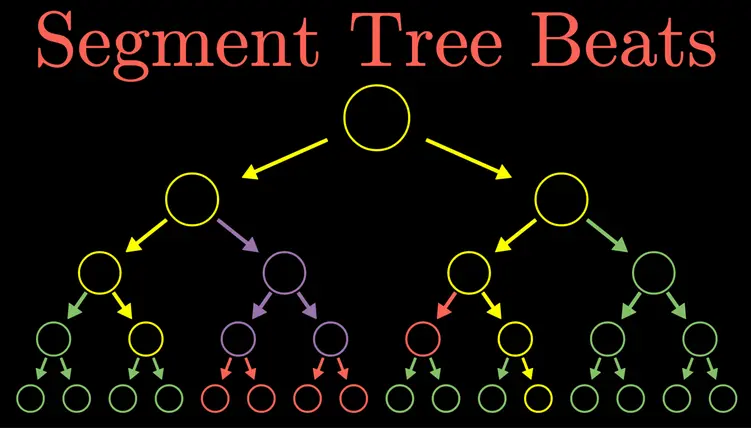
A Segment Tree is a versatile tree-based data structure used in computer science for efficiently handling range queries and updates on arrays. It is essentially a binary tree where each node represents an interval of the array, with the root node covering the entire array and leaf nodes representing individual elements.
The structure allows for quick operations like:
– Range Queries: Computing sums, minimums, maximums, or other aggregates over a specified subarray.
– Point Updates: Modifying a single element in the array and propagating changes to relevant nodes.
Built as a full binary tree, a Segment Tree for an array of size n typically has a height of O(log n), enabling queries and updates in O(log n) time complexity. This makes it ideal for problems involving frequent range-based computations, such as in competitive programming, graphics, or database optimizations.
For instance, to build a Segment Tree for an array, you recursively divide the array into halves and store aggregated values at each node. When querying a range, you traverse the tree to combine results from overlapping nodes, ensuring efficiency without scanning the entire array.
Table of Contents
- Part 1: Create A Segment Tree Quiz in Minutes Using AI with OnlineExamMaker
- Part 2: 20 Segment Tree Quiz Questions & Answers
- Part 3: AI Question Generator – Automatically Create Questions for Your Next Assessment
Part 1: Create A Segment Tree Quiz in Minutes Using AI with OnlineExamMaker
When it comes to ease of creating a Segment Tree skills assessment, OnlineExamMaker is one of the best AI-powered quiz making software for your institutions or businesses. With its AI Question Generator, just upload a document or input keywords about your assessment topic, you can generate high-quality quiz questions on any topic, difficulty level, and format.
Overview of its key assessment-related features:
● AI Question Generator to help you save time in creating quiz questions automatically.
● Share your online exam with audiences on social platforms like Facebook, Twitter, Reddit and more.
● Instantly scores objective questions and subjective answers use rubric-based scoring for consistency.
● Simply copy and insert a few lines of embed codes to display your online exams on your website or WordPress blog.
Automatically generate questions using AI
Part 2: 20 Segment Tree Quiz Questions & Answers
or
Question 1:
What is a Segment Tree primarily used for?
A) Storing individual elements of an array
B) Performing range queries and updates efficiently
C) Sorting arrays in linear time
D) Implementing binary search trees
Answer: B
Explanation: A Segment Tree is a binary tree data structure that allows for efficient querying and updating of array segments, typically in O(log N) time for both operations.
Question 2:
How is a Segment Tree typically constructed?
A) Using a recursive approach to divide the array into halves
B) By linearly traversing the array and adding nodes
C) Using dynamic programming to build from the leaves
D) By sorting the array and creating nodes based on order
Answer: A
Explanation: The construction of a Segment Tree involves recursively dividing the array into two halves until the segments are single elements, then building the tree from the bottom up.
Question 3:
What is the time complexity for building a Segment Tree for an array of size N?
A) O(1)
B) O(N)
C) O(N log N)
D) O(N^2)
Answer: C
Explanation: Building a Segment Tree requires processing each element and its ancestors, resulting in a time complexity of O(N log N) due to the tree’s structure.
Question 4:
In a Segment Tree, what does each leaf node represent?
A) The entire array
B) A single element of the array
C) The sum of all elements
D) The midpoint of the array
Answer: B
Explanation: Leaf nodes in a Segment Tree represent individual elements of the original array, while internal nodes represent aggregates of their child segments.
Question 5:
What operation is performed when querying a range in a Segment Tree?
A) Traversing the tree from root to leaves
B) Combining values from relevant nodes
C) Sorting the nodes in the tree
D) Deleting nodes outside the range
Answer: B
Explanation: Querying involves traversing the tree and combining the values of nodes that fully or partially cover the query range, such as summing or finding the minimum.
Question 6:
What is the space complexity of a Segment Tree for an array of size N?
A) O(1)
B) O(N)
C) O(N log N)
D) O(log N)
Answer: C
Explanation: A Segment Tree typically uses an array of size 4N to store all nodes, leading to O(N log N) space complexity in the worst case.
Question 7:
How does lazy propagation work in a Segment Tree?
A) It updates only the root node
B) It defers updates to subtrees until necessary
C) It propagates queries from leaves to root
D) It eliminates the need for a tree structure
Answer: B
Explanation: Lazy propagation delays the application of updates to nodes until they are needed for a query, improving the efficiency of range updates.
Question 8:
What is the time complexity for a range update query with lazy propagation?
A) O(1)
B) O(log N)
C) O(N)
D) O(N log N)
Answer: B
Explanation: With lazy propagation, range updates can be performed in O(log N) time by marking nodes and propagating only when required.
Question 9:
In a Segment Tree for minimum queries, what value is stored in an internal node?
A) The maximum value in its segment
B) The minimum value in its segment
C) The sum of its segment
D) The average of its segment
Answer: B
Explanation: For minimum queries, each internal node stores the minimum value of the elements in the segment it represents.
Question 10:
What happens if you update an element in the original array using a Segment Tree?
A) Only the leaf node is updated
B) The path from the leaf to the root is updated
C) The entire tree is rebuilt
D) Nothing changes in the tree
Answer: B
Explanation: Updating an element requires modifying the leaf node and propagating the change up the tree to update all affected ancestor nodes.
Question 11:
Can a Segment Tree handle dynamic arrays?
A) Yes, by resizing the tree automatically
B) No, it only works with fixed-size arrays
C) Yes, but only for sorted arrays
D) No, it requires a linked list instead
Answer: B
Explanation: Segment Trees are typically built for fixed-size arrays; handling dynamic arrays would require rebuilding the tree or using a different structure.
Question 12:
What is the purpose of the “query” function in a Segment Tree?
A) To insert new elements
B) To retrieve the aggregate for a given range
C) To delete elements from the array
D) To sort the tree nodes
Answer: B
Explanation: The query function computes and returns the aggregate (e.g., sum, min) for a specified range by traversing the relevant parts of the tree.
Question 13:
In a Segment Tree, how many children does each internal node have?
A) One
B) Two
C) Three
D) Variable, depending on the array size
Answer: B
Explanation: A Segment Tree is a binary tree, so each internal node has exactly two children, representing the left and right halves of its segment.
Question 14:
What type of Segment Tree is used for range sum queries?
A) A tree that stores minimum values
B) A tree that stores the sum of segments
C) A tree that stores maximum values
D) A tree that stores individual elements only
Answer: B
Explanation: For range sum queries, each node stores the sum of the elements in its segment, allowing quick computation of totals for any range.
Question 15:
Why is a Segment Tree more efficient than a simple array for range queries?
A) It uses less memory
B) It allows O(1) queries
C) It reduces the number of elements accessed
D) It eliminates the need for loops
Answer: C
Explanation: Segment Trees minimize the number of nodes visited during queries, enabling faster operations compared to scanning the array each time.
Question 16:
What is the root node of a Segment Tree?
A) Represents a single element
B) Represents the entire array
C) Represents an empty segment
D) Is always a leaf node
Answer: B
Explanation: The root node of a Segment Tree represents the entire array or the full range of the input.
Question 17:
How do you handle overlapping ranges in Segment Tree queries?
A) By ignoring overlaps
B) By combining partial overlaps in the query function
C) By rebuilding the tree
D) By using external sorting
Answer: B
Explanation: The query function handles overlapping ranges by adding or combining values from nodes that partially cover the query range.
Question 18:
What is a common application of Segment Trees?
A) Graph traversal
B) String matching
C) Range minimum queries in competitive programming
D) Database indexing
Answer: C
Explanation: Segment Trees are widely used in competitive programming for problems involving range queries, such as finding the minimum in a subarray.
Question 19:
If an array has 8 elements, what is the size of the Segment Tree array?
A) 8
B) 16
C) 24
D) 32
Answer: D
Explanation: For an array of size 8, a Segment Tree typically uses an array of size 4N (which is 32) to accommodate all nodes.
Question 20:
What is the main drawback of using a Segment Tree?
A) It is too simple to implement
B) It requires O(N log N) space
C) It only works for numerical data
D) It cannot handle updates
Answer: B
Explanation: The primary drawback is the higher space requirement of O(N log N), which can be inefficient for very large arrays compared to other structures.
or
Part 3: AI Question Generator – Automatically Create Questions for Your Next Assessment
Automatically generate questions using AI