Propane, also known as liquefied petroleum gas (LPG), is a colorless, odorless, and flammable hydrocarbon gas commonly used as a fuel source. It is a byproduct of natural gas processing and petroleum refining, making it an abundant and versatile energy resource.
#Chemical Properties
– Chemical Formula: C₃H₈
– State at Room Temperature: Gas, but easily liquefies under moderate pressure, which allows for efficient storage and transport.
– Boiling Point: -42°C (-44°F) at atmospheric pressure.
– Energy Content: Propane has a high energy density, providing about 91,452 BTU per gallon, making it an efficient fuel for heating and powering engines.
#Sources and Production
Propane is extracted during the refining of crude oil and the processing of natural gas. It is often found in natural gas deposits and is separated through fractionation. Major producers include the United States, Saudi Arabia, and Russia, with global demand driven by its use in residential, commercial, and industrial sectors.
#Common Uses
– Residential: Propane powers home heating systems, water heaters, stoves, and grills. It is popular in rural areas without access to natural gas pipelines.
– Commercial and Industrial: Used in forklifts, generators, and manufacturing processes. It also serves as a fuel for vehicles, such as buses and trucks, in regions with propane infrastructure.
– Agriculture: Propane-fueled equipment is used for crop drying, weed control, and powering farm machinery.
– Other Applications: In the chemical industry, propane is a feedstock for producing propylene and other petrochemicals. It is also used in aerosol propellants and as a refrigerant.
#Environmental and Safety Considerations
– Environmental Impact: Propane burns cleaner than gasoline or diesel, emitting lower levels of greenhouse gases and pollutants. It is considered a low-emission fuel and supports efforts to reduce air pollution.
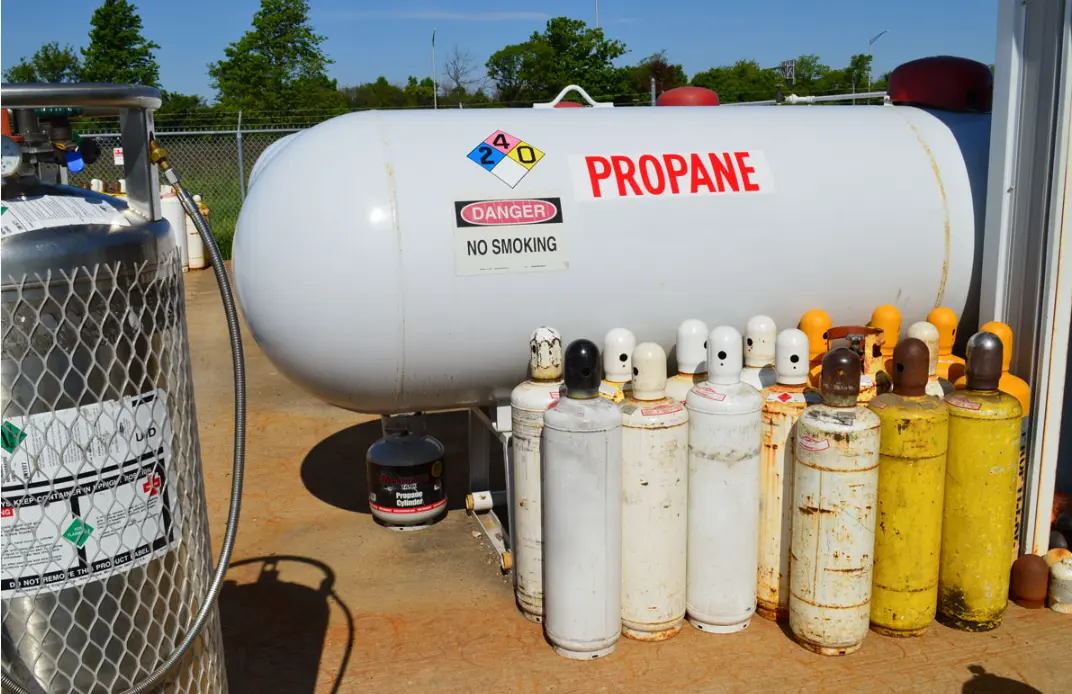
– Safety: Propane is non-toxic but highly flammable. It is odorized with mercaptan to detect leaks. Proper storage in tanks and adherence to safety standards are essential to prevent accidents. In the event of a leak, it is heavier than air and can accumulate in low areas, posing a fire risk.
#Advantages and Challenges
– Advantages: Affordable, portable, and reliable, with a long shelf life. It reduces dependence on electricity during outages and is widely available.
– Challenges: Fluctuating prices based on oil markets, the need for infrastructure like tanks and pipelines, and potential risks from improper handling.
Propane continues to play a vital role in global energy systems, offering a bridge to more sustainable practices as renewable technologies evolve.
Table of Contents
- Part 1: OnlineExamMaker AI Quiz Generator – Save Time and Efforts
- Part 2: 20 Propane Quiz Questions & Answers
- Part 3: OnlineExamMaker AI Question Generator: Generate Questions for Any Topic
Part 1: OnlineExamMaker AI Quiz Generator – Save Time and Efforts
What’s the best way to create a Propane quiz online? OnlineExamMaker is the best AI quiz making software for you. No coding, and no design skills required. If you don’t have the time to create your online quiz from scratch, you are able to use OnlineExamMaker AI Question Generator to create question automatically, then add them into your online assessment. What is more, the platform leverages AI proctoring and AI grading features to streamline the process while ensuring exam integrity.
Key features of OnlineExamMaker:
● Combines AI webcam monitoring to capture cheating activities during online exam.
● Allow the quiz taker to answer by uploading video or a Word document, adding an image, and recording an audio file.
● Automatically scores multiple-choice, true/false, and even open-ended/audio responses using AI, reducing manual work.
● OnlineExamMaker API offers private access for developers to extract your exam data back into your system automatically.
Automatically generate questions using AI
Part 2: 20 Propane Quiz Questions & Answers
or
1. Question: What is the chemical formula of propane?
Options:
A) C2H6
B) C3H8
C) C4H10
D) CH4
Answer: B) C3H8
Explanation: Propane is an alkane with three carbon atoms, following the formula CnH2n+2, so for n=3, it is C3H8.
2. Question: What is the primary use of propane in households?
Options:
A) As a refrigerant
B) For cooking and heating
C) In car batteries
D) As a cleaning agent
Answer: B) For cooking and heating
Explanation: Propane is commonly used as a fuel for grills, stoves, and heaters due to its efficient combustion.
3. Question: At room temperature, what is the state of propane?
Options:
A) Solid
B) Liquid
C) Gas
D) Plasma
Answer: C) Gas
Explanation: Propane is a gas at room temperature (around 20°C) and standard atmospheric pressure.
4. Question: Which of the following is a common hazard associated with propane?
Options:
A) It is highly acidic
B) It is flammable and can cause explosions
C) It is toxic when ingested
D) It causes corrosion on metals
Answer: B) It is flammable and can cause explosions
Explanation: Propane is a highly flammable gas, and improper handling can lead to fires or explosions.
5. Question: What type of hydrocarbon is propane?
Options:
A) Aromatic
B) Alkyne
C) Alkane
D) Alkene
Answer: C) Alkane
Explanation: Propane belongs to the alkane family, which consists of saturated hydrocarbons with single bonds.
6. Question: In what form is propane typically stored and transported?
Options:
A) As a solid block
B) In liquid form under pressure
C) As an aerosol spray
D) In powdered form
Answer: B) In liquid form under pressure
Explanation: Propane is stored as a liquefied petroleum gas (LPG) in tanks under pressure to make it easier to handle.
7. Question: What is the boiling point of propane?
Options:
A) -42°C
B) 0°C
C) 100°C
D) -10°C
Answer: A) -42°C
Explanation: Propane boils at approximately -42°C, which is why it vaporizes quickly at room temperature.
8. Question: Which gas is propane often mixed with to form liquefied petroleum gas (LPG)?
Options:
A) Oxygen
B) Butane
C) Methane
D) Helium
Answer: B) Butane
Explanation: LPG is a mixture primarily of propane and butane, used for fuel in various applications.
9. Question: What is the complete combustion reaction of propane?
Options:
A) C3H8 + 5O2 → 3CO2 + 4H2O
B) C3H8 + 3O2 → 3CO + 4H2O
C) C3H8 + 2O2 → 3CO2 + 4H2
D) C3H8 + 4O2 → 3CO2 + 2H2O
Answer: A) C3H8 + 5O2 → 3CO2 + 4H2O
Explanation: The balanced equation for propane’s complete combustion produces carbon dioxide and water.
10. Question: How many carbon atoms are in a molecule of propane?
Options:
A) 1
B) 2
C) 3
D) 4
Answer: C) 3
Explanation: Propane has three carbon atoms in its structure, making it a three-carbon alkane.
11. Question: Which environmental issue is associated with the burning of propane?
Options:
A) Ozone layer depletion
B) Greenhouse gas emissions
C) Acid rain formation
D) Soil contamination
Answer: B) Greenhouse gas emissions
Explanation: Burning propane releases carbon dioxide, a greenhouse gas that contributes to climate change.
12. Question: What is the molecular weight of propane (C3H8)?
Options:
A) 44 g/mol
B) 58 g/mol
C) 30 g/mol
D) 72 g/mol
Answer: A) 44 g/mol
Explanation: The molecular weight of C3H8 is calculated as (3 × 12) + (8 × 1) = 36 + 8 = 44 g/mol.
13. Question: In which industry is propane widely used as a fuel?
Options:
A) Textile manufacturing
B) Agriculture for crop drying
C) Pharmaceutical production
D) Electronics assembly
Answer: B) Agriculture for crop drying
Explanation: Propane is used in agriculture for drying crops and heating greenhouses due to its availability and efficiency.
14. Question: What safety measure is essential when handling propane tanks?
Options:
A) Store them in direct sunlight
B) Ensure proper ventilation to prevent gas buildup
C) Keep them near open flames
D) Use them without checking for leaks
Answer: B) Ensure proper ventilation to prevent gas buildup
Explanation: Proper ventilation is crucial to avoid the accumulation of propane gas, which could lead to explosions.
15. Question: Propane is derived from which natural source?
Options:
A) Coal mining
B) Natural gas processing
C) Water treatment
D) Solar energy
Answer: B) Natural gas processing
Explanation: Propane is a byproduct of natural gas processing and petroleum refining.
16. Question: What is the ignition temperature of propane?
Options:
A) 100°C
B) 287°C
C) 500°C
D) 50°C
Answer: B) 287°C
Explanation: The auto-ignition temperature of propane is approximately 287°C, meaning it can ignite without a spark at this temperature.
17. Question: Which of the following is a common alternative name for propane?
Options:
A) Ethane
B) Propene
C) Liquefied petroleum gas (LPG) component
D) Butadiene
Answer: C) Liquefied petroleum gas (LPG) component
Explanation: Propane is a key component of LPG, which is another common term for it in fuel contexts.
18. Question: How does propane compare to natural gas in terms of energy content?
Options:
A) Propane has lower energy content
B) Propane has higher energy content per unit volume
C) They have the same energy content
D) Propane has no energy content
Answer: B) Propane has higher energy content per unit volume
Explanation: Propane provides more energy per unit volume than natural gas, making it efficient for certain applications.
19. Question: What byproduct is produced when propane is incompletely burned?
Options:
A) Carbon monoxide
B) Nitrogen gas
C) Helium
D) Oxygen
Answer: A) Carbon monoxide
Explanation: Incomplete combustion of propane can produce carbon monoxide, a dangerous gas.
20. Question: In what year was propane first isolated as a distinct compound?
Options:
A) 1816
B) 1857
C) 1900
D) 1945
Answer: B) 1857
Explanation: Propane was first isolated by Marcellin Berthelot in 1857 during his experiments with hydrocarbons.
or
Part 3: OnlineExamMaker AI Question Generator: Generate Questions for Any Topic
Automatically generate questions using AI