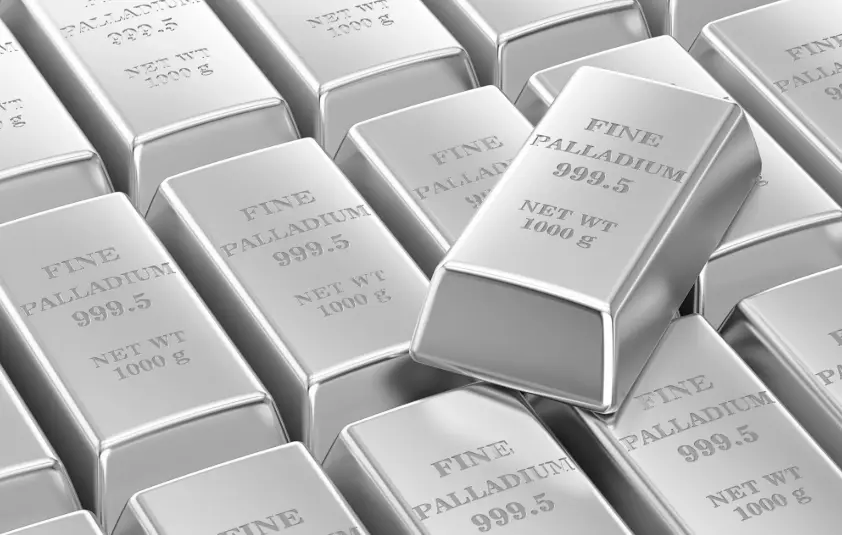
Palladium is a chemical element with the symbol Pd and atomic number 46, classified as a rare and lustrous silvery-white metal in the platinum group of the periodic table. Discovered in 1803 by William Hyde Wollaston, it is named after the asteroid Pallas and is known for its high corrosion resistance, low electrical conductivity, and ability to absorb hydrogen gas up to 900 times its own volume.
Physically, palladium has a melting point of 1,554°C (2,849°F) and is denser than platinum, making it valuable in high-temperature applications. Chemically, it is relatively inert but forms compounds with halogens, oxygen, and other elements, often exhibiting catalytic properties due to its ability to facilitate reactions without being consumed.
Palladium’s primary uses include catalytic converters in automobiles, where it helps reduce harmful emissions by converting pollutants like carbon monoxide and hydrocarbons into less harmful substances. It is also essential in electronics for components like multilayer ceramic capacitors, in jewelry as a white metal alternative to platinum, and in medicine for dental alloys and certain cancer treatments. Additionally, it plays a role in hydrogen purification and fuel cell technology, contributing to advancements in clean energy.
Globally, palladium is mined primarily in Russia, South Africa, and Canada, with supplies often influenced by geopolitical factors. Its price volatility is tied to industrial demand, particularly in the automotive sector, and it is traded as a commodity on exchanges like the New York Mercantile Exchange. As a precious metal, palladium’s scarcity and versatility underscore its importance in modern technology and environmental efforts.
Table of Contents
- Part 1: Create A Palladium Quiz in Minutes Using AI with OnlineExamMaker
- Part 2: 20 Palladium Quiz Questions & Answers
- Part 3: Automatically Generate Quiz Questions Using AI Question Generator
Part 1: Create A Palladium Quiz in Minutes Using AI with OnlineExamMaker
When it comes to ease of creating a Palladium skills assessment, OnlineExamMaker is one of the best AI-powered quiz making software for your institutions or businesses. With its AI Question Generator, just upload a document or input keywords about your assessment topic, you can generate high-quality quiz questions on any topic, difficulty level, and format.
Overview of its key assessment-related features:
● AI Question Generator to help you save time in creating quiz questions automatically.
● Share your online exam with audiences on social platforms like Facebook, Twitter, Reddit and more.
● Instantly scores objective questions and subjective answers use rubric-based scoring for consistency.
● Simply copy and insert a few lines of embed codes to display your online exams on your website or WordPress blog.
Automatically generate questions using AI
Part 2: 20 Palladium Quiz Questions & Answers
or
1. What is the atomic number of Palladium?
A. 44
B. 46
C. 48
D. 50
Answer: B
Explanation: Palladium has an atomic number of 46, which means it has 46 protons in its nucleus.
2. Which group in the periodic table does Palladium belong to?
A. Group 8
B. Group 9
C. Group 10
D. Group 11
Answer: C
Explanation: Palladium is in Group 10 of the periodic table, along with other transition metals like nickel and platinum.
3. What is the electron configuration of Palladium?
A. [Kr] 4d8 5s2
B. [Kr] 4d10
C. [Kr] 4d6 5s2
D. [Kr] 4d7 5s1
Answer: B
Explanation: The electron configuration of Palladium is [Kr] 4d10, which is an exception due to the stability of a fully filled d-subshell.
4. Palladium is primarily used in which of the following applications?
A. As a building material
B. In catalytic converters for automobiles
C. In food packaging
D. As a fertilizer
Answer: B
Explanation: Palladium is widely used in catalytic converters to reduce harmful emissions from vehicles by converting pollutants into less harmful gases.
5. What is the melting point of Palladium?
A. 1,554°C
B. 1,418°C
C. 1,768°C
D. 1,064°C
Answer: A
Explanation: Palladium has a melting point of approximately 1,554°C, making it suitable for high-temperature applications.
6. Which scientist is credited with the discovery of Palladium?
A. Marie Curie
B. William Hyde Wollaston
C. Dmitri Mendeleev
D. Antoine Lavoisier
Answer: B
Explanation: William Hyde Wollaston discovered Palladium in 1803 while analyzing platinum ore from South America.
7. Palladium can absorb how many times its own volume of hydrogen gas?
A. Up to 100 times
B. Up to 900 times
C. Up to 500 times
D. Up to 200 times
Answer: B
Explanation: Palladium can absorb up to 900 times its own volume of hydrogen gas, which is a key property used in hydrogen purification and storage.
8. What is the primary ore from which Palladium is extracted?
A. Hematite
B. Bauxite
C. Sperrylite
D. Galena
Answer: C
Explanation: Palladium is often extracted from sperrylite, a mineral that contains palladium along with other platinum group metals.
9. Which of the following is a common alloy of Palladium?
A. Brass
B. Steel
C. White gold
D. Bronze
Answer: C
Explanation: Palladium is used in white gold alloys to provide a white color and enhance durability in jewelry.
10. What is the density of Palladium at room temperature?
A. 12.02 g/cm³
B. 8.96 g/cm³
C. 21.45 g/cm³
D. 10.49 g/cm³
Answer: A
Explanation: Palladium has a density of approximately 12.02 g/cm³, which is higher than most common metals.
11. Palladium is resistant to corrosion due to the formation of what?
A. An oxide layer
B. A nitride layer
C. A passive oxide film
D. A sulfide layer
Answer: C
Explanation: Palladium forms a passive oxide film that protects it from corrosion, similar to other noble metals.
12. In which year was Palladium first isolated?
A. 1789
B. 1803
C. 1817
D. 1869
Answer: B
Explanation: Palladium was first isolated by William Hyde Wollaston in 1803 from crude platinum.
13. What is the primary reason Palladium is used in electronics?
A. Its low conductivity
B. Its high melting point
C. Its excellent electrical conductivity and resistance to tarnish
D. Its magnetic properties
Answer: C
Explanation: Palladium’s excellent electrical conductivity and resistance to tarnish make it ideal for use in connectors and circuit components.
14. Which isotope of Palladium is the most abundant?
A. Palladium-102
B. Palladium-104
C. Palladium-106
D. Palladium-108
Answer: C
Explanation: Palladium-106 is the most abundant stable isotope, making up about 27.33% of natural Palladium.
15. Palladium catalysts are used in which organic reaction?
A. Combustion
B. Hydrogenation
C. Oxidation
D. Both B and C
Answer: D
Explanation: Palladium catalysts are used in both hydrogenation and oxidation reactions, such as in the production of pharmaceuticals and fine chemicals.
16. What color is pure Palladium metal?
A. Yellow
B. Silver-white
C. Red
D. Green
Answer: B
Explanation: Pure Palladium is a silver-white metal, though it can appear slightly grayish in some forms.
17. How does Palladium compare to Platinum in terms of cost?
A. Always more expensive
B. Generally less expensive
C. Identical in price
D. Depends on market conditions
Answer: D
Explanation: The cost of Palladium compared to Platinum varies based on market conditions, supply, and demand, but Palladium has often been more expensive recently.
18. Palladium is part of which group of elements?
A. Alkali metals
B. Halogens
C. Platinum group metals
D. Rare earth metals
Answer: C
Explanation: Palladium belongs to the platinum group metals, which are known for their catalytic properties and resistance to corrosion.
19. What is the boiling point of Palladium?
A. 2,963°C
B. 3,827°C
C. 4,000°C
D. 2,500°C
Answer: A
Explanation: The boiling point of Palladium is approximately 2,963°C, which is one of the highest among metals.
20. Which property makes Palladium suitable for use in hydrogen fuel cells?
A. Its ability to conduct heat
B. Its catalytic activity for hydrogen reactions
C. Its low density
D. Its color
Answer: B
Explanation: Palladium’s catalytic activity allows it to facilitate hydrogen dissociation and recombination, making it useful in fuel cells.
or
Part 3: Automatically generate quiz questions using OnlineExamMaker AI Question Generator
Automatically generate questions using AI