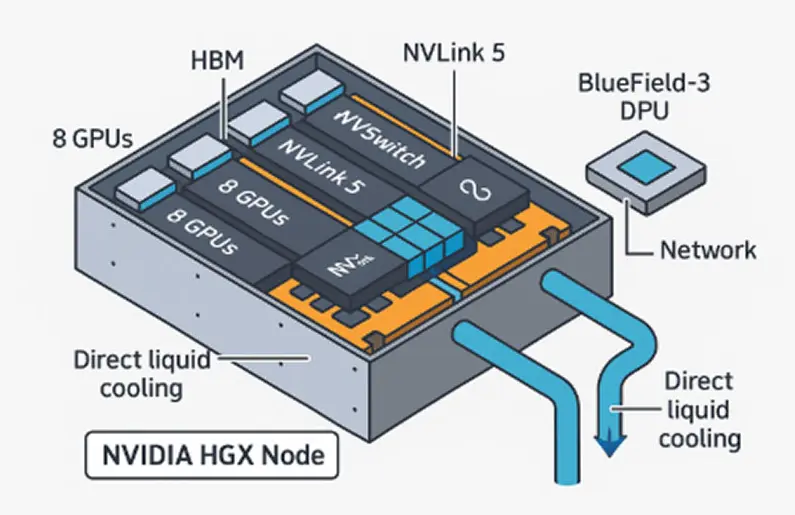
Nvidia HGX Systems are advanced, GPU-accelerated computing platforms designed for AI, machine learning, data analytics, and high-performance computing in data centers. At their core, HGX systems integrate multiple Nvidia GPUs, such as the A100 or H100, with high-speed interconnects like NVLink, powerful CPUs, and optimized networking to deliver exceptional performance for complex workloads.
Key features include:
– Scalable Architecture: Allows seamless expansion by adding GPUs, supporting configurations from 4 to 8 or more per system, making it adaptable for various enterprise needs.
– High Bandwidth and Low Latency: NVLink and NVSwitch enable fast data transfer between GPUs, accelerating tasks like deep learning training and inference.
– Energy Efficiency: Built with power-optimized components to reduce operational costs while maintaining high throughput.
– Integrated Software Ecosystem: Fully compatible with Nvidia’s tools, including CUDA, TensorRT, and AI frameworks like TensorFlow and PyTorch, streamlining development and deployment.
Benefits of HGX Systems:
– Accelerated Processing: Speeds up AI model training by up to 10x compared to traditional servers, enabling faster innovation in fields like healthcare, finance, and autonomous driving.
– Reliability and Management: Features built-in redundancy, remote management capabilities, and support for containerization, ensuring uptime and ease of use in large-scale environments.
– Versatility: Supports a wide range of applications, from scientific simulations and video rendering to real-time analytics and edge computing.
Overall, HGX Systems empower organizations to handle massive datasets and compute-intensive tasks with unprecedented efficiency, driving advancements in AI and beyond.
Table of Contents
- Part 1: OnlineExamMaker AI Quiz Generator – The Easiest Way to Make Quizzes Online
- Part 2: 20 Nvidia HGX Systems Quiz Questions & Answers
- Part 3: OnlineExamMaker AI Question Generator: Generate Questions for Any Topic
Part 1: OnlineExamMaker AI Quiz Generator – The Easiest Way to Make Quizzes Online
Are you looking for an online assessment to test the Nvidia HGX Systems skills of your learners? OnlineExamMaker uses artificial intelligence to help quiz organizers to create, manage, and analyze exams or tests automatically. Apart from AI features, OnlineExamMaker advanced security features such as full-screen lockdown browser, online webcam proctoring, and face ID recognition.
Take a product tour of OnlineExamMaker:
● Includes a safe exam browser (lockdown mode), webcam and screen recording, live monitoring, and chat oversight to prevent cheating.
● AI Exam Grader for efficiently grading quizzes and assignments, offering inline comments, automatic scoring, and “fudge points” for manual adjustments.
● Embed quizzes on websites, blogs, or share via email, social media (Facebook, Twitter), or direct links.
● Handles large-scale testing (thousands of exams/semester) without internet dependency, backed by cloud infrastructure.
Automatically generate questions using AI
Part 2: 20 Nvidia HGX Systems Quiz Questions & Answers
or
Question 1: What does HGX stand for in the context of Nvidia’s technology?
A) High Graphics eXecution
B) Heterogeneous GPU eXecution
C) High-Performance GPU eXchange
D) Hyperconverged GPU eXtension
Answer: B) Heterogeneous GPU eXecution
Explanation: HGX refers to Nvidia’s Heterogeneous GPU eXecution platform, designed for integrating multiple GPUs in a unified system for AI and high-performance computing tasks.
Question 2: Which Nvidia GPU series is commonly associated with HGX systems?
A) GeForce RTX
B) Quadro
C) A100 or H100
D) Tesla K80
Answer: C) A100 or H100
Explanation: HGX systems typically utilize Nvidia’s A100 or H100 GPUs, which are optimized for data center-scale AI workloads and provide high bandwidth and performance.
Question 3: What is the primary interconnect technology used in Nvidia HGX for GPU communication?
A) PCIe
B) NVLink
C) Ethernet
D) InfiniBand
Answer: B) NVLink
Explanation: NVLink enables direct, high-speed communication between GPUs in HGX systems, reducing latency and improving efficiency for parallel computing tasks.
Question 4: How many GPUs can a standard Nvidia HGX H100 system support?
A) 4
B) 8
C) 16
D) 32
Answer: B) 8
Explanation: The Nvidia HGX H100 configuration typically supports up to 8 GPUs, allowing for scalable AI training and inference in enterprise environments.
Question 5: What is a key benefit of using Nvidia HGX in data centers?
A) Improved gaming performance
B) Enhanced video editing capabilities
C) Accelerated AI and machine learning workloads
D) Better web browsing speed
Answer: C) Accelerated AI and machine learning workloads
Explanation: HGX is designed to handle large-scale AI computations efficiently, providing the infrastructure needed for training complex models quickly.
Question 6: Which component is NOT typically part of an Nvidia HGX system?
A) CPUs
B) GPUs
C) NVSwitch
D) Hard disk drives for consumer storage
Answer: D) Hard disk drives for consumer storage
Explanation: HGX focuses on compute resources like CPUs, GPUs, and NVSwitch for high-performance tasks, not general consumer storage solutions.
Question 7: In Nvidia HGX, what role does NVSwitch play?
A) It manages power supply
B) It connects GPUs for multi-GPU scaling
C) It handles external network connections
D) It processes CPU tasks
Answer: B) It connects GPUs for multi-GPU scaling
Explanation: NVSwitch facilitates high-bandwidth connections between GPUs in HGX systems, enabling seamless data sharing for distributed computing.
Question 8: What type of memory technology is optimized in Nvidia HGX for AI applications?
A) DDR4 RAM
B) HBM (High Bandwidth Memory)
C) Standard SSD storage
D) USB flash drives
Answer: B) HBM (High Bandwidth Memory)
Explanation: HGX systems use HBM to provide the high memory bandwidth required for demanding AI workloads, improving overall system performance.
Question 9: Which Nvidia software is often used alongside HGX for managing GPU resources?
A) CUDA
B) GeForce Experience
C) Nvidia AI Enterprise
D) Windows Media Player
Answer: C) Nvidia AI Enterprise
Explanation: Nvidia AI Enterprise integrates with HGX to manage and optimize GPU resources for enterprise-level AI deployments.
Question 10: What is the maximum theoretical bandwidth of NVLink in an HGX system?
A) 100 GB/s
B) 300 GB/s per link
C) 600 GB/s
D) 1 TB/s
Answer: C) 600 GB/s
Explanation: NVLink in HGX systems can achieve up to 600 GB/s of bidirectional bandwidth, supporting fast data transfer between connected GPUs.
Question 11: How does Nvidia HGX support scalability for larger deployments?
A) By adding more monitors
B) Through rack-scale designs and clustering
C) Via consumer-grade upgrades
D) By increasing CPU clock speeds
Answer: B) Through rack-scale designs and clustering
Explanation: HGX allows for easy scaling by supporting rack-level configurations and GPU clustering, making it suitable for expanding data center operations.
Question 12: Which industry is NOT a primary use case for Nvidia HGX?
A) Healthcare for medical imaging
B) Finance for algorithmic trading
C) Automotive for self-driving cars
D) Personal gaming consoles
Answer: D) Personal gaming consoles
Explanation: HGX is targeted at enterprise and scientific applications like healthcare, finance, and automotive, not consumer gaming hardware.
Question 13: What is the power efficiency advantage of HGX compared to traditional servers?
A) Lower TDP per core
B) Higher energy consumption for better performance
C) Optimized for AI with reduced waste heat
D) No power management features
Answer: C) Optimized for AI with reduced waste heat
Explanation: HGX systems are designed for energy-efficient AI processing, minimizing waste heat and improving overall power usage effectiveness.
Question 14: In an HGX setup, how are GPUs typically cooled?
A) Passive air cooling
B) Liquid cooling
C) Fan-based desktop cooling
D) No cooling required
Answer: B) Liquid cooling
Explanation: HGX systems often use liquid cooling to handle the high thermal output from multiple GPUs, ensuring reliable performance in data centers.
Question 15: What certification might an HGX system achieve for data center use?
A) Dolby Vision
B) ENERGY STAR
C) Nvidia DGX Ready
D) Bluetooth compatibility
Answer: C) Nvidia DGX Ready
Explanation: HGX systems can be certified as DGX Ready, indicating they meet Nvidia’s standards for running DGX software and AI frameworks.
Question 16: Which feature of HGX enhances multi-tenant environments in cloud computing?
A) Shared GPU partitioning
B) Single-user access only
C) Limited remote access
D) Basic web hosting
Answer: A) Shared GPU partitioning
Explanation: HGX supports GPU partitioning, allowing multiple users or workloads to share resources efficiently in multi-tenant cloud setups.
Question 17: How does HGX integrate with Nvidia’s CUDA ecosystem?
A) It doesn’t support CUDA
B) Through optimized libraries for parallel computing
C) Only for graphics rendering
D) Via external plugins
Answer: B) Through optimized libraries for parallel computing
Explanation: HGX is built to leverage CUDA cores and libraries, enabling accelerated parallel processing for AI and scientific simulations.
Question 18: What is the typical form factor of an Nvidia HGX system?
A) Desktop tower
B) Rack-mounted server
C) Laptop chassis
D) Smartphone module
Answer: B) Rack-mounted server
Explanation: HGX is designed as a rack-mounted solution for data centers, facilitating easy integration into server environments.
Question 19: Which protocol does HGX use for high-speed data transfer between nodes?
A) HTTP
B) RDMA over fabrics like InfiniBand
C) FTP
D) Bluetooth
Answer: B) RDMA over fabrics like InfiniBand
Explanation: HGX employs RDMA protocols over high-speed fabrics like InfiniBand to enable low-latency, high-throughput data transfers in clustered setups.
Question 20: Why is HGX preferred for deep learning training over standard GPU setups?
A) Lower cost
B) Integrated hardware and software for distributed training
C) Simpler user interface
D) Compatibility with mobile apps
Answer: B) Integrated hardware and software for distributed training
Explanation: HGX provides a complete ecosystem with hardware like NVLink and software tools that optimize distributed deep learning, outperforming standard GPU setups.
or
Part 3: OnlineExamMaker AI Question Generator: Generate Questions for Any Topic
Automatically generate questions using AI