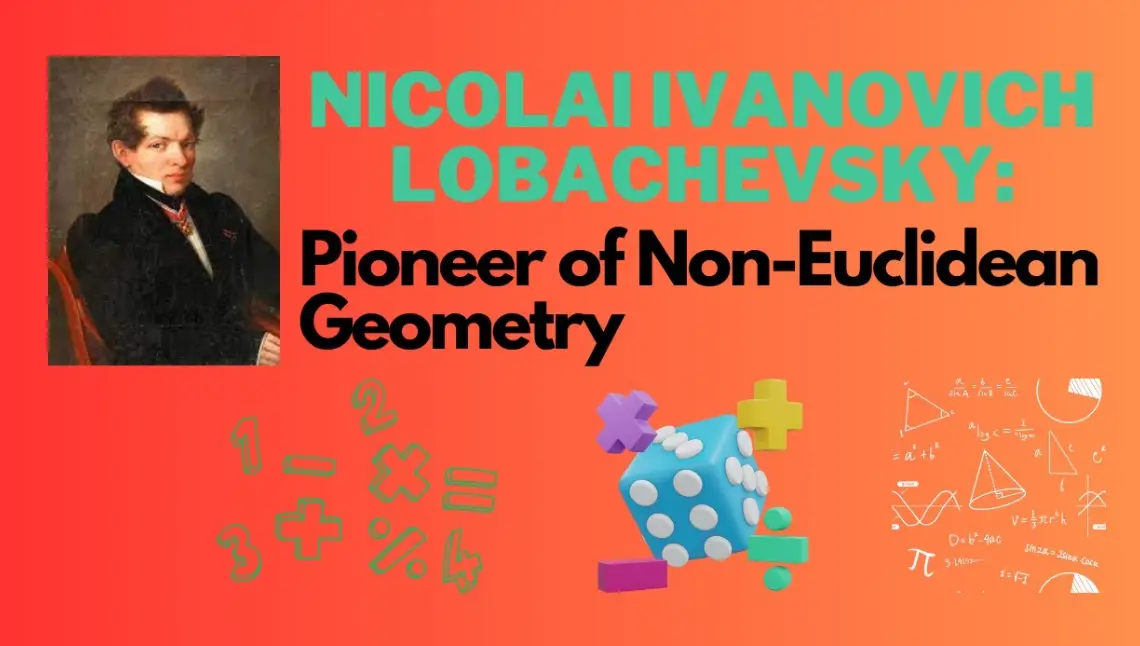
Nikolai Lobachevsky (1792–1856) was a pioneering Russian mathematician best known for developing non-Euclidean geometry. Born in Nizhny Novgorod, he studied at Kazan University, where he later served as professor and rector. In the 1820s and 1830s, Lobachevsky challenged Euclid’s parallel postulate by proposing a system where, through a curved space, lines could diverge, forming what is now called hyperbolic geometry. His work, published in papers like “On the Principles of Geometry” (1829–1830), faced initial resistance but revolutionized mathematics, influencing relativity theory and modern physics. Lobachevsky’s contributions extended to education, as he advocated for scientific advancement in Russia.
Table of Contents
- Part 1: OnlineExamMaker – Generate and Share Nikolai Lobachevsky Quiz with AI Automatically
- Part 2: 20 Nikolai Lobachevsky Quiz Questions & Answers
- Part 3: Save Time and Energy: Generate Quiz Questions with AI Technology
Part 1: OnlineExamMaker – Generate and Share Nikolai Lobachevsky Quiz with AI Automatically
OnlineExamMaker is a powerful AI-powered assessment platform to create auto-grading Nikolai Lobachevsky skills assessments. It’s designed for educators, trainers, businesses, and anyone looking to generate engaging quizzes without spending hours crafting questions manually. The AI Question Generator feature allows you to input a topic or specific details, and it generates a variety of question types automatically.
Top features for assessment organizers:
● Prevent cheating by randomizing questions or changing the order of questions, so learners don’t get the same set of questions each time.
● AI Exam Grader for efficiently grading quizzes and assignments, offering inline comments, automatic scoring, and “fudge points” for manual adjustments.
● Embed quizzes on websites, blogs, or share via email, social media (Facebook, Twitter), or direct links.
● Handles large-scale testing (thousands of exams/semester) without internet dependency, backed by cloud infrastructure.
Automatically generate questions using AI
Part 2: 20 Nikolai Lobachevsky Quiz Questions & Answers
or
1. Question: What was Nikolai Lobachevsky’s nationality?
A) French
B) Russian
C) German
D) Italian
Answer: B
Explanation: Lobachevsky was a Russian mathematician, born in Nizhny Novgorod, Russia.
2. Question: In which year was Nikolai Lobachevsky born?
A) 1792
B) 1800
C) 1812
D) 1820
Answer: A
Explanation: Lobachevsky was born on December 1, 1792, in Nizhny Novgorod, Russia.
3. Question: What is Lobachevsky best known for in mathematics?
A) Euclidean geometry
B) Non-Euclidean geometry
C) Algebra
D) Calculus
Answer: B
Explanation: Lobachevsky developed non-Euclidean geometry, challenging Euclid’s parallel postulate.
4. Question: Which postulate did Lobachevsky primarily challenge in his work?
A) The angle sum postulate
B) The parallel postulate
C) The congruence postulate
D) The similarity postulate
Answer: B
Explanation: Lobachevsky’s geometry rejected Euclid’s fifth postulate, allowing for multiple parallel lines through a point.
5. Question: What type of non-Euclidean geometry is associated with Lobachevsky?
A) Elliptic geometry
B) Hyperbolic geometry
C) Spherical geometry
D) Projective geometry
Answer: B
Explanation: Lobachevsky’s work led to the development of hyperbolic geometry, where the parallel postulate does not hold.
6. Question: In what year did Lobachevsky publish his major work on geometry?
A) 1829
B) 1830
C) 1840
D) 1850
Answer: A
Explanation: Lobachevsky presented his ideas in a paper titled “On the Principles of Geometry” in 1829.
7. Question: Which university did Lobachevsky serve as rector?
A) University of Moscow
B) Kazan Imperial University
C) University of St. Petersburg
D) University of Berlin
Answer: B
Explanation: Lobachevsky was the rector of Kazan Imperial University from 1827 to 1846.
8. Question: How did Lobachevsky’s geometry differ from Euclid’s in terms of parallel lines?
A) Only one parallel line exists
B) Multiple parallel lines can exist
C) No parallel lines exist
D) All lines are parallel
Answer: B
Explanation: In Lobachevsky’s hyperbolic geometry, through a point not on a line, more than one line can be drawn parallel to the given line.
9. Question: Who were Lobachevsky’s contemporaries in developing non-Euclidean geometry?
A) Isaac Newton and Galileo
B) János Bolyai and Carl Friedrich Gauss
C) Albert Einstein and Niels Bohr
D) René Descartes and Blaise Pascal
Answer: B
Explanation: Lobachevsky’s work was independent but parallel to that of János Bolyai and Carl Friedrich Gauss.
10. Question: What was the title of Lobachevsky’s 1829 paper?
A) “Elements of Geometry”
B) “On the Principles of Geometry”
C) “New Foundations of Geometry”
D) “Hyperbolic Spaces”
Answer: B
Explanation: The paper “On the Principles of Geometry” outlined his non-Euclidean ideas.
11. Question: In Lobachevsky’s geometry, what happens to the sum of angles in a triangle?
A) It equals 180 degrees
B) It is always greater than 180 degrees
C) It is always less than 180 degrees
D) It varies based on the triangle’s size
Answer: C
Explanation: In hyperbolic geometry, the sum of the angles in a triangle is less than 180 degrees.
12. Question: When did Lobachevsky die?
A) 1856
B) 1860
C) 1870
D) 1880
Answer: A
Explanation: Lobachevsky died on February 24, 1856, in Kazan, Russia.
13. Question: What field of mathematics did Lobachevsky contribute to beyond geometry?
A) Probability theory
B) Number theory
C) Astronomy and physics applications
D) Logic and set theory
Answer: C
Explanation: Lobachevsky applied his geometric ideas to astronomy and physics, influencing later developments.
14. Question: Which of the following is a key feature of Lobachevsky’s space?
A) Positive curvature
B) Zero curvature
C) Negative curvature
D) Infinite curvature
Answer: C
Explanation: Hyperbolic geometry, as developed by Lobachevsky, features spaces of negative curvature.
15. Question: How did the mathematical community initially react to Lobachevsky’s ideas?
A) Immediate acceptance
B) Widespread controversy and skepticism
C) Indifference
D) Quick integration into textbooks
Answer: B
Explanation: Lobachevsky’s ideas were met with skepticism and controversy during his lifetime but were later validated.
16. Question: What was Lobachevsky’s role at Kazan University besides rector?
A) Librarian
B) Professor of mathematics
C) Dean of sciences
D) All of the above
Answer: D
Explanation: Lobachevsky served as professor, rector, and librarian at Kazan University.
17. Question: In what language did Lobachevsky primarily write his works?
A) English
B) French
C) Russian
D) Latin
Answer: C
Explanation: Lobachevsky wrote most of his works in Russian, though some were translated.
18. Question: Which modern application is linked to Lobachevsky’s geometry?
A) Computer graphics
B) General relativity in physics
C) Basic arithmetic
D) Cartography
Answer: B
Explanation: Lobachevsky’s hyperbolic geometry influenced Einstein’s theory of general relativity.
19. Question: What award or recognition did Lobachevsky receive for his work?
A) Nobel Prize
B) Demidov Prize
C) Fields Medal
D) Copley Medal
Answer: B
Explanation: Lobachevsky was awarded the Demidov Prize in 1866 for his contributions to science.
20. Question: How did Lobachevsky’s work impact the foundations of mathematics?
A) It reinforced Euclidean dominance
B) It expanded the understanding of axioms and geometry
C) It led to the abandonment of geometry
D) It had no significant impact
Answer: B
Explanation: Lobachevsky’s ideas broadened the foundations of mathematics by showing that alternative geometries are possible.
or
Part 3: Save Time and Energy: Generate Quiz Questions with AI Technology
Automatically generate questions using AI