Microscopes are essential optical instruments designed to magnify small objects or structures that are invisible to the naked eye, allowing detailed observation at the microscopic level. They have revolutionized fields like biology, medicine, and materials science by enabling the study of cells, microorganisms, and intricate materials.
History and Evolution
The invention of the microscope dates back to the late 16th century, with early models credited to Dutch spectacle makers Zacharias Janssen and his father Hans in the 1590s. These simple compound microscopes used lenses to magnify images. By the 17th century, scientists like Antonie van Leeuwenhoek advanced the technology with his single-lens microscopes, discovering bacteria and protists. The 20th century brought electron microscopes, which use beams of electrons for much higher magnification, transforming scientific research.
Types of Microscopes
Microscopes vary based on their design and application:
– Optical Microscopes: The most common type, using visible light and lenses to magnify specimens. Subtypes include compound microscopes (for slides) and stereo microscopes (for three-dimensional views).
– Electron Microscopes: These provide extremely high resolution by using electron beams instead of light. Transmission electron microscopes (TEM) view internal structures, while scanning electron microscopes (SEM) produce detailed surface images.
– Fluorescence Microscopes: Employ fluorescent dyes to highlight specific parts of a specimen, useful in cell biology.
– Digital Microscopes: Integrate cameras and software for digital imaging, often used in education and industry for easy sharing and analysis.
– Confocal Microscopes: Use lasers to produce sharp images of thick specimens by scanning layer by layer.
Key Components and Functionality
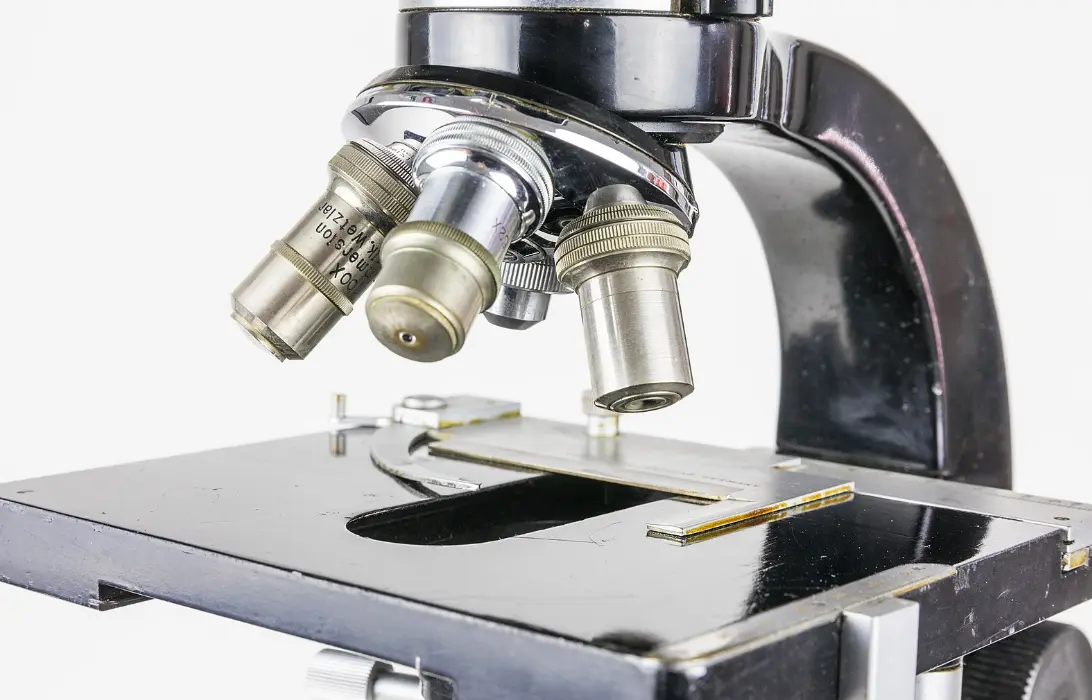
A basic microscope consists of an eyepiece, objective lenses, a stage for holding samples, and a light source. Magnification is achieved through the objective lens (which gathers light) and the eyepiece (which further enlarges the image). Resolution, or the ability to distinguish fine details, depends on the wavelength of light used and the quality of lenses.
Applications and Importance
Microscopes are indispensable in various fields:
– In biology and medicine, they aid in examining tissues, diagnosing diseases, and studying cellular processes.
– In materials science, they analyze the microstructure of metals, polymers, and semiconductors.
– Forensic science uses them for evidence analysis, such as fibers or fingerprints.
– Education relies on microscopes to teach concepts in science curricula.
Advancements in microscopy continue to drive innovation, with modern tools like atomic force microscopes enabling nanoscale imaging. Overall, microscopes have expanded human understanding of the microscopic world, leading to breakthroughs in science and technology.
Table of Contents
- Part 1: Best AI Quiz Making Software for Creating A Microscopes Quiz
- Part 2: 20 Microscopes Quiz Questions & Answers
- Part 3: OnlineExamMaker AI Question Generator: Generate Questions for Any Topic
Part 1: Best AI Quiz Making Software for Creating A Microscopes Quiz
OnlineExamMaker is a powerful AI-powered assessment platform to create auto-grading Microscopes skills assessments. It’s designed for educators, trainers, businesses, and anyone looking to generate engaging quizzes without spending hours crafting questions manually. The AI Question Generator feature allows you to input a topic or specific details, and it generates a variety of question types automatically.
Top features for assessment organizers:
● Combines AI webcam monitoring to capture cheating activities during online exam.
● Enhances assessments with interactive experience by embedding video, audio, image into quizzes and multimedia feedback.
● Once the exam ends, the exam scores, question reports, ranking and other analytics data can be exported to your device in Excel file format.
● API and SSO help trainers integrate OnlineExamMaker with Google Classroom, Microsoft Teams, CRM and more.
Automatically generate questions using AI
Part 2: 20 Microscopes Quiz Questions & Answers
or
1. What is the primary function of the objective lens in a compound microscope?
A. To magnify the image further
B. To focus light on the specimen
C. To gather and magnify light from the specimen
D. To hold the slide in place
Answer: C
Explanation: The objective lens is closest to the specimen and collects light to form a magnified real image.
2. Which type of microscope uses a beam of electrons to view specimens?
A. Light microscope
B. Stereo microscope
C. Electron microscope
D. Compound microscope
Answer: C
Explanation: Electron microscopes use electron beams instead of light, allowing for much higher magnification and resolution.
3. What is the typical magnification range of a standard light microscope?
A. 10x to 100x
B. 100x to 1,000x
C. 1,000x to 10,000x
D. 10,000x to 100,000x
Answer: B
Explanation: Light microscopes generally achieve magnifications from 100x to 1,000x, depending on the lenses used.
4. Who is credited with inventing the first practical microscope?
A. Robert Hooke
B. Antonie van Leeuwenhoek
C. Louis Pasteur
D. Galileo Galilei
Answer: B
Explanation: Antonie van Leeuwenhoek improved microscope design in the 17th century, allowing for detailed observations of microorganisms.
5. In a microscope, what does the term “resolution” refer to?
A. The ability to enlarge an image
B. The clarity and detail of the image
C. The color of the specimen
D. The speed of focusing
Answer: B
Explanation: Resolution is the ability of a microscope to distinguish between two closely spaced objects as separate.
6. Which part of the microscope adjusts the amount of light reaching the specimen?
A. Eyepiece
B. Stage
C. Diaphragm
D. Objective lens
Answer: C
Explanation: The diaphragm controls the aperture size, regulating the light intensity for optimal viewing.
7. What is the main advantage of a scanning electron microscope (SEM) over a transmission electron microscope (TEM)?
A. Higher magnification
B. Ability to view three-dimensional surfaces
C. Simpler operation
D. Lower cost
Answer: B
Explanation: SEM provides detailed images of the surface topography of specimens, while TEM focuses on internal structures.
8. How does oil immersion improve microscope performance?
A. By increasing the working distance
B. By reducing light refraction between the lens and specimen
C. By adding color to the image
D. By enlarging the stage
Answer: B
Explanation: Oil immersion minimizes light loss due to refraction, enhancing resolution in high-magnification objectives.
9. What type of microscope is commonly used for dissecting small organisms?
A. Compound microscope
B. Electron microscope
C. Stereo microscope
D. Phase-contrast microscope
Answer: C
Explanation: Stereo microscopes provide a three-dimensional view at low magnification, ideal for dissection and observation of larger specimens.
10. Which lens in a compound microscope is responsible for the final magnification?
A. Objective lens
B. Condenser lens
C. Eyepiece lens
D. Iris diaphragm
Answer: C
Explanation: The eyepiece lens magnifies the image produced by the objective lens, contributing to the total magnification.
11. What is the purpose of the condenser in a microscope?
A. To hold the specimen
B. To focus light onto the specimen
C. To adjust the magnification
D. To protect the lenses
Answer: B
Explanation: The condenser concentrates and directs light through the specimen for better illumination and contrast.
12. Which microscope technique uses differences in refractive index to enhance contrast in transparent specimens?
A. Brightfield microscopy
B. Phase-contrast microscopy
C. Darkfield microscopy
D. Fluorescence microscopy
Answer: B
Explanation: Phase-contrast microscopy converts phase shifts in light into brightness changes, making unstained specimens visible.
13. What is the numerical aperture (NA) of a lens an indicator of?
A. The lens’s color
B. The lens’s ability to gather light and resolve detail
C. The lens’s weight
D. The lens’s age
Answer: B
Explanation: Numerical aperture measures the light-gathering capability of a lens, directly affecting resolution and brightness.
14. In fluorescence microscopy, what excites the fluorescent dyes in the specimen?
A. Visible light
B. Ultraviolet light
C. Infrared light
D. X-rays
Answer: B
Explanation: Ultraviolet light is used to excite fluorophores, causing them to emit visible light and highlight specific structures.
15. Why must specimens be thinly sliced for viewing under a light microscope?
A. To increase magnification
B. To allow light to pass through
C. To make the specimen heavier
D. To add color
Answer: B
Explanation: Thin sections ensure that light can penetrate the specimen, providing a clear image without distortion.
16. What is the difference between total magnification and actual magnification in microscopy?
A. Total magnification is the product of eyepiece and objective magnifications
B. Actual magnification accounts for distortions
C. There is no difference
D. Total magnification is always lower
Answer: A
Explanation: Total magnification is calculated by multiplying the powers of the objective and eyepiece lenses.
17. Which microscope is best for viewing live, unstained cells?
A. Electron microscope
B. Phase-contrast microscope
C. Confocal microscope
D. Both B and C
Answer: D
Explanation: Phase-contrast and confocal microscopes allow for observation of live cells without staining, with confocal providing optical sectioning.
18. What role does the stage clip play in a microscope?
A. It holds the slide in place
B. It magnifies the image
C. It adjusts the light
D. It focuses the lens
Answer: A
Explanation: Stage clips secure the specimen slide on the stage, preventing movement during observation.
19. How does a compound microscope differ from a simple microscope?
A. A compound microscope has one lens
B. A simple microscope has multiple lenses
C. A compound microscope uses two or more lenses for greater magnification
D. They are the same
Answer: C
Explanation: A compound microscope combines an objective lens and an eyepiece for higher magnification, unlike a simple microscope with a single lens.
20. What is the main limitation of light microscopes compared to electron microscopes?
A. Lower resolution
B. Higher cost
C. Inability to view live specimens
D. Requirement for staining
Answer: A
Explanation: Light microscopes are limited by the wavelength of light, resulting in lower resolution than electron microscopes, which use electrons.
or
Part 3: OnlineExamMaker AI Question Generator: Generate Questions for Any Topic
Automatically generate questions using AI