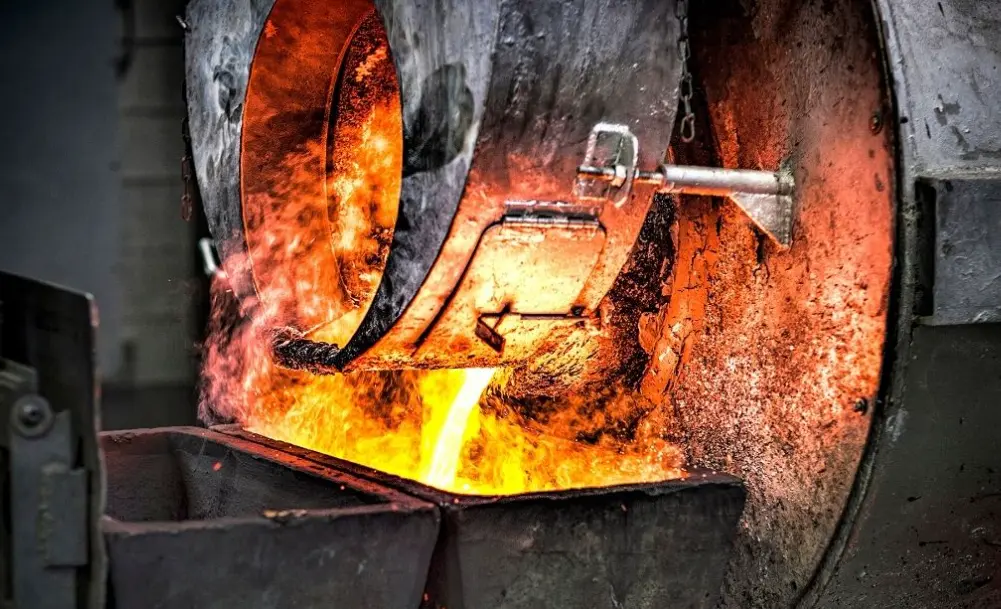
Metal refining is a critical process in metallurgy that transforms raw ores or impure metals into high-purity materials essential for various industries. It involves removing impurities such as slag, oxides, and other contaminants through techniques like smelting, where heat is applied to melt and separate the metal from its ore; electrolysis, which uses electric currents to deposit pure metal from a solution; and refining methods like distillation or zone refining for precision.
For example, in copper refining, blister copper is processed in an electrolytic cell to achieve 99.9% purity, eliminating sulfur and other elements. This not only enhances the metal’s strength and conductivity but also ensures it meets stringent standards for applications in electronics, construction, and manufacturing. By controlling temperature, chemical reactions, and energy inputs, metal refining minimizes waste and maximizes resource efficiency, making it a cornerstone of modern industrial production.
Table of Contents
- Part 1: OnlineExamMaker – Generate and Share Metal Refining Quiz with AI Automatically
- Part 2: 20 Metal Refining Quiz Questions & Answers
- Part 3: Try OnlineExamMaker AI Question Generator to Create Quiz Questions
Part 1: OnlineExamMaker – Generate and Share Metal Refining Quiz with AI Automatically
The quickest way to assess the Metal Refining knowledge of candidates is using an AI assessment platform like OnlineExamMaker. With OnlineExamMaker AI Question Generator, you are able to input content—like text, documents, or topics—and then automatically generate questions in various formats (multiple-choice, true/false, short answer). Its AI Exam Grader can automatically grade the exam and generate insightful reports after your candidate submit the assessment.
What you will like:
● Create a question pool through the question bank and specify how many questions you want to be randomly selected among these questions.
● Allow the quiz taker to answer by uploading video or a Word document, adding an image, and recording an audio file.
● Display the feedback for correct or incorrect answers instantly after a question is answered.
● Create a lead generation form to collect an exam taker’s information, such as email, mobile phone, work title, company profile and so on.
Automatically generate questions using AI
Part 2: 20 Metal Refining Quiz Questions & Answers
or
1. What is the primary purpose of roasting in metal refining?
A. To reduce metal oxides to metals
B. To remove volatile impurities and convert sulfides to oxides
C. To melt the ore directly
D. To alloy different metals
Answer: B
Explanation: Roasting heats sulfide ores in the presence of oxygen, converting them to oxides and removing sulfur as sulfur dioxide gas, which facilitates subsequent reduction processes.
2. Which process is commonly used for refining impure copper?
A. Distillation
B. Electrorefining
C. Froth flotation
D. Smelting
Answer: B
Explanation: Electrorefining uses electrolysis to purify copper by depositing pure copper on the cathode while impurities remain in the electrolyte or as anode sludge.
3. In the Bessemer process, what is the main function of blowing air through molten iron?
A. To cool the iron rapidly
B. To oxidize impurities like carbon and silicon
C. To add alloying elements
D. To increase the iron’s density
Answer: B
Explanation: Blowing air oxidizes impurities such as carbon, silicon, and manganese, converting them to gases or slag, resulting in purer steel.
4. What is the role of flux in smelting?
A. To act as a fuel source
B. To combine with impurities and form slag
C. To reduce the ore directly
D. To increase the melting point of the ore
Answer: B
Explanation: Flux reacts with gangue (impurities) to form a low-melting-point slag that can be easily separated from the molten metal.
5. Which method is primarily used for refining aluminum from bauxite ore?
A. The Mond process
B. The Bayer process followed by electrolysis
C. Zone refining
D. Roasting
Answer: B
Explanation: The Bayer process extracts alumina from bauxite, and then electrolysis in the Hall-Héroult process refines it into pure aluminum by reducing alumina with carbon electrodes.
6. What is hydrometallurgy?
A. Refining metals using high temperatures
B. Extracting metals using aqueous solutions
C. Melting ores in a furnace
D. Distilling volatile metals
Answer: B
Explanation: Hydrometallurgy involves leaching metals from ores using chemical solutions, followed by purification steps like solvent extraction or precipitation.
7. In zone refining, how is the metal purified?
A. By melting the entire sample at once
B. By passing a molten zone through the metal to move impurities
C. By chemical reactions in a solution
D. By electrolysis
Answer: B
Explanation: A narrow molten zone is moved along the metal bar, causing impurities to dissolve in the melt and move to one end, leaving the rest of the metal purer.
8. Which gas is commonly used in the refining of nickel via the Mond process?
A. Carbon monoxide
B. Oxygen
C. Hydrogen
D. Nitrogen
Answer: A
Explanation: Carbon monoxide forms a volatile complex with nickel, allowing it to be separated from impurities and then decomposed to yield pure nickel.
9. What is the main advantage of the electrolytic refining method?
A. It is energy-efficient
B. It produces very high-purity metals
C. It works at low temperatures
D. It requires no chemicals
Answer: B
Explanation: Electrolytic refining achieves high purity by selectively depositing the metal at the cathode while leaving impurities behind, making it ideal for precious metals.
10. Which impurity is typically removed during the puddling process for wrought iron?
A. Carbon
B. Silicon
C. Phosphorus
D. All of the above
Answer: D
Explanation: Puddling oxidizes and removes carbon, silicon, and other impurities from pig iron by stirring in a reverberatory furnace, producing malleable wrought iron.
11. In pyrometallurgy, what is the purpose of a reverberatory furnace?
A. To perform chemical leaching
B. To heat materials indirectly with flames
C. To cool metals rapidly
D. To distill volatile compounds
Answer: B
Explanation: A reverberatory furnace reflects heat from the roof onto the charge, allowing for melting and refining without direct contact between the fuel and the metal.
12. What is the primary ore for extracting titanium, and how is it refined?
A. Hematite, by smelting
B. Ilmenite, by the Kroll process
C. Bauxite, by electrolysis
D. Galena, by roasting
Answer: B
Explanation: Ilmenite is refined via the Kroll process, which involves chlorination to produce titanium tetrachloride, followed by reduction with magnesium to yield pure titanium.
13. Why is the Parkes process used in lead refining?
A. To remove zinc impurities
B. To extract gold and silver from lead
C. To oxidize sulfur
D. To alloy lead with copper
Answer: B
Explanation: The Parkes process adds zinc to molten lead, which forms a zinc alloy with gold and silver, allowing these precious metals to be skimmed off and separated.
14. What is the key reaction in the extraction of iron in a blast furnace?
A. Reduction of iron oxide with carbon monoxide
B. Oxidation of iron with oxygen
C. Electrolysis of iron ore
D. Distillation of iron vapor
Answer: A
Explanation: In a blast furnace, carbon monoxide reduces iron oxide to iron, while coke provides the carbon source and generates the reducing gases.
15. Which factor primarily affects the efficiency of solvent extraction in hydrometallurgy?
A. Temperature of the furnace
B. Selectivity of the solvent for the metal
C. Pressure in the reactor
D. Color of the ore
Answer: B
Explanation: Solvent extraction relies on the solvent’s ability to selectively bind and extract the desired metal ions from the aqueous solution, improving separation efficiency.
16. In the refining of gold, what is the purpose of the cyanide process?
A. To melt gold directly
B. To leach gold from ore using sodium cyanide
C. To remove silver impurities
D. To alloy gold with copper
Answer: B
Explanation: The cyanide process dissolves gold from its ore in a sodium cyanide solution, forming a complex that can be further processed to recover pure gold.
17. What is slag in metal refining?
A. The pure metal product
B. A byproduct of impurities and flux
C. The original ore material
D. A type of fuel
Answer: B
Explanation: Slag is a molten mixture of flux and impurities that floats on top of the molten metal and is removed, helping to purify the metal.
18. Which refining method is most suitable for producing ultra-pure silicon for semiconductors?
A. Smelting
B. Zone refining
C. Electrorefining
D. Roasting
Answer: B
Explanation: Zone refining repeatedly melts a small zone of silicon, moving impurities to the ends, resulting in extremely high purity required for electronic applications.
19. How does the addition of limestone function in iron ore sintering?
A. As a reducing agent
B. To flux and remove silica impurities
C. To provide oxygen
D. To cool the sinter
Answer: B
Explanation: Limestone decomposes to lime, which reacts with silica and other acidic impurities to form slag, improving the quality of the sintered ore for the blast furnace.
20. What is the environmental concern associated with mercury in gold refining?
A. It increases energy consumption
B. It contaminates water and soil due to toxicity
C. It causes excessive heat
D. It reduces metal yield
Answer: B
Explanation: Mercury used in small-scale gold refining can leach into the environment, leading to bioaccumulation and health risks, highlighting the need for safer alternatives.
or
Part 3: Try OnlineExamMaker AI Question Generator to Create Quiz Questions
Automatically generate questions using AI