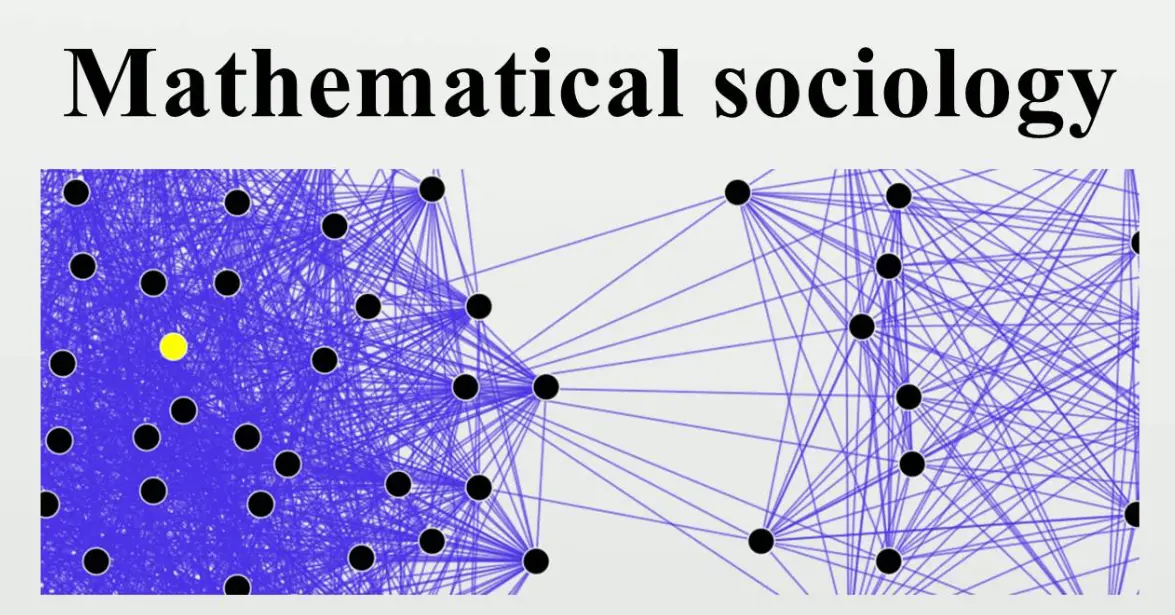
Mathematical Sociology is a subfield of sociology that employs mathematical models, theories, and quantitative methods to analyze social phenomena, structures, and behaviors. It emerged in the mid-20th century as scholars sought more rigorous tools to complement qualitative approaches, drawing from disciplines like mathematics, statistics, and computer science.
Key methods include:
– Network analysis: Examining relationships and interactions within social networks, such as how information spreads or how communities form, using graphs and matrices to represent connections.
– Game theory: Modeling strategic decision-making and conflicts among individuals or groups, helping to explain phenomena like cooperation, competition, and social norms.
– Statistical modeling: Applying probability, regression, and other statistical techniques to analyze large datasets on social trends, such as inequality, mobility, or demographic changes.
– Simulation and computational models: Using algorithms and computer simulations to predict outcomes of social processes, like the evolution of opinions in a population or the dynamics of organizations.
Historically, pioneers like James Coleman, with his 1990 work *Foundations of Social Theory*, integrated mathematics into sociology by emphasizing rational choice and social capital. Other key figures include Harrison White, who advanced network theory, and Thomas Fararo, who explored algebraic models of social systems.
Applications span various areas, including:
– Understanding diffusion of innovations, such as how ideas or technologies spread through societies.
– Analyzing social mobility and inequality using Markov chains or agent-based models.
– Studying organizational behavior, conflict resolution, and population dynamics.
By providing precise, testable hypotheses and predictive power, Mathematical Sociology bridges the gap between abstract theory and empirical research, enhancing sociology’s scientific foundation and informing policy in fields like public health, economics, and urban planning.
Table of Contents
- Part 1: Create An Amazing Mathematical Sociology Quiz Using AI Instantly in OnlineExamMaker
- Part 2: 20 Mathematical Sociology Quiz Questions & Answers
- Part 3: Automatically Generate Quiz Questions Using AI Question Generator
Part 1: Create An Amazing Mathematical Sociology Quiz Using AI Instantly in OnlineExamMaker
The quickest way to assess the Mathematical Sociology knowledge of candidates is using an AI assessment platform like OnlineExamMaker. With OnlineExamMaker AI Question Generator, you are able to input content—like text, documents, or topics—and then automatically generate questions in various formats (multiple-choice, true/false, short answer). Its AI Exam Grader can automatically grade the exam and generate insightful reports after your candidate submit the assessment.
Overview of its key assessment-related features:
● Create up to 10 question types, including multiple-choice, true/false, fill-in-the-blank, matching, short answer, and essay questions.
● Automatically generates detailed reports—individual scores, question report, and group performance.
● Instantly scores objective questions and subjective answers use rubric-based scoring for consistency.
● API and SSO help trainers integrate OnlineExamMaker with Google Classroom, Microsoft Teams, CRM and more.
Automatically generate questions using AI
Part 2: 20 Mathematical Sociology Quiz Questions & Answers
or
1. Question: In a social network graph, what does the degree centrality of a node represent?
A. The number of paths from that node to others
B. The number of direct connections the node has
C. The shortest path distance to all other nodes
D. The influence based on betweenness
Answer: B
Explanation: Degree centrality measures the number of direct ties a node has, indicating the node’s immediate connections in the network.
2. Question: In the Bass diffusion model, what does the parameter p represent?
A. The coefficient of innovation
B. The coefficient of imitation
C. The total market potential
D. The rate of external influence
Answer: A
Explanation: The parameter p in the Bass model represents the coefficient of innovation, which is the probability that an individual adopts an innovation without social influence.
3. Question: What is the primary assumption of homophily in social networks?
A. Individuals connect randomly
B. Individuals prefer to connect with similar others
C. Networks are always complete graphs
D. Connections decrease with distance
Answer: B
Explanation: Homophily assumes that people form ties with others who are similar to them in attributes like age, race, or interests, leading to clustered networks.
4. Question: In Markov chains applied to social mobility, what does a transition matrix represent?
A. The steady-state distribution
B. The probabilities of moving between states over time
C. The initial state probabilities
D. The variance of social positions
Answer: B
Explanation: A transition matrix in Markov chains shows the probabilities of transitioning from one social state (e.g., income level) to another in subsequent periods.
5. Question: For a balanced signed graph, which condition must hold for a triangle of nodes?
A. All edges must be positive
B. The product of the signs of the edges must be positive
C. All edges must be negative
D. The graph must be bipartite
Answer: B
Explanation: In balance theory, a triangle is balanced if the product of the signs of its edges is positive, meaning an even number of negative edges.
6. Question: In game theory for sociology, what is a Nash equilibrium?
A. A strategy where one player maximizes gains regardless of others
B. A point where no player can benefit by changing their strategy unilaterally
C. The total payoff for all players
D. A random strategy selection
Answer: B
Explanation: A Nash equilibrium occurs when each player’s strategy is optimal given the strategies of others, making it a stable outcome in social interactions.
7. Question: What does the clustering coefficient measure in a social network?
A. The average path length
B. The degree of a node
C. The tendency for nodes to cluster together
D. The overall size of the network
Answer: C
Explanation: The clustering coefficient quantifies how closely connected a node’s neighbors are, indicating the presence of tightly knit groups or clusters.
8. Question: In exponential random graph models (ERGMs), what is the role of parameters?
A. They represent fixed network structures
B. They control the probability of certain configurations
C. They measure the network’s density
D. They predict future edges
Answer: B
Explanation: Parameters in ERGMs influence the likelihood of specific subgraphs, allowing the model to capture patterns like reciprocity or transitivity.
9. Question: What is the key feature of a small-world network?
A. High clustering and short average path lengths
B. Complete connectivity
C. Random edge distribution
D. Low density
Answer: A
Explanation: Small-world networks exhibit high clustering among local neighbors and short paths between distant nodes, mimicking real social structures.
10. Question: In sociophysics, how is the Ising model used?
A. To model economic growth
B. To simulate opinion dynamics and phase transitions in societies
C. To predict population growth
D. To analyze traffic flow
Answer: B
Explanation: The Ising model is adapted in sociophysics to represent how individual opinions align or flip, leading to collective phenomena like consensus.
11. Question: What does the PageRank algorithm measure in a social network?
A. The number of followers
B. The importance of a node based on incoming links
C. The shortest paths
D. The community’s size
Answer: B
Explanation: PageRank assesses a node’s importance by considering the quality and quantity of links pointing to it, similar to influence in social hierarchies.
12. Question: In blockmodeling, what is a block?
A. A single edge in the network
B. A group of nodes with similar connection patterns
C. The entire network matrix
D. A random subgraph
Answer: B
Explanation: Blockmodeling partitions nodes into blocks where within-block and between-block ties follow regular patterns, simplifying network analysis.
13. Question: What is assortative mixing in networks?
A. Nodes connecting to dissimilar nodes
B. Nodes connecting to similar nodes
C. Random connections
D. Directed edges only
Answer: B
Explanation: Assortative mixing occurs when nodes preferentially connect to others with similar attributes, reinforcing homophily.
14. Question: In diffusion of innovations, what is the S-curve?
A. A linear adoption rate
B. A sigmoidal pattern of cumulative adoption over time
C. A declining trend
D. A cyclical pattern
Answer: B
Explanation: The S-curve illustrates the slow initial adoption, rapid growth, and eventual saturation of an innovation in a population.
15. Question: What is the purpose of centrality measures in social network analysis?
A. To count the total nodes
B. To identify the most influential or central actors
C. To measure edge weights
D. To predict network collapse
Answer: B
Explanation: Centrality measures help pinpoint key individuals by quantifying their position and influence within the network structure.
16. Question: In agent-based modeling for sociology, what do agents represent?
A. Fixed network structures
B. Individual actors with rules and behaviors
C. Global trends
D. Statistical averages
Answer: B
Explanation: Agents are simulated entities that follow defined rules, allowing researchers to study emergent social phenomena from individual interactions.
17. Question: What is a bipartite graph in social networks?
A. A graph with only positive edges
B. A graph divided into two sets where edges only connect between sets
C. A complete graph
D. A directed acyclic graph
Answer: B
Explanation: In bipartite graphs, nodes are split into two disjoint sets, and edges only exist between the sets, often used for relationships like authors and papers.
18. Question: In social balance theory, why might a network become unstable?
A. If all triangles are balanced
B. If there are imbalanced triangles
C. If the network is too dense
D. If edges are undirected
Answer: B
Explanation: Imbalanced triangles (e.g., two positive and one negative edge) create tension, potentially leading to changes in relationships for stability.
19. Question: What does the concept of structural equivalence mean?
A. Nodes with identical degrees
B. Nodes that connect to the same other nodes
C. Randomly equivalent positions
D. Overlapping communities
Answer: B
Explanation: Structural equivalence occurs when two nodes have identical patterns of connections to other nodes, implying similar roles in the network.
20. Question: In stochastic actor-oriented models (SAOMs), what is modeled?
A. Static network snapshots
B. The co-evolution of networks and actor attributes over time
C. Fixed social roles
D. Isolated individual behaviors
Answer: B
Explanation: SAOMs simulate how networks and individual characteristics (like behaviors) influence each other dynamically through probabilistic processes.
or
Part 3: Automatically generate quiz questions using OnlineExamMaker AI Question Generator
Automatically generate questions using AI