Language Engineering is a multidisciplinary field that applies engineering principles to the development and optimization of technologies for processing human languages. It encompasses areas such as natural language processing (NLP), machine translation, speech recognition, and text analytics, enabling machines to understand, generate, and interact with linguistic data effectively. By integrating computer science, linguistics, and artificial intelligence, it addresses challenges like language barriers, data extraction from vast text sources, and the creation of intelligent systems that mimic human communication. This field drives innovations in areas such as chatbots, search engines, and automated content analysis, making digital interactions more seamless and accessible across diverse languages and cultures.
Table of Contents
- Part 1: OnlineExamMaker AI Quiz Generator – The Easiest Way to Make Quizzes Online
- Part 2: 20 Language Engineering Quiz Questions & Answers
- Part 3: Automatically Generate Quiz Questions Using AI Question Generator
Part 1: OnlineExamMaker AI Quiz Generator – The Easiest Way to Make Quizzes Online
When it comes to ease of creating a Language Engineering skills assessment, OnlineExamMaker is one of the best AI-powered quiz making software for your institutions or businesses. With its AI Question Generator, just upload a document or input keywords about your assessment topic, you can generate high-quality quiz questions on any topic, difficulty level, and format.
What you will like:
● AI Question Generator to help you save time in creating quiz questions automatically.
● Share your online exam with audiences on social platforms like Facebook, Twitter, Reddit and more.
● Display the feedback for correct or incorrect answers instantly after a question is answered.
● Create a lead generation form to collect an exam taker’s information, such as email, mobile phone, work title, company profile and so on.
Automatically generate questions using AI
Part 2: 20 Language Engineering Quiz Questions & Answers
or
1. Question: What is the primary goal of Natural Language Processing (NLP)?
A) To enable computers to understand and process human languages.
B) To design hardware for language devices.
C) To study ancient languages.
D) To create physical language models.
Answer: A
Explanation: NLP focuses on the interaction between computers and human languages, allowing machines to process, understand, and generate language.
2. Question: Which technique is used to break text into individual words or tokens?
A) Tokenization
B) Stemming
C) Parsing
D) Lemmatization
Answer: A
Explanation: Tokenization divides text into smaller units like words or sentences, which is a fundamental step in text processing.
3. Question: What does stemming do in language engineering?
A) Reduces words to their root form by removing suffixes.
B) Converts words to their base or dictionary form.
C) Analyzes sentence structure.
D) Translates text into another language.
Answer: A
Explanation: Stemming simplifies words for tasks like search engines by stripping endings, though it may not always produce a valid word.
4. Question: In the Bag of Words model, what aspect of text is ignored?
A) Word order
B) Word frequency
C) Unique words
D) Sentence length
Answer: A
Explanation: The Bag of Words model treats text as an unordered set of words, focusing only on frequency and ignoring the sequence.
5. Question: What does TF-IDF stand for, and what is its purpose?
A) Term Frequency-Inverse Document Frequency; to evaluate word importance in a document relative to a corpus.
B) Text Format Identification; to classify document types.
C) Time Frequency Identification; to analyze temporal data.
D) Term Function Index; to index database terms.
Answer: A
Explanation: TF-IDF weights terms based on their rarity in a corpus, helping to highlight significant words in information retrieval.
6. Question: Which algorithm is commonly used for machine translation?
A) Sequence-to-sequence models
B) Linear regression
C) K-means clustering
D) Decision trees
Answer: A
Explanation: Sequence-to-sequence models, often with attention mechanisms, translate one sequence of words to another effectively.
7. Question: What is sentiment analysis primarily used for?
A) Determining the emotional tone of text.
B) Counting words in a document.
C) Generating new sentences.
D) Translating languages.
Answer: A
Explanation: Sentiment analysis classifies text as positive, negative, or neutral to gauge opinions in applications like social media monitoring.
8. Question: What is Part-of-Speech (POS) tagging?
A) Assigning grammatical categories to words in a sentence.
B) Grouping similar words together.
C) Removing stop words from text.
D) Converting speech to text.
Answer: A
Explanation: POS tagging labels words as nouns, verbs, etc., which aids in syntactic analysis and understanding sentence structure.
9. Question: In Named Entity Recognition (NER), what types of entities are typically identified?
A) Persons, organizations, and locations.
B) Only numbers and dates.
C) Synonyms of common words.
D) Grammatical errors in text.
Answer: A
Explanation: NER extracts and classifies named entities from text, such as people, places, and organizations, for information extraction.
10. Question: What is a key component of chatbots in language engineering?
A) Natural Language Understanding (NLU)
B) Image processing algorithms
C) Physical sensor integration
D) Hardware design
Answer: A
Explanation: NLU enables chatbots to interpret user inputs and generate appropriate responses by understanding language context.
11. Question: Which model is an example of a transformer in NLP?
A) BERT
B) Linear Support Vector Machine
C) Random Forest
D) K-Nearest Neighbors
Answer: A
Explanation: BERT uses transformer architecture to handle bidirectional context, improving tasks like question answering and text classification.
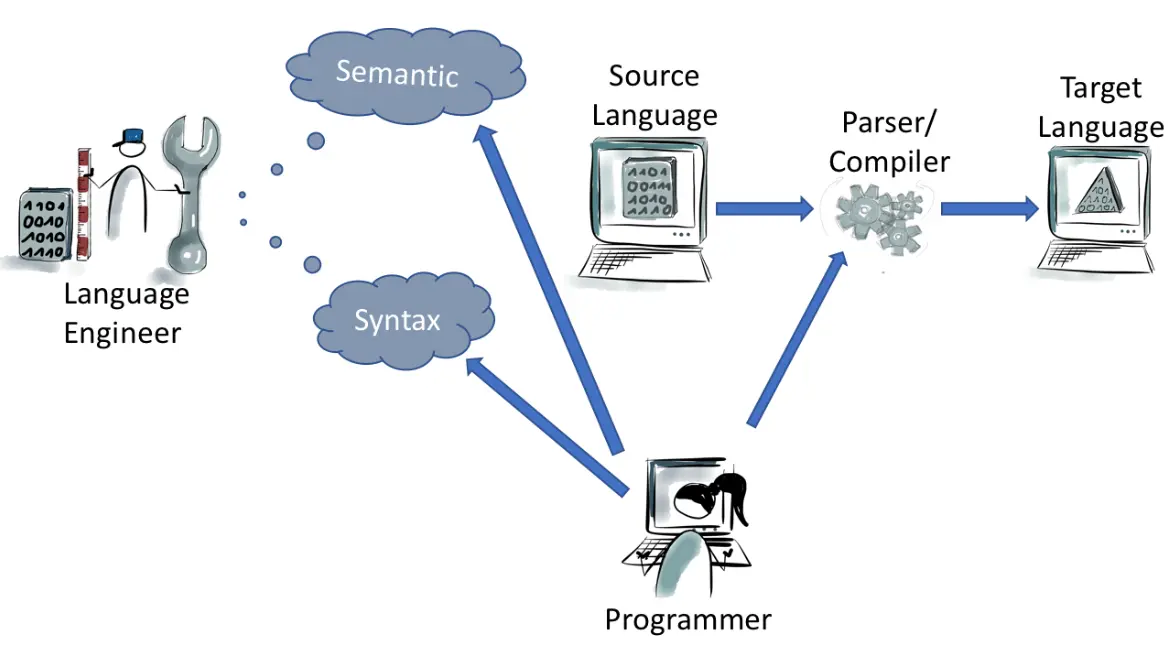
12. Question: What is a syntax tree used for?
A) Representing the hierarchical structure of a sentence.
B) Storing word frequencies.
C) Generating random text.
D) Translating code to language.
Answer: A
Explanation: Syntax trees visualize how words in a sentence relate grammatically, aiding in parsing and analysis.
13. Question: In semantic analysis, what is the focus?
A) The meaning and interpretation of words and sentences.
B) The physical pronunciation of words.
C) The historical evolution of languages.
D) The visual representation of text.
Answer: A
Explanation: Semantic analysis deals with understanding the actual meaning behind language, beyond just syntax.
14. Question: What is a corpus in language engineering?
A) A large collection of text or speech data for analysis.
B) A single word in a dictionary.
C) A programming language syntax.
D) A hardware device for language processing.
Answer: A
Explanation: A corpus serves as a dataset for training and testing language models, providing real-world language examples.
15. Question: Which metric is used to evaluate classification models in NLP?
A) Precision and Recall
B) Speed of execution
C) File size of data
D) Number of users
Answer: A
Explanation: Precision and Recall measure the accuracy of positive predictions, crucial for tasks like spam detection.
16. Question: How are neural networks applied in NLP?
A) For learning patterns in language data through layers of processing.
B) For manual rule-based processing.
C) For storing large datasets.
D) For hardware optimization.
Answer: A
Explanation: Neural networks, like RNNs and CNNs, process sequential data to learn complex language patterns automatically.
17. Question: What is a sequence-to-sequence model best suited for?
A) Tasks like machine translation and text summarization.
B) Image recognition.
C) Static data analysis.
D) Numerical computations.
Answer: A
Explanation: These models handle input and output sequences, making them ideal for transforming one form of language to another.
18. Question: What are word embeddings?
A) Vector representations of words that capture semantic meanings.
B) Physical maps of word origins.
C) Lists of synonyms.
D) Audio files of pronunciations.
Answer: A
Explanation: Word embeddings, like Word2Vec, map words to numerical vectors, allowing machines to understand word relationships.
19. Question: In language generation, what technique is used for creating coherent text?
A) Language models like GPT
B) Basic string concatenation
C) Random word selection
D) Image-to-text conversion
Answer: A
Explanation: Language models generate text by predicting sequences based on learned patterns from vast datasets.
20. Question: What ethical concern is prominent in language engineering?
A) Bias in AI models leading to unfair representations.
B) Color schemes in user interfaces.
C) Speed of data processing.
D) Paper usage in documentation.
Answer: A
Explanation: Bias can perpetuate stereotypes if training data is not diverse, making it a key ethical issue in developing fair language systems.
or
Part 3: Automatically generate quiz questions using OnlineExamMaker AI Question Generator
Automatically generate questions using AI