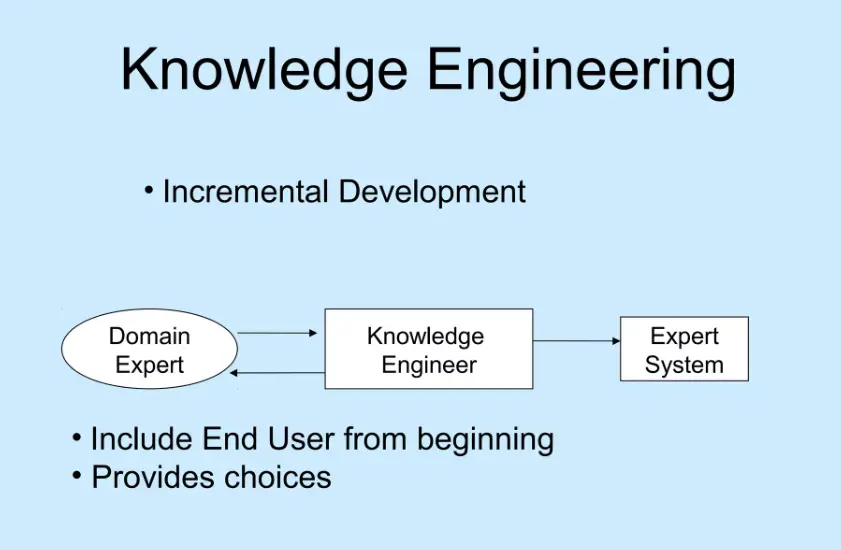
Knowledge Engineering is a multidisciplinary field within artificial intelligence that focuses on the acquisition, representation, and utilization of human expertise to build intelligent systems. It involves systematically gathering domain-specific knowledge from experts, encoding it into a structured format—such as rules, ontologies, or knowledge graphs—and integrating it into software applications. This process enables machines to mimic human reasoning, solve complex problems, and make informed decisions in areas like medical diagnosis, financial forecasting, and automated troubleshooting. By bridging the gap between human cognition and computer processing, Knowledge Engineering enhances the capabilities of expert systems, supports decision-making, and drives advancements in fields such as natural language processing, robotics, and data analytics. Its iterative nature ensures that knowledge bases evolve, adapting to new information and improving accuracy over time.
Table of Contents
- Part 1: Create A Knowledge Engineering Quiz in Minutes Using AI with OnlineExamMaker
- Part 2: 20 Knowledge Engineering Quiz Questions & Answers
- Part 3: Automatically Generate Quiz Questions Using AI Question Generator
Part 1: Create A Knowledge Engineering Quiz in Minutes Using AI with OnlineExamMaker
When it comes to ease of creating a Knowledge Engineering skills assessment, OnlineExamMaker is one of the best AI-powered quiz making software for your institutions or businesses. With its AI Question Generator, just upload a document or input keywords about your assessment topic, you can generate high-quality quiz questions on any topic, difficulty level, and format.
Overview of its key assessment-related features:
● AI Question Generator to help you save time in creating quiz questions automatically.
● Share your online exam with audiences on social platforms like Facebook, Twitter, Reddit and more.
● Instantly scores objective questions and subjective answers use rubric-based scoring for consistency.
● Simply copy and insert a few lines of embed codes to display your online exams on your website or WordPress blog.
Automatically generate questions using AI
Part 2: 20 Knowledge Engineering Quiz Questions & Answers
or
1. What is the primary goal of Knowledge Engineering?
A. To design hardware components
B. To acquire and represent knowledge for AI systems
C. To focus on data storage techniques
D. To develop programming languages
Answer: B
Explanation: Knowledge Engineering involves capturing expert knowledge and structuring it for use in intelligent systems, enabling machines to mimic human reasoning.
2. Which of the following is a common method for knowledge representation?
A. Binary code
B. Semantic networks
C. Random access memory
D. File systems
Answer: B
Explanation: Semantic networks represent knowledge as nodes and links, allowing for the depiction of relationships between concepts in a structured way.
3. In Knowledge Engineering, what does an ontology primarily define?
A. Physical hardware specifications
B. Concepts and their relationships in a domain
C. User interface designs
D. Database query languages
Answer: B
Explanation: An ontology provides a formal structure for representing knowledge, including classes, properties, and relationships, to facilitate shared understanding.
4. Which phase of Knowledge Engineering involves extracting knowledge from experts?
A. Knowledge validation
B. Knowledge acquisition
C. Knowledge application
D. Knowledge storage
Answer: B
Explanation: Knowledge acquisition is the process of gathering and converting human expertise into a machine-readable format for AI systems.
5. What is a rule-based system in Knowledge Engineering?
A. A system that uses neural networks
B. A system that applies if-then rules to make decisions
C. A system for graphical user interfaces
D. A system for data encryption
Answer: B
Explanation: Rule-based systems use predefined rules (e.g., IF condition THEN action) to encode knowledge and perform inference.
6. Which tool is often used in Knowledge Engineering for building expert systems?
A. Microsoft Word
B. Protégé
C. Adobe Photoshop
D. Excel spreadsheets
Answer: B
Explanation: Protégé is an open-source tool specifically designed for creating and managing ontologies and knowledge bases.
7. What does inference mean in the context of Knowledge Engineering?
A. Storing data in a database
B. Deriving new knowledge from existing knowledge
C. Designing algorithms
D. Inputting data into a system
Answer: B
Explanation: Inference involves logical processes, such as deduction or induction, to draw conclusions from the knowledge represented in a system.
8. Which knowledge representation technique uses frames to organize information?
A. Decision trees
B. Logic programming
C. Frames
D. Bayesian networks
Answer: C
Explanation: Frames represent knowledge as structured templates with slots for attributes, making it easier to model real-world objects and their properties.
9. What is the main challenge in Knowledge Engineering related to experts?
A. Hardware limitations
B. Knowledge elicitation difficulties
C. Software updates
D. Network connectivity
Answer: B
Explanation: Eliciting accurate and complete knowledge from human experts can be challenging due to issues like incomplete recall or communication barriers.
10. In an expert system, what role does the inference engine play?
A. It stores the knowledge base
B. It applies rules to the knowledge base to solve problems
C. It designs the user interface
D. It collects data from users
Answer: B
Explanation: The inference engine processes the rules and facts in the knowledge base to perform reasoning and generate solutions.
11. Which of the following is an example of declarative knowledge in Knowledge Engineering?
A. How to ride a bike
B. Facts about historical events
C. Procedural code for sorting algorithms
D. User commands in a program
Answer: B
Explanation: Declarative knowledge involves static facts and information, such as “Paris is the capital of France,” rather than processes.
12. What is the purpose of validation in Knowledge Engineering?
A. To make the system visually appealing
B. To ensure the accuracy and reliability of the knowledge base
C. To speed up processing time
D. To add more data
Answer: B
Explanation: Validation checks for errors, inconsistencies, and completeness in the knowledge base to maintain its effectiveness.
13. Which model is commonly used for uncertain knowledge in Knowledge Engineering?
A. Deterministic models
B. Bayesian networks
C. Linear regression
D. Simple lists
Answer: B
Explanation: Bayesian networks handle probabilistic relationships and uncertainties by representing variables and their conditional dependencies.
14. What is a knowledge base in Knowledge Engineering?
A. A collection of algorithms
B. A structured repository of facts and rules
C. A user manual
D. A programming library
Answer: B
Explanation: A knowledge base is the central component that stores organized knowledge for use in reasoning and decision-making.
15. Which technique involves reusing knowledge across different domains?
A. Domain-specific coding
B. Ontology mapping
C. Random sampling
D. Data visualization
Answer: B
Explanation: Ontology mapping allows knowledge from one domain to be integrated or translated into another, promoting reuse and interoperability.
16. In Knowledge Engineering, what is tacit knowledge?
A. Explicitly written rules
B. Knowledge that is difficult to articulate and is based on experience
C. Stored data in databases
D. Visual diagrams
Answer: B
Explanation: Tacit knowledge is intuitive and personal, often gained through practice, and requires special methods to capture in engineering processes.
17. What does the term “knowledge refinement” refer to?
A. Initial knowledge acquisition
B. Improving and updating the knowledge base over time
C. Deleting unnecessary data
D. Sharing knowledge online
Answer: B
Explanation: Knowledge refinement involves iteratively enhancing the knowledge base based on feedback, new data, or performance evaluations.
18. Which approach in Knowledge Engineering focuses on capturing common sense knowledge?
A. Expert interviews only
B. Cyc project
C. Simple databases
D. Machine learning algorithms
Answer: B
Explanation: The Cyc project aims to represent a vast amount of common sense knowledge in a formal structure for broad AI applications.
19. What is the difference between procedural and declarative knowledge?
A. Procedural is about facts, declarative is about processes
B. Procedural is about processes, declarative is about facts
C. Both are the same
D. Neither is used in engineering
Answer: B
Explanation: Procedural knowledge describes how to perform tasks, while declarative knowledge states what is true, aiding in different aspects of representation.
20. Why is modularity important in Knowledge Engineering?
A. It makes the system more complex
B. It allows easy updates and maintenance of knowledge components
C. It slows down processing
D. It requires more hardware
Answer: B
Explanation: Modularity divides knowledge into independent modules, facilitating easier modification, testing, and scalability in systems.
or
Part 3: Automatically generate quiz questions using OnlineExamMaker AI Question Generator
Automatically generate questions using AI