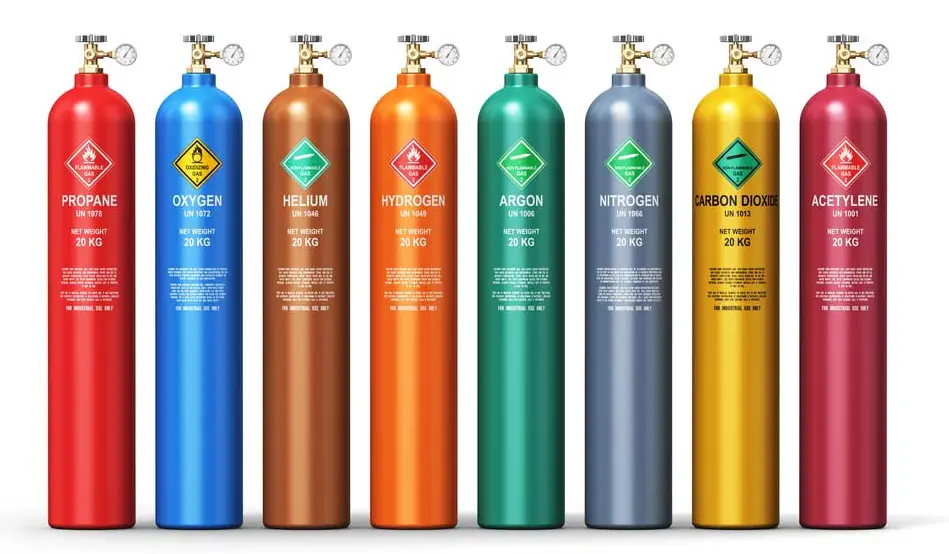
Industrial gases are essential substances used across various sectors for manufacturing, processing, and innovation. These gases are typically produced in large quantities and include common types such as oxygen, nitrogen, hydrogen, carbon dioxide, argon, and acetylene.
#Types of Industrial Gases
– Oxygen (O₂): Widely used for combustion, oxidation processes, and medical applications.
– Nitrogen (N₂): Inert gas employed for blanketing, freezing, and as a refrigerant.
– Hydrogen (H₂): Key in chemical synthesis, fuel cells, and refining petroleum.
– Carbon Dioxide (CO₂): Utilized in carbonation, welding, and enhanced oil recovery.
– Argon (Ar): Used as a shielding gas in welding and for inert atmospheres.
– Acetylene (C₂H₂): Primarily for oxy-fuel welding and cutting.
#Production Methods
Industrial gases are produced through methods like air separation (for oxygen and nitrogen), steam reforming (for hydrogen), and chemical processes (for CO₂). Cryogenic distillation, membrane separation, and adsorption techniques ensure high purity levels.
#Applications
– Manufacturing: Gases support metal fabrication, electronics production, and chemical manufacturing.
– Healthcare: Oxygen for respiration therapy and nitrogen for cryopreservation.
– Food and Beverage: CO₂ for carbonation and packaging to extend shelf life.
– Energy: Hydrogen in fuel cells and natural gas processing.
– Environmental: Nitrogen for pollution control and CO₂ for carbon capture.
#Safety and Environmental Considerations
Handling industrial gases requires strict adherence to safety protocols due to their flammable, asphyxiant, or toxic properties. Environmentally, efforts focus on reducing emissions, such as through green hydrogen production, to minimize the carbon footprint.
In summary, industrial gases play a pivotal role in modern industry, driving efficiency and innovation while necessitating responsible management for safety and sustainability.
Table of Contents
- Part 1: OnlineExamMaker AI Quiz Maker – Make A Free Quiz in Minutes
- Part 2: 20 Industrial Gases Quiz Questions & Answers
- Part 3: OnlineExamMaker AI Question Generator: Generate Questions for Any Topic
Part 1: OnlineExamMaker AI Quiz Maker – Make A Free Quiz in Minutes
Still spend a lot of time in editing questions for your next Industrial Gases assessment? OnlineExamMaker is an AI quiz maker that leverages artificial intelligence to help users create quizzes, tests, and assessments quickly and efficiently. You can start by inputting a topic or specific details into the OnlineExamMaker AI Question Generator, and the AI will generate a set of questions almost instantly. It also offers the option to include answer explanations, which can be short or detailed, helping learners understand their mistakes.
What you may like:
● Automatic grading and insightful reports. Real-time results and interactive feedback for quiz-takers.
● The exams are automatically graded with the results instantly, so that teachers can save time and effort in grading.
● LockDown Browser to restrict browser activity during quizzes to prevent students searching answers on search engines or other software.
● Create certificates with personalized company logo, certificate title, description, date, candidate’s name, marks and signature.
Automatically generate questions using AI
Part 2: 20 Industrial Gases Quiz Questions & Answers
or
1. Question: What is the primary component of air that is separated to produce industrial nitrogen?
A) Oxygen
B) Carbon dioxide
C) Nitrogen
D) Argon
Answer: C
Explanation: Nitrogen makes up about 78% of the atmosphere and is extracted through air separation processes for industrial use.
2. Question: Which gas is commonly used in the steel industry for removing impurities from molten metal?
A) Hydrogen
B) Oxygen
C) Helium
D) Carbon monoxide
Answer: B
Explanation: Oxygen is used in steelmaking to react with carbon and other impurities, producing a purer metal.
3. Question: What method is primarily used to produce hydrogen on an industrial scale?
A) Electrolysis of water
B) Steam reforming of natural gas
C) Fractional distillation of air
D) Combustion of coal
Answer: B
Explanation: Steam reforming of natural gas is the most efficient and common industrial method for large-scale hydrogen production.
4. Question: Which industrial gas is often used as a shielding gas in welding to prevent oxidation?
A) Carbon dioxide
B) Argon
C) Ammonia
D) Sulfur dioxide
Answer: B
Explanation: Argon is an inert gas that creates a protective atmosphere around the weld, minimizing contamination from oxygen.
5. Question: What is the main use of carbon dioxide in the food and beverage industry?
A) As a refrigerant
B) In carbonation of drinks
C) For metal cutting
D) As a fuel source
Answer: B
Explanation: Carbon dioxide is dissolved under pressure in beverages to create carbonation, giving them fizz.
6. Question: Which gas is cryogenic and used for cooling in superconductivity applications?
A) Nitrogen
B) Helium
C) Oxygen
D) Methane
Answer: B
Explanation: Helium has the lowest boiling point of any element and is ideal for achieving the extremely low temperatures needed for superconductors.
7. Question: How is industrial oxygen typically produced?
A) By chemical synthesis
B) Through air liquefaction and fractional distillation
C) From petroleum refining
D) By electrolysis of brine
Answer: B
Explanation: Air is cooled to a liquid state and then distilled to separate oxygen, which is about 21% of air.
8. Question: What property makes acetylene suitable for oxy-fuel welding?
A) Its high flammability and hot flame
B) Its inert nature
C) Its low density
D) Its solubility in water
Answer: A
Explanation: Acetylene produces one of the hottest flames when burned with oxygen, making it effective for cutting and welding metals.
9. Question: Which industrial gas is a byproduct of ammonia production and used in refrigeration?
A) Chlorine
B) Ammonia
C) Propane
D) Ethylene
Answer: B
Explanation: Ammonia is produced via the Haber-Bosch process and is widely used as a refrigerant due to its efficient heat absorption properties.
10. Question: What is the primary environmental concern with the release of sulfur hexafluoride?
A) It is highly flammable
B) It is a potent greenhouse gas
C) It causes acid rain
D) It depletes the ozone layer
Answer: B
Explanation: Sulfur hexafluoride has a high global warming potential and persists in the atmosphere for thousands of years.
11. Question: In which industry is argon most commonly applied for creating an inert environment?
A) Pharmaceuticals
B) Electronics manufacturing
C) Automotive
D) Textiles
Answer: B
Explanation: Argon is used in electronics to prevent oxidation during processes like semiconductor fabrication.
12. Question: What gas is used in the production of semiconductors to etch silicon wafers?
A) Nitrogen
B) Chlorine
C) Hydrogen chloride
D) Carbon dioxide
Answer: C
Explanation: Hydrogen chloride is employed in etching to remove material precisely from silicon surfaces in semiconductor production.
13. Question: Which gas is essential for the Haber process in fertilizer manufacturing?
A) Oxygen
B) Hydrogen
C) Helium
D) Carbon monoxide
Answer: B
Explanation: Hydrogen reacts with nitrogen in the Haber process to produce ammonia, a key component in fertilizers.
14. Question: What makes nitrous oxide useful in medical and automotive applications?
A) Its explosive properties
B) Its ability to support combustion
C) Its anesthetic and oxidizing effects
D) Its cooling capacity
Answer: C
Explanation: Nitrous oxide acts as an anesthetic in medicine and provides extra oxygen for combustion in engines.
15. Question: How is industrial carbon monoxide primarily produced?
A) By partial oxidation of hydrocarbons
B) Through photosynthesis
C) From volcanic emissions
D) By electrolysis
Answer: A
Explanation: Carbon monoxide is generated by the incomplete combustion or partial oxidation of natural gas or coal.
16. Question: Which safety precaution is critical when handling hydrogen gas?
A) Storing it in open containers
B) Avoiding ignition sources due to its flammability
C) Exposing it to high heat
D) Mixing it with oxygen freely
Answer: B
Explanation: Hydrogen is highly flammable and can ignite easily, so it must be handled in controlled environments away from sparks.
17. Question: What is a key risk associated with industrial use of chlorine gas?
A) It is odorless and undetectable
B) It is toxic and can cause respiratory issues
C) It is highly explosive
D) It promotes bacterial growth
Answer: B
Explanation: Chlorine is a strong irritant and toxic gas, requiring strict handling to prevent health hazards.
18. Question: In which application is liquefied petroleum gas (LPG) commonly used as an industrial gas?
A) As a coolant in refrigerators
B) For heating and fuel in various industries
C) In air separation plants
D) For medical sterilization
Answer: B
Explanation: LPG, a mixture of propane and butane, is widely used as a clean-burning fuel for industrial heating and processes.
19. Question: What role does ethylene play in the chemical industry?
A) As a refrigerant
B) In the production of plastics and polymers
C) As an inert gas
D) In water treatment
Answer: B
Explanation: Ethylene is a key feedstock for producing polyethylene and other polymers used in manufacturing.
20. Question: Which gas is used in fire suppression systems due to its ability to displace oxygen?
A) Carbon dioxide
B) Oxygen
C) Nitrogen
D) Hydrogen
Answer: A
Explanation: Carbon dioxide is released to reduce oxygen levels in a fire, effectively smothering the flames.
or
Part 3: OnlineExamMaker AI Question Generator: Generate Questions for Any Topic
Automatically generate questions using AI