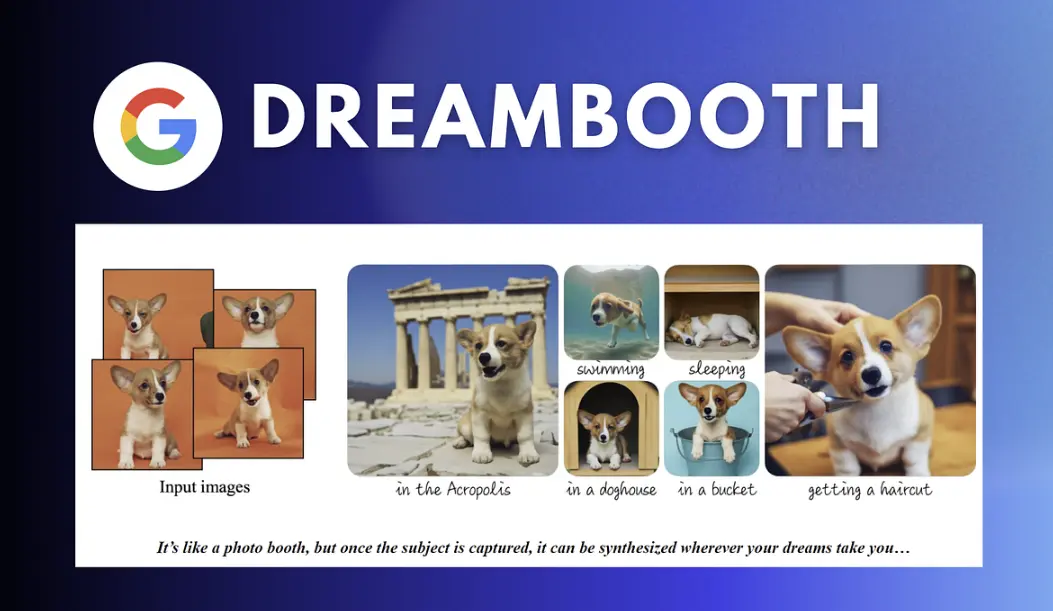
Google Dreambooth is an innovative AI technique developed by Google Research that enables users to fine-tune text-to-image diffusion models with just a few images of a specific subject. This method allows for the creation of personalized generative models, where everyday objects, pets, or even people can be seamlessly integrated into new scenes and styles. By training on a small dataset, Dreambooth preserves the unique characteristics of the subject while leveraging the model’s existing capabilities, making it easier to generate high-quality, custom images without extensive data requirements. This advancement democratizes AI creativity, empowering artists, designers, and enthusiasts to produce tailored visual content efficiently.
Table of Contents
- Part 1: OnlineExamMaker AI Quiz Generator – Save Time and Efforts
- Part 2: 20 Google Dreambooth Quiz Questions & Answers
- Part 3: Automatically Generate Quiz Questions Using AI Question Generator
Part 1: OnlineExamMaker AI Quiz Generator – Save Time and Efforts
What’s the best way to create a Google Dreambooth quiz online? OnlineExamMaker is the best AI quiz making software for you. No coding, and no design skills required. If you don’t have the time to create your online quiz from scratch, you are able to use OnlineExamMaker AI Question Generator to create question automatically, then add them into your online assessment. What is more, the platform leverages AI proctoring and AI grading features to streamline the process while ensuring exam integrity.
Key features of OnlineExamMaker:
● Combines AI webcam monitoring to capture cheating activities during online exam.
● Allow the quiz taker to answer by uploading video or a Word document, adding an image, and recording an audio file.
● Automatically scores multiple-choice, true/false, and even open-ended/audio responses using AI, reducing manual work.
● OnlineExamMaker API offers private access for developers to extract your exam data back into your system automatically.
Automatically generate questions using AI
Part 2: 20 Google Dreambooth Quiz Questions & Answers
or
1. Question: What is Google Dreambooth primarily used for?
Options:
A. Generating text from images
B. Fine-tuning text-to-image models for personalized content
C. Creating animated videos
D. Processing audio files
Answer: B
Explanation: Google Dreambooth is a technique that allows users to fine-tune pre-trained text-to-image diffusion models to generate images of specific subjects by incorporating a small set of reference images.
2. Question: Which organization is associated with the development of Dreambooth?
Options:
A. OpenAI
B. Google Research
C. Meta
D. Microsoft
Answer: B
Explanation: Dreambooth was introduced by researchers at Google Research as a method for personalized text-to-image generation.
3. Question: What type of machine learning model is typically fine-tuned using Dreambooth?
Options:
A. Recurrent Neural Networks (RNNs)
B. Diffusion models
C. Convolutional Neural Networks (CNNs) for classification
D. Generative Adversarial Networks (GANs) for video
Answer: B
Explanation: Dreambooth specifically fine-tunes diffusion models, which are used in text-to-image generation tasks to create high-quality, personalized outputs.
4. Question: In Dreambooth, what is the purpose of using a small set of reference images?
Options:
A. To train a model from scratch
B. To personalize the model for specific subjects
C. To reduce the model’s accuracy
D. To generate random noise
Answer: B
Explanation: Reference images in Dreambooth help the model learn and incorporate unique characteristics of a subject, enabling personalized image generation without extensive retraining.
5. Question: What is a key advantage of Dreambooth over traditional image generation methods?
Options:
A. It requires less computational power
B. It allows for subject-specific fine-tuning with fewer images
C. It only works with black-and-white images
D. It eliminates the need for text prompts
Answer: B
Explanation: Dreambooth efficiently personalizes models using a minimal dataset, making it more accessible and effective for creating custom generations compared to methods that need large datasets.
6. Question: Which of the following is NOT a typical step in the Dreambooth process?
Options:
A. Collecting reference images
B. Fine-tuning the base model
C. Generating images with text prompts
D. Manually drawing images
Answer: D
Explanation: Dreambooth involves collecting reference images, fine-tuning, and generating outputs, but it does not require manual drawing, as it relies on AI-driven fine-tuning.
7. Question: How does Dreambooth handle overfitting during fine-tuning?
Options:
A. By using a large dataset
B. Through regularization techniques like prior preservation
C. By ignoring the training data
D. By reducing the number of epochs
Answer: B
Explanation: Dreambooth employs prior preservation losses to prevent overfitting, ensuring the model retains its general capabilities while learning specific details.
8. Question: What format are the reference images typically provided in for Dreambooth?
Options:
A. Audio files
B. Text descriptions
C. High-resolution photographs
D. Video clips
Answer: C
Explanation: Reference images in Dreambooth are usually high-resolution photographs that capture the subject’s details for effective fine-tuning.
9. Question: In what year was the Dreambooth paper published?
Options:
A. 2018
B. 2022
C. 2020
D. 2015
Answer: B
Explanation: The Dreambooth method was introduced in a paper published in 2022 by Google Research.
10. Question: What role do text prompts play in Dreambooth-generated images?
Options:
A. They are not used at all
B. They guide the style and context of the output
C. They replace the need for reference images
D. They are only for audio generation
Answer: B
Explanation: Text prompts in Dreambooth help specify the desired scene or style, allowing the fine-tuned model to combine them with the learned subject details for customized results.
11. Question: Which hardware is commonly recommended for running Dreambooth fine-tuning?
Options:
A. A basic CPU
B. A GPU with sufficient VRAM
C. A simple smartphone
D. Cloud-based audio processors
Answer: B
Explanation: Dreambooth fine-tuning requires significant computational resources, such as a GPU with ample VRAM, to handle the complex diffusion model training.
12. Question: What is the primary output of a Dreambooth fine-tuned model?
Options:
A. Text summaries
B. Personalized images
C. Edited videos
D. Musical compositions
Answer: B
Explanation: The main output of Dreambooth is high-quality, personalized images generated based on the fine-tuned model and user prompts.
13. Question: How does Dreambooth differ from Stable Diffusion in its approach?
Options:
A. Stable Diffusion is not fine-tunable
B. Dreambooth adds personalization layers to existing models like Stable Diffusion
C. They are identical technologies
D. Dreambooth is only for text generation
Answer: B
Explanation: Dreambooth builds on models like Stable Diffusion by providing a framework for fine-tuning them with personal data, enabling subject-specific adaptations.
14. Question: What ethical concern is associated with Dreambooth?
Options:
A. Overuse of energy
B. Potential for misuse in creating deepfakes
C. Limited accessibility
D. All of the above
Answer: D
Explanation: Dreambooth raises ethical issues including high energy consumption, the risk of generating misleading deepfakes, and accessibility barriers due to required hardware.
15. Question: In Dreambooth, what does “prior preservation” refer to?
Options:
A. Saving the original model
B. Maintaining the model’s general knowledge during fine-tuning
C. Deleting old data
D. Generating new prompts
Answer: B
Explanation: Prior preservation in Dreambooth ensures that the base model’s broad capabilities are preserved while incorporating new, specific data to avoid overfitting.
16. Question: Which programming language is most commonly used to implement Dreambooth?
Options:
A. Java
B. Python
C. C++
D. JavaScript
Answer: B
Explanation: Dreambooth implementations typically use Python due to its extensive libraries for machine learning, such as PyTorch or TensorFlow.
17. Question: What is the typical number of reference images needed for effective Dreambooth fine-tuning?
Options:
A. Over 1000
B. 3 to 5
C. Exactly 10
D. None, as it’s not required
Answer: B
Explanation: Dreambooth can achieve good results with just 3 to 5 high-quality reference images, making it efficient for personalization.
18. Question: Can Dreambooth be used for commercial applications?
Options:
A. No, it’s only for research
B. Yes, with proper licensing and ethical considerations
C. Yes, but only for non-profit use
D. No, due to patent restrictions
Answer: B
Explanation: Dreambooth can be applied commercially, but users must address licensing from Google and ensure ethical use to avoid issues like copyright infringement.
19. Question: What happens if the reference images in Dreambooth are of poor quality?
Options:
A. The model improves automatically
B. The generated images may lack detail or accuracy
C. Nothing, as quality doesn’t matter
D. The process fails completely
Answer: B
Explanation: Poor-quality reference images can lead to suboptimal results, such as blurry or inaccurate generations, emphasizing the need for clear, high-resolution inputs.
20. Question: How does Dreambooth contribute to advancements in AI?
Options:
A. By focusing on text-only models
B. By enabling more accessible personalization in generative AI
C. By replacing all existing models
D. By limiting AI to specific industries
Answer: B
Explanation: Dreambooth advances AI by democratizing personalized image generation, allowing users to create custom content with minimal resources and data.
or
Part 3: Automatically generate quiz questions using OnlineExamMaker AI Question Generator
Automatically generate questions using AI