Dynamic Search Ads (DSA) in Google Ads is an automated advertising feature designed to help advertisers reach potential customers searching for content on their website. Here’s a breakdown:
What Are Dynamic Search Ads?
DSA uses Google’s advanced algorithms to automatically generate ad headlines and landing pages based on the actual content of your website. Instead of manually creating ads for every keyword, DSA scans your site in real-time and matches it to relevant search queries.
How Do They Work?
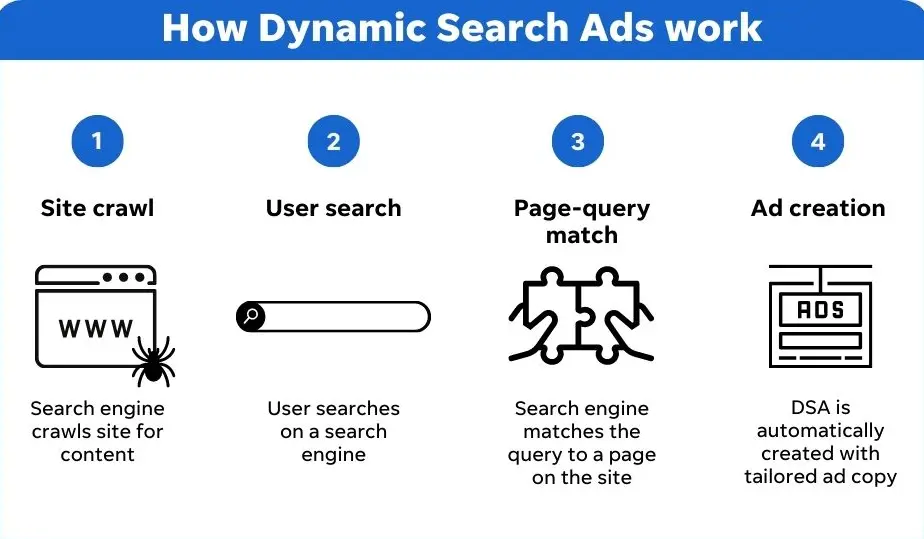
1. Website Crawling: Google crawls your website to index its pages, identifying key themes, products, and services.
2. Ad Generation: When a user searches for something related to your site, Google creates dynamic ads with headlines pulled from your content and directs users to the most relevant landing page.
3. Bidding and Targeting: You set bids for categories or your entire site, and Google handles the targeting based on search intent, making it easier to cover long-tail keywords.
Key Features:
– Automatic Keyword Discovery: DSA identifies new search terms that might not be in your keyword list, expanding your reach.
– Customizable Settings: You can exclude specific pages, set negative keywords, or target by category to refine ad performance.
– Performance Insights: Google Ads provides reports on which pages and searches drive clicks, helping you optimize your site and campaigns.
Benefits:
– Efficiency: Saves time by automating ad creation, ideal for large websites or e-commerce stores.
– Increased Coverage: Captures searches you might miss with traditional ads, boosting visibility and traffic.
– Cost-Effective: Focuses on relevant queries, potentially improving click-through rates (CTR) and return on ad spend (ROAS).
– Mobile Optimization: Ads adapt seamlessly to mobile devices, enhancing user experience.
Best Practices for Using DSA:
– Ensure your website is mobile-friendly and has high-quality, relevant content to maximize ad effectiveness.
– Monitor performance regularly and add negative keywords to avoid irrelevant traffic.
– Combine DSA with other campaign types for a comprehensive advertising strategy.
– Start with a small budget to test and refine before scaling.
By leveraging DSA, advertisers can streamline their Google Ads efforts and connect with users searching for exactly what their site offers.
Table of Contents
- Part 1: Create A Google Ads Dynamic Search Ads Quiz in Minutes Using AI with OnlineExamMaker
- Part 2: 20 Google Ads Dynamic Search Ads Quiz Questions & Answers
- Part 3: AI Question Generator – Automatically Create Questions for Your Next Assessment
Part 1: Create A Google Ads Dynamic Search Ads Quiz in Minutes Using AI with OnlineExamMaker
Are you looking for an online assessment to test the Google Ads Dynamic Search Ads skills of your learners? OnlineExamMaker uses artificial intelligence to help quiz organizers to create, manage, and analyze exams or tests automatically. Apart from AI features, OnlineExamMaker advanced security features such as full-screen lockdown browser, online webcam proctoring, and face ID recognition.
Recommended features for you:
● Includes a safe exam browser (lockdown mode), webcam and screen recording, live monitoring, and chat oversight to prevent cheating.
● Enhances assessments with interactive experience by embedding video, audio, image into quizzes and multimedia feedback.
● Once the exam ends, the exam scores, question reports, ranking and other analytics data can be exported to your device in Excel file format.
● Offers question analysis to evaluate question performance and reliability, helping instructors optimize their training plan.
Automatically generate questions using AI
Part 2: 20 Google Ads Dynamic Search Ads Quiz Questions & Answers
or
1. Question 1: What is the primary purpose of Dynamic Search Ads in Google Ads?
A) To manually create ads for specific keywords
B) To automatically generate ads based on website content
C) To target only display networks
D) To replace all standard search ads
Answer: B
Explanation: Dynamic Search Ads use your website’s content to automatically create ad headlines and landing pages, matching them to user searches without needing predefined keywords, which saves time and improves coverage.
2. Question 2: Which element does Google Ads analyze to generate headlines for Dynamic Search Ads?
A) Your ad copy history
B) The content on your website
C) Competitor ads
D) Social media posts
Answer: B
Explanation: Google Ads scans your website’s content, such as text and images, to dynamically create relevant ad headlines that align with user queries.
3. Question 3: When should you use Dynamic Search Ads?
A) For campaigns with a small number of products
B) For websites with frequently updated content
C) Only for brand awareness
D) For exact keyword matching only
Answer: B
Explanation: Dynamic Search Ads are ideal for websites with large or dynamic inventories, as they automatically adapt to changes in content, helping to capture long-tail searches.
4. Question 4: How do Dynamic Search Ads differ from standard search ads?
A) They require more manual bidding
B) They automatically generate ads based on Google’s index
C) They only work on mobile devices
D) They don’t use keywords at all
Answer: B
Explanation: Unlike standard search ads, which rely on predefined keywords, Dynamic Search Ads use Google’s web index to match ads to queries, reducing the need for extensive keyword research.
5. Question 5: What is a key benefit of using Dynamic Search Ads?
A) Lower click-through rates
B) Automated ad creation for better coverage
C) Restricted to specific geographies
D) Higher manual management requirements
Answer: B
Explanation: Dynamic Search Ads automate the ad creation process, allowing advertisers to reach more relevant searches without creating individual ads, thus improving efficiency and reach.
6. Question 6: Which targeting option is commonly used with Dynamic Search Ads?
A) Category targeting
B) Only demographic targeting
C) Device-specific targeting
D) All of the above
Answer: A
Explanation: Category targeting allows you to focus Dynamic Search Ads on specific sections of your website, such as products or services, to ensure ads are more relevant to user intent.
7. Question 7: What must your website have for Dynamic Search Ads to function effectively?
A) A minimum of 100 pages
B) High-quality, crawlable content
C) Encrypted URLs only
D) No images at all
Answer: B
Explanation: Google needs to crawl and index high-quality content on your website to generate accurate ads; poor content can lead to irrelevant ads and lower performance.
8. Question 8: In the ad auction, how are Dynamic Search Ads treated?
A) They are excluded from auctions
B) They compete like standard ads based on bid and Quality Score
C) They always win due to automation
D) They only bid on branded terms
Answer: B
Explanation: Dynamic Search Ads participate in the same auction as other ads, with their performance determined by factors like bid amount and Quality Score, ensuring fair competition.
9. Question 9: What role do negative keywords play in Dynamic Search Ads?
A) They increase ad frequency
B) They prevent ads from showing for irrelevant queries
C) They automatically generate new keywords
D) They are not applicable
Answer: B
Explanation: Negative keywords help refine Dynamic Search Ads by blocking irrelevant searches, improving ad relevance and optimizing your budget.
10. Question 10: How can you measure the performance of Dynamic Search Ads?
A) Only through impressions
B) Using metrics like click-through rate and conversion rate
C) Exclusively via social shares
D) Through manual surveys
Answer: B
Explanation: Key performance indicators for Dynamic Search Ads include click-through rate (CTR), conversion rate, and return on ad spend (ROAS), which help assess how effectively the ads drive results.
11. Question 11: What is a potential drawback of Dynamic Search Ads?
A) Overly specific targeting
B) Risk of showing ads for irrelevant queries if website content is broad
C) Always requiring high bids
D) Limited to text ads only
Answer: B
Explanation: If your website content is not well-optimized, Dynamic Search Ads might match to unrelated searches, leading to wasted spend, so regular content reviews are essential.
12. Question 12: Can Dynamic Search Ads be combined with remarketing?
A) No, they are standalone
B) Yes, through audience targeting
C) Only for email campaigns
D) Yes, but only on display networks
Answer: B
Explanation: You can integrate Dynamic Search Ads with remarketing by adding audience lists, allowing you to retarget visitors with dynamic ads based on their previous interactions.
13. Question 13: What does Google use to determine the landing page for Dynamic Search Ads?
A) Random page selection
B) The most popular page on your site
C) Relevant pages from your website based on the query
D) External links only
Answer: C
Explanation: Google selects the most relevant landing page from your site by analyzing the query and your content, ensuring users land on pages that match their search intent.
14. Question 14: How do Dynamic Search Ads impact Quality Score?
A) They bypass Quality Score entirely
B) They are influenced by ad relevance and landing page experience
C) They always have a perfect Quality Score
D) Quality Score is irrelevant for them
Answer: B
Explanation: Like other ads, Dynamic Search Ads’ Quality Score depends on factors such as ad relevance and landing page quality, which affect their ranking and cost.
15. Question 15: What is the best practice for optimizing Dynamic Search Ads?
A) Ignore bid adjustments
B) Regularly review and add negative keywords
C) Use them without any tracking
D) Limit to one ad group
Answer: B
Explanation: Regularly adding negative keywords helps refine targeting, reduces irrelevant traffic, and improves overall campaign efficiency for Dynamic Search Ads.
16. Question 16: Are Dynamic Search Ads suitable for e-commerce sites?
A) No, only for service-based businesses
B) Yes, especially for sites with many products
C) Only if products are static
D) Yes, but only for physical stores
Answer: B
Explanation: E-commerce sites benefit from Dynamic Search Ads due to their ability to automatically promote a wide range of products based on inventory changes and user queries.
17. Question 17: How can you test different versions of Dynamic Search Ads?
A) Through A/B testing in ad groups
B) By disabling them entirely
C) Only via manual reviews
D) Through external tools only
Answer: A
Explanation: You can run A/B tests within Google Ads by creating multiple ad groups or variations to compare performance metrics and optimize Dynamic Search Ads.
18. Question 18: What seasonal adjustments might you make for Dynamic Search Ads?
A) No adjustments needed
B) Increase bids during peak seasons
C) Pause all ads in winter
D) Only decrease budgets
Answer: B
Explanation: Adjusting bids seasonally ensures Dynamic Search Ads capture high-demand periods, such as holidays, while maintaining relevance and maximizing ROI.
19. Question 19: How do Dynamic Search Ads help with long-tail keywords?
A) They ignore long-tail keywords
B) They automatically target them based on content
C) They require manual entry of long-tail keywords
D) They are not effective for long-tail searches
Answer: B
Explanation: Dynamic Search Ads excel at capturing long-tail keywords by matching user queries to your website content, even for phrases you haven’t explicitly targeted.
20. Question 20: What is a key factor for the success of Dynamic Search Ads?
A) High-frequency manual updates
B) A well-structured website with relevant content
C) Avoiding any bidding strategies
D) Limiting to one language
Answer: B
Explanation: Success depends on having a well-structured, relevant website, as Google uses this content to generate and match ads effectively, leading to better engagement and conversions.
or
Part 3: AI Question Generator – Automatically Create Questions for Your Next Assessment
Automatically generate questions using AI