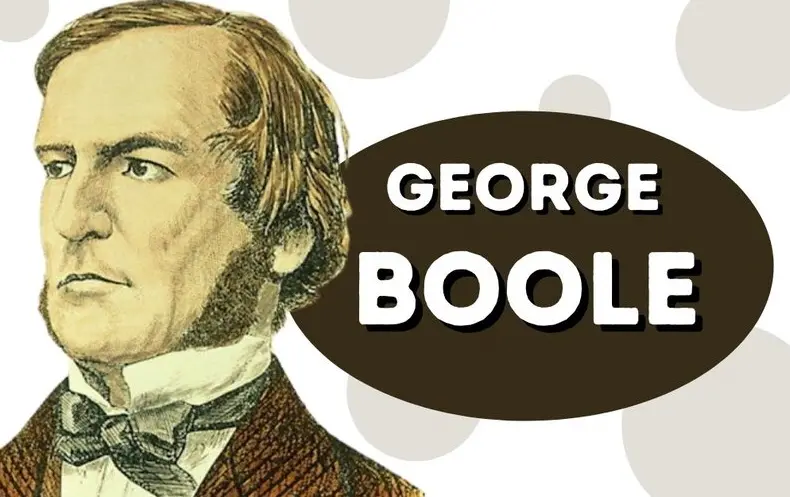
George Boole (1815–1864) was an influential English mathematician and logician, best known for developing Boolean algebra, a foundational system in modern computing and logic. Born in Lincoln, England, Boole was largely self-taught and rose to prominence through his innovative work in mathematics. He published his groundbreaking book, “The Mathematical Analysis of Logic,” in 1847, introducing a method to express logical relationships using algebraic symbols. This was further expanded in his 1854 work, “An Investigation of the Laws of Thought,” where he formalized the principles of binary operations and set theory.
Boole’s contributions revolutionized fields such as philosophy, probability, and differential equations. Despite facing financial hardships early in life, he became a professor at Queen’s College, Cork, Ireland, in 1849. His ideas laid the groundwork for digital electronics, enabling the creation of computers that operate on binary code—true or false, 1 or 0. Boole’s legacy endures as a cornerstone of computer science, influencing everything from search engines to artificial intelligence.
Table of Contents
- Part 1: OnlineExamMaker AI Quiz Maker – Make A Free Quiz in Minutes
- Part 2: 20 George Boole Quiz Questions & Answers
- Part 3: Save Time and Energy: Generate Quiz Questions with AI Technology
Part 1: OnlineExamMaker AI Quiz Maker – Make A Free Quiz in Minutes
What’s the best way to create a George Boole quiz online? OnlineExamMaker is the best AI quiz making software for you. No coding, and no design skills required. If you don’t have the time to create your online quiz from scratch, you are able to use OnlineExamMaker AI Question Generator to create question automatically, then add them into your online assessment. What is more, the platform leverages AI proctoring and AI grading features to streamline the process while ensuring exam integrity.
Key features of OnlineExamMaker:
● Create up to 10 question types, including multiple-choice, true/false, fill-in-the-blank, matching, short answer, and essay questions.
● Build and store questions in a centralized portal, tagged by categories and keywords for easy reuse and organization.
● Automatically scores multiple-choice, true/false, and even open-ended/audio responses using AI, reducing manual work.
● Create certificates with personalized company logo, certificate title, description, date, candidate’s name, marks and signature.
Automatically generate questions using AI
Part 2: 20 George Boole Quiz Questions & Answers
or
1. Question: Who is credited with developing Boolean algebra?
Options: A) Alan Turing
B) George Boole
C) Charles Babbage
D) Gottfried Leibniz
Answer: B) George Boole
Explanation: George Boole introduced Boolean algebra in his 1854 book “An Investigation of the Laws of Thought,” which laid the foundation for modern digital logic.
2. Question: In which year was George Boole born?
Options: A) 1815
B) 1791
C) 1847
D) 1813
Answer: A) 1815
Explanation: George Boole was born on November 2, 1815, in Lincoln, England, and he became a self-taught mathematician.
3. Question: What was the title of George Boole’s first major work on logic?
Options: A) “The Laws of Thought”
B) “Principia Mathematica”
C) “The Mathematical Analysis of Logic”
D) “Symbolic Logic”
Answer: C) “The Mathematical Analysis of Logic”
Explanation: Published in 1847, this work by Boole introduced the use of algebraic symbols to represent logical operations.
4. Question: Which logical operation is represented by the Boolean operator AND?
Options: A) Addition
B) Multiplication (in Boolean terms)
C) Subtraction
D) Division
Answer: B) Multiplication (in Boolean terms)
Explanation: In Boolean algebra, AND corresponds to multiplication, where the output is true only if both inputs are true.
5. Question: Where did George Boole serve as a professor?
Options: A) University of Cambridge
B) Queen’s College, Cork
C) University of Oxford
D) University of London
Answer: B) Queen’s College, Cork
Explanation: Boole was appointed as the first professor of mathematics at Queen’s College, Cork, in Ireland in 1849.
6. Question: What is the truth value of a NOT operator applied to a true statement?
Options: A) True
B) False
C) Undefined
D) Both true and false
Answer: B) False
Explanation: The NOT operator in Boolean algebra inverts the truth value, so if the input is true, the output is false.
7. Question: Which of Boole’s works is considered his most influential?
Options: A) “A Treatise on Differential Equations”
B) “An Investigation of the Laws of Thought”
C) “The Calculus of Logic”
D) “Papers on Probability”
Answer: B) “An Investigation of the Laws of Thought”
Explanation: This 1854 book formalized Boolean algebra and its applications to logic and probability.
8. Question: In Boolean algebra, what does the OR operator represent?
Options: A) Intersection
B) Union
C) Difference
D) Complement
Answer: B) Union
Explanation: The OR operator in Boolean logic corresponds to the union of sets, where the output is true if at least one input is true.
9. Question: What caused George Boole’s death?
Options: A) Pneumonia after a rain-soaked lecture
B) Heart attack
C) Accident
D) Old age
Answer: A) Pneumonia after a rain-soaked lecture
Explanation: Boole died in 1864 from pneumonia, which he contracted after delivering a lecture in wet clothes.
10. Question: How many values can a Boolean variable take?
Options: A) Infinite
B) Two (true or false)
C) Three
D) One
Answer: B) Two (true or false)
Explanation: Boolean algebra is binary, with variables typically representing only two states: true (1) or false (0).
11. Question: What field did George Boole contribute to besides logic?
Options: A) Physics
B) Differential equations
C) Chemistry
D) Astronomy
Answer: B) Differential equations
Explanation: Boole made significant contributions to the study of differential equations in mathematics.
12. Question: In a Boolean expression, what is the result of 1 AND 0?
Options: A) 1
B) 0
C) Undefined
D) 2
Answer: B) 0
Explanation: The AND operation requires both inputs to be 1 for the output to be 1; otherwise, it is 0.
13. Question: What honor was bestowed upon George Boole after his death?
Options: A) Nobel Prize
B) Royal Medal
C) Fellowship in the Royal Society
D) Knighthood
Answer: C) Fellowship in the Royal Society
Explanation: Boole was elected a Fellow of the Royal Society in 1855, recognizing his contributions to mathematics.
14. Question: Which law in Boolean algebra states that A OR (A AND B) equals A?
Options: A) Absorption law
B) Commutative law
C) Associative law
D) Distributive law
Answer: A) Absorption law
Explanation: The absorption law simplifies expressions, reflecting Boole’s logical principles.
15. Question: George Boole was primarily self-educated; what was his early profession?
Options: A) Teacher
B) Engineer
C) Doctor
D) Lawyer
Answer: A) Teacher
Explanation: Boole worked as a schoolteacher in his early years, which allowed him to pursue mathematics independently.
16. Question: In Boolean algebra, what is the identity element for OR?
Options: A) 0
B) 1
C) A variable
D) None
Answer: B) 1
Explanation: The OR operation with 1 always results in 1, making 1 the identity element.
17. Question: How did Boolean algebra influence modern technology?
Options: A) It enabled the development of computer circuits
B) It revolutionized astronomy
C) It improved mechanical engines
D) It advanced biology
Answer: A) It enabled the development of computer circuits
Explanation: Boolean algebra is the basis for digital electronics, including logic gates in computers.
18. Question: What is the Boolean expression for NOT A OR NOT B?
Options: A) A NAND B
B) A NOR B
C) A AND B
D) A OR B
Answer: B) A NOR B
Explanation: NOR is the negation of OR, so NOT (A OR B) is equivalent to NOT A OR NOT B in some forms.
19. Question: George Boole married Mary Everest; what was her relation to a famous mathematician?
Options: A) Niece of George Everest
B) Daughter of Sir George Everest
C) Sister of Ada Lovelace
D) Wife of Charles Babbage
Answer: B) Daughter of Sir George Everest
Explanation: Mary Everest Boole was the daughter of Sir George Everest, the surveyor for whom Mount Everest is named.
20. Question: Which of the following is not a basic Boolean operator?
Options: A) AND
B) OR
C) NOT
D) PLUS
Answer: D) PLUS
Explanation: The basic Boolean operators are AND, OR, and NOT; PLUS is not a standard operator in Boolean algebra.
or
Part 3: Save Time and Energy: Generate Quiz Questions with AI Technology
Automatically generate questions using AI