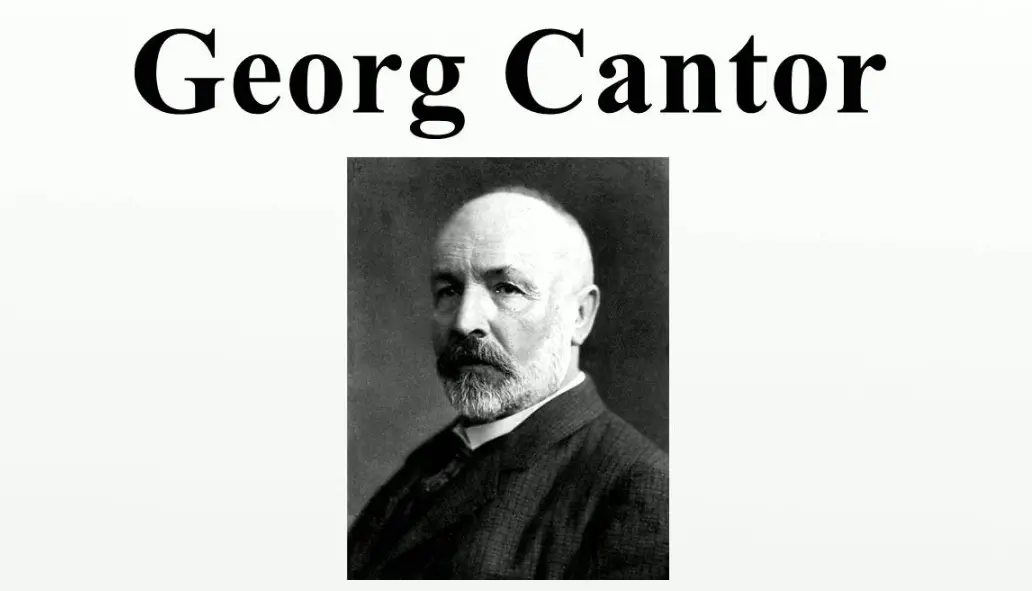
Georg Cantor (1845–1918) was a German mathematician renowned for founding set theory, a cornerstone of modern mathematics. Born in Saint Petersburg, Russia, to a Danish father and Russian mother, he moved to Germany as a child and studied at the University of Zurich and later earned his doctorate from the University of Berlin in 1867.
Cantor’s early work focused on trigonometry and analysis, but he revolutionized mathematics with his theory of infinite sets. In the 1870s and 1880s, he introduced the concept of different sizes of infinity, proving that the set of real numbers is uncountably infinite while the set of natural numbers is countably infinite. This led to his famous diagonal argument and the establishment of cardinal numbers.
He also developed ordinal numbers to describe the order types of well-ordered sets, addressing the continuum hypothesis, which questions whether there is a set whose cardinality is strictly between that of the integers and the real numbers.
Despite his groundbreaking contributions, Cantor faced significant personal and professional challenges, including criticism from contemporaries like Leopold Kronecker, battles with depression, and institutionalization in his later years. His work laid the foundation for topology, measure theory, and the axiomatic development of set theory by later mathematicians like David Hilbert and Ernst Zermelo.
Cantor’s ideas initially met resistance but are now fundamental to mathematics, influencing fields from logic to computer science. He died in 1918 in Halle, Germany, leaving a profound legacy in the understanding of infinity.
Table of Contents
- Part 1: Create A Georg Cantor Quiz in Minutes Using AI with OnlineExamMaker
- Part 2: 20 Georg Cantor Quiz Questions & Answers
- Part 3: Save Time and Energy: Generate Quiz Questions with AI Technology
Part 1: Create A Georg Cantor Quiz in Minutes Using AI with OnlineExamMaker
Are you looking for an online assessment to test the Georg Cantor skills of your learners? OnlineExamMaker uses artificial intelligence to help quiz organizers to create, manage, and analyze exams or tests automatically. Apart from AI features, OnlineExamMaker advanced security features such as full-screen lockdown browser, online webcam proctoring, and face ID recognition.
Recommended features for you:
● Includes a safe exam browser (lockdown mode), webcam and screen recording, live monitoring, and chat oversight to prevent cheating.
● Enhances assessments with interactive experience by embedding video, audio, image into quizzes and multimedia feedback.
● Once the exam ends, the exam scores, question reports, ranking and other analytics data can be exported to your device in Excel file format.
● Offers question analysis to evaluate question performance and reliability, helping instructors optimize their training plan.
Automatically generate questions using AI
Part 2: 20 Georg Cantor Quiz Questions & Answers
or
1. Who is Georg Cantor?
A. A physicist who developed quantum theory
B. A mathematician who founded set theory
C. A biologist who discovered evolution
D. A chemist who invented the periodic table
Answer: B
Explanation: Georg Cantor is renowned for founding set theory and making significant contributions to the understanding of infinite sets.
2. What was Cantor’s most famous contribution to mathematics?
A. The Pythagorean theorem
B. The concept of transfinite numbers
C. The laws of motion
D. The formula for pi
Answer: B
Explanation: Cantor introduced transfinite numbers to describe different levels of infinity, revolutionizing the field of mathematics.
3. In which year was Georg Cantor born?
A. 1845
B. 1776
C. 1905
D. 1820
Answer: A
Explanation: Georg Ferdinand Ludwig Philipp Cantor was born on March 3, 1845, in Saint Petersburg, Russia.
4. What is Cantor’s diagonal argument primarily used to prove?
A. That all sets are countable
B. That the real numbers are uncountable
C. That prime numbers are infinite
D. That geometry is Euclidean
Answer: B
Explanation: Cantor’s diagonal argument demonstrates that the set of real numbers is uncountable, showing a larger infinity than the set of natural numbers.
5. Which mathematician was a contemporary and collaborator of Cantor?
A. Isaac Newton
B. Richard Dedekind
C. Albert Einstein
D. Carl Friedrich Gauss
Answer: B
Explanation: Richard Dedekind collaborated with Cantor on set theory and the concept of real numbers.
6. What did Cantor call the smallest transfinite cardinal number?
A. Aleph-zero
B. Omega
C. Infinity symbol
D. Pi
Answer: A
Explanation: Cantor denoted the smallest transfinite cardinal as aleph-zero (ℵ₀), representing the cardinality of the set of natural numbers.
7. What was the main opposition Cantor faced in his work?
A. From philosophers
B. From Kronecker, who rejected his ideas
C. From astronomers
D. From artists
Answer: B
Explanation: Leopold Kronecker opposed Cantor’s work on set theory, calling it “pathological” and leading to significant professional conflicts.
8. Which concept did Cantor develop to compare the sizes of infinite sets?
A. Cardinality
B. Algebra
C. Probability
D. Calculus
Answer: A
Explanation: Cardinality is a concept Cantor developed to measure the size of sets, including infinite ones, by comparing their elements.
9. What illness did Cantor suffer from later in life?
A. Depression
B. Tuberculosis
C. Cancer
D. Alzheimer’s disease
Answer: A
Explanation: Cantor experienced severe depression and was institutionalized multiple times, which affected his later years.
10. Which of the following is an example of a countable set according to Cantor?
A. The set of real numbers
B. The set of rational numbers
C. The set of complex numbers
D. The set of irrational numbers
Answer: B
Explanation: The set of rational numbers is countable, meaning it can be put into a one-to-one correspondence with the natural numbers, as per Cantor’s work.
11. What is the continuum hypothesis related to in Cantor’s theory?
A. The size of the universe
B. The cardinality between aleph-zero and the continuum
C. The speed of light
D. The number of planets
Answer: B
Explanation: The continuum hypothesis, proposed by Cantor, concerns whether there is a set with cardinality strictly between that of the integers and the real numbers.
12. In what country did Cantor spend most of his academic career?
A. Russia
B. Germany
C. France
D. England
Answer: B
Explanation: Cantor worked primarily in Germany, holding a position at the University of Halle.
13. What did Cantor prove about the power set of a set?
A. It has the same cardinality as the original set
B. It always has a greater cardinality
C. It is finite
D. It is empty
Answer: B
Explanation: Cantor proved that the power set of any set has a strictly greater cardinality than the original set, leading to his hierarchy of infinities.
14. Which paradox is associated with Cantor’s work on sets?
A. Russell’s paradox
B. Zeno’s paradox
C. The twin paradox
D. The Monty Hall paradox
Answer: A
Explanation: Russell’s paradox, which involves sets that contain themselves, arose from Cantor’s set theory and highlighted issues in naive set theory.
15. What was Cantor’s educational background?
A. He studied law
B. He studied mathematics at universities in Zurich and Berlin
C. He was self-taught
D. He studied medicine
Answer: B
Explanation: Cantor studied mathematics at the Swiss Polytechnic in Zurich and the University of Berlin.
16. How did Cantor’s work influence modern mathematics?
A. It led to the development of topology
B. It provided the foundation for real analysis and computer science
C. It revolutionized physics
D. It created new forms of art
Answer: B
Explanation: Cantor’s set theory underpins real analysis, measure theory, and computer science, particularly in algorithms involving infinite processes.
17. What is a bijection in the context of Cantor’s work?
A. A one-to-one correspondence between sets
B. A mathematical equation
C. A type of graph
D. A physical measurement
Answer: A
Explanation: A bijection is a function that establishes a one-to-one correspondence, which Cantor used to compare the sizes of sets.
18. When did Cantor die?
A. 1918
B. 1933
C. 1945
D. 1920
Answer: A
Explanation: Georg Cantor died on January 6, 1918, in Halle, Germany.
19. Which of Cantor’s ideas was initially controversial?
A. The existence of multiple infinities
B. Basic arithmetic
C. Euclidean geometry
D. Trigonometry
Answer: A
Explanation: Cantor’s proposal of different sizes of infinity was highly controversial and met with resistance from the mathematical community.
20. What award did Cantor receive for his contributions?
A. The Nobel Prize
B. The Sylvester Medal
C. The Fields Medal
D. No major award during his lifetime
Answer: D
Explanation: Despite his groundbreaking work, Cantor did not receive a major award during his lifetime, though his contributions were later widely recognized.
or
Part 3: Save Time and Energy: Generate Quiz Questions with AI Technology
Automatically generate questions using AI