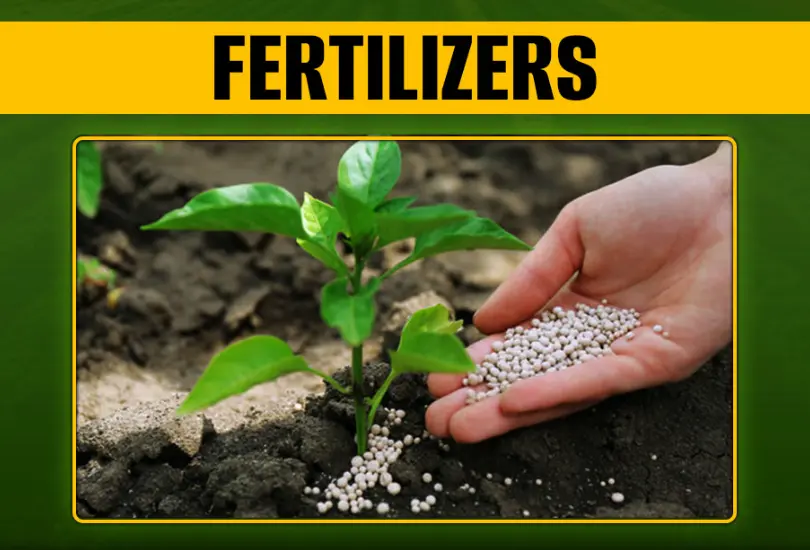
Fertilizers are essential substances used to enhance soil fertility and promote plant growth by supplying essential nutrients. They play a crucial role in modern agriculture, horticulture, and landscaping, helping to address nutrient deficiencies in soil and boost crop yields.
Types of Fertilizers
1. Organic Fertilizers: Derived from natural sources such as animal manure, compost, bone meal, and plant residues. These release nutrients slowly, improve soil structure, and enhance microbial activity, making them environmentally friendly and sustainable.
2. Inorganic (Synthetic) Fertilizers: Manufactured chemically, including ammonium nitrate, urea, and superphosphate. They provide nutrients quickly and are highly concentrated, allowing for precise application, but may lead to soil degradation if overused.
3. Biofertilizers: Composed of living microorganisms like bacteria, fungi, or algae that fix atmospheric nitrogen or solubilize phosphorus in the soil. Examples include rhizobium for legumes and mycorrhizal fungi for root enhancement.
Key Nutrients
Fertilizers typically supply three primary macronutrients:
– Nitrogen (N): Promotes leaf and stem growth; found in fertilizers like urea and ammonium sulfate.
– Phosphorus (P): Supports root development, flowering, and fruiting; common in forms like rock phosphate.
– Potassium (K): Aids in disease resistance, water regulation, and overall plant vigor; often delivered via potash.
Secondary nutrients such as calcium, magnesium, and sulfur, as well as micronutrients like iron, zinc, and manganese, may also be included.
Uses and Applications
– Agriculture: Applied to large-scale farms to increase productivity of crops like wheat, rice, and corn.
– Gardening and Horticulture: Used for lawns, flowers, and vegetables to ensure healthy growth in home or commercial settings.
– Specialized Applications: In hydroponics, forestry, and turf management, fertilizers are tailored to specific needs.
Benefits
– Increased Yields: By replenishing soil nutrients, fertilizers can significantly enhance crop production and quality.
– Soil Improvement: Organic types improve texture, water retention, and biological activity.
– Efficiency: Modern formulations allow for targeted nutrient delivery, reducing waste and optimizing resources.
Environmental Considerations
While fertilizers boost productivity, overuse can lead to issues such as soil acidification, nutrient runoff causing water pollution (e.g., eutrophication), and greenhouse gas emissions. Sustainable practices, like integrated nutrient management and precision farming, are recommended to minimize these risks.
In summary, fertilizers are vital for global food security, but their use must be balanced with environmental stewardship for long-term benefits.
Table of Contents
- Part 1: OnlineExamMaker AI Quiz Maker – Make A Free Quiz in Minutes
- Part 2: 20 Fertilizers Quiz Questions & Answers
- Part 3: OnlineExamMaker AI Question Generator: Generate Questions for Any Topic
Part 1: OnlineExamMaker AI Quiz Maker – Make A Free Quiz in Minutes
What’s the best way to create a Fertilizers quiz online? OnlineExamMaker is the best AI quiz making software for you. No coding, and no design skills required. If you don’t have the time to create your online quiz from scratch, you are able to use OnlineExamMaker AI Question Generator to create question automatically, then add them into your online assessment. What is more, the platform leverages AI proctoring and AI grading features to streamline the process while ensuring exam integrity.
Key features of OnlineExamMaker:
● Create up to 10 question types, including multiple-choice, true/false, fill-in-the-blank, matching, short answer, and essay questions.
● Build and store questions in a centralized portal, tagged by categories and keywords for easy reuse and organization.
● Automatically scores multiple-choice, true/false, and even open-ended/audio responses using AI, reducing manual work.
● Create certificates with personalized company logo, certificate title, description, date, candidate’s name, marks and signature.
Automatically generate questions using AI
Part 2: 20 Fertilizers Quiz Questions & Answers
or
1. Question: What is the primary function of nitrogen in fertilizers?
A) Promotes root development
B) Enhances flowering and fruiting
C) Stimulates leafy growth
D) Improves disease resistance
Answer: C) Stimulates leafy growth
Explanation: Nitrogen is a key component for chlorophyll production, which is essential for photosynthesis and promotes vigorous vegetative growth in plants.
2. Question: Which type of fertilizer is derived from plant or animal sources?
A) Synthetic fertilizer
B) Inorganic fertilizer
C) Organic fertilizer
D) Chemical fertilizer
Answer: C) Organic fertilizer
Explanation: Organic fertilizers come from natural sources like compost or manure, providing nutrients slowly and improving soil structure.
3. Question: What does the ‘P’ stand for in NPK fertilizer ratings?
A) Potassium
B) Phosphorus
C) Protein
D) pH level
Answer: B) Phosphorus
Explanation: In NPK, ‘P’ represents phosphorus, which is crucial for energy transfer and root development in plants.
4. Question: Which fertilizer is commonly used to correct potassium deficiencies in soil?
A) Ammonium nitrate
B) Superphosphate
C) Potash
D) Urea
Answer: C) Potash
Explanation: Potash is a rich source of potassium, helping plants with water regulation, enzyme activation, and disease resistance.
5. Question: What is the main environmental concern associated with excessive fertilizer use?
A) Soil erosion
B) Eutrophication
C) Desertification
D) Acid rain
Answer: B) Eutrophication
Explanation: Excess fertilizers can lead to nutrient runoff into water bodies, causing algal blooms that deplete oxygen and harm aquatic life.
6. Question: Which fertilizer releases nutrients slowly over time?
A) Liquid fertilizer
B) Controlled-release fertilizer
C) Granular fertilizer
D) Foliar fertilizer
Answer: B) Controlled-release fertilizer
Explanation: Controlled-release fertilizers use coatings to gradually release nutrients, reducing the risk of overuse and providing steady plant nutrition.
7. Question: What is the chemical formula for urea, a common nitrogen fertilizer?
A) NH3
B) CO(NH2)2
C) KCl
D) CaCO3
Answer: B) CO(NH2)2
Explanation: Urea is a synthetic organic compound with the formula CO(NH2)2, providing a high concentration of nitrogen for plant uptake.
8. Question: Which nutrient in fertilizers helps in the development of strong roots and flowers?
A) Nitrogen
B) Phosphorus
C) Potassium
D) Sulfur
Answer: B) Phosphorus
Explanation: Phosphorus aids in root growth, flower formation, and energy storage in plants through compounds like ATP.
9. Question: What method involves applying fertilizer directly to plant leaves?
A) Soil incorporation
B) Foliar spraying
C) Band placement
D) Broadcasting
Answer: B) Foliar spraying
Explanation: Foliar spraying allows nutrients to be absorbed quickly through the leaves, bypassing soil issues for immediate plant needs.
10. Question: Which fertilizer is made from rock phosphate?
A) Ammonium sulfate
B) Superphosphate
C) Potassium nitrate
D) Urea
Answer: B) Superphosphate
Explanation: Superphosphate is produced by treating rock phosphate with sulfuric acid, making phosphorus more available to plants.
11. Question: How do fertilizers primarily benefit soil?
A) By increasing acidity
B) By replenishing essential nutrients
C) By compacting the soil
D) By reducing water retention
Answer: B) By replenishing essential nutrients
Explanation: Fertilizers add vital elements like nitrogen, phosphorus, and potassium, which are depleted by plant growth and environmental factors.
12. Question: What is the ideal pH range for most fertilizers to be effective in soil?
A) 3.0 to 5.0
B) 5.5 to 7.0
C) 7.5 to 9.0
D) 9.5 to 11.0
Answer: B) 5.5 to 7.0
Explanation: Most fertilizers work best in slightly acidic to neutral soils, as extreme pH levels can lock up nutrients and reduce availability.
13. Question: Which element in fertilizers helps in improving fruit quality and disease resistance?
A) Nitrogen
B) Potassium
C) Calcium
D) Magnesium
Answer: B) Potassium
Explanation: Potassium enhances the plant’s ability to withstand diseases, improves fruit size and quality, and regulates water movement.
14. Question: What type of fertilizer is ammonium nitrate?
A) Organic
B) Inorganic
C) Bio-based
D) Natural
Answer: B) Inorganic
Explanation: Ammonium nitrate is a synthetic, inorganic fertilizer that provides readily available nitrogen but can pose environmental risks if misused.
15. Question: Why is balanced fertilization important?
A) To promote only one nutrient
B) To prevent nutrient imbalances and toxicities
C) To increase soil temperature
D) To reduce plant growth
Answer: B) To prevent nutrient imbalances and toxicities
Explanation: Balanced fertilization ensures all essential nutrients are provided in the right proportions, avoiding deficiencies or excesses that harm plants.
16. Question: Which fertilizer is often used in hydroponic systems?
A) Compost
B) Liquid nutrient solutions
C) Manure
D) Granules
Answer: B) Liquid nutrient solutions
Explanation: Liquid fertilizers dissolve easily in water, making them ideal for hydroponics where plants grow without soil.
17. Question: What happens if too much phosphorus is applied as fertilizer?
A) It enhances nitrogen uptake
B) It can lead to zinc deficiency in plants
C) It improves soil aeration
D) It reduces pest attacks
Answer: B) It can lead to zinc deficiency in plants
Explanation: Excess phosphorus can bind with other micronutrients like zinc, making them unavailable and causing deficiencies in plants.
18. Question: Which fertilizer contains sulfur as a key component?
A) Potassium chloride
B) Ammonium sulfate
C) Calcium nitrate
D) Urea
Answer: B) Ammonium sulfate
Explanation: Ammonium sulfate provides both nitrogen and sulfur, which is essential for protein synthesis and enzyme function in plants.
19. Question: How does over-fertilization affect the environment?
A) It increases biodiversity
B) It causes groundwater contamination
C) It stabilizes ecosystems
D) It promotes soil formation
Answer: B) It causes groundwater contamination
Explanation: Over-fertilization leads to nutrient leaching into groundwater, polluting water sources and affecting human and animal health.
20. Question: What is the role of micronutrients in fertilizers?
A) They provide bulk to the soil
B) They support specific plant functions like enzyme activity
C) They replace water in plants
D) They increase plant height rapidly
Answer: B) They support specific plant functions like enzyme activity
Explanation: Micronutrients such as iron, zinc, and boron are needed in small amounts for processes like photosynthesis and disease resistance.
or
Part 3: OnlineExamMaker AI Question Generator: Generate Questions for Any Topic
Automatically generate questions using AI