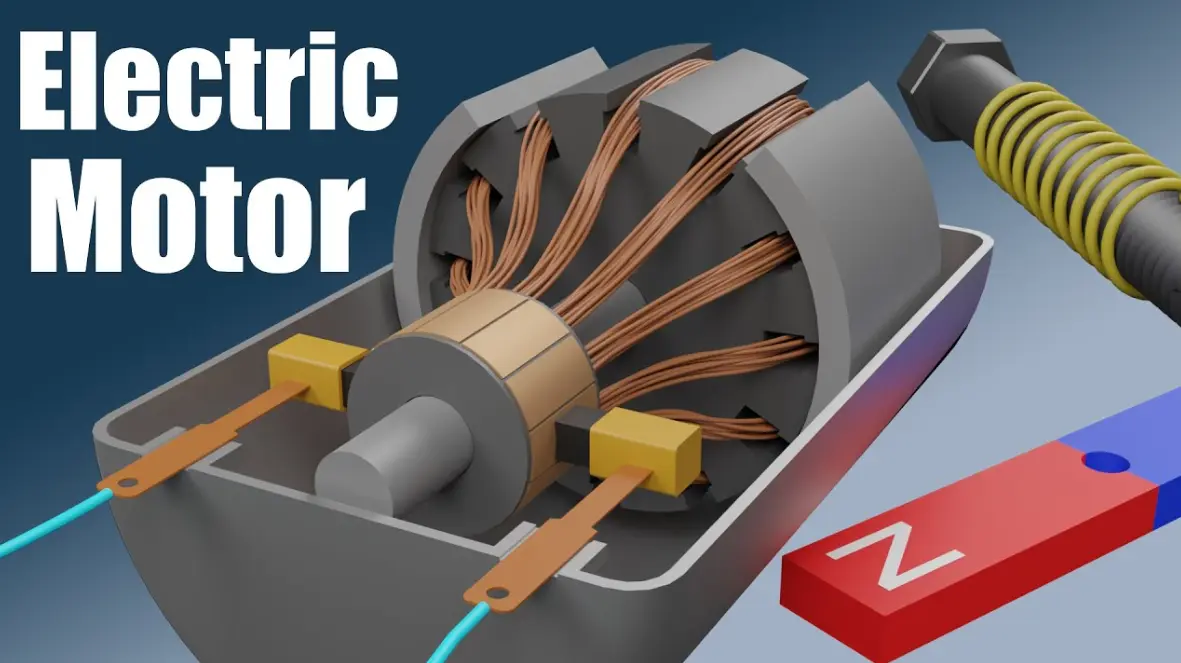
Electric motors are devices that convert electrical energy into mechanical energy, powering a wide range of machinery and equipment. They operate on the principle of electromagnetism, where an electric current generates a magnetic field that interacts with a permanent magnet or another electromagnet to produce motion.
Key components of an electric motor include the stator (stationary part), rotor (rotating part), and windings that carry the electric current. The basic operation involves the Lorentz force, which causes the rotor to spin when current flows through the windings in a magnetic field.
There are several types of electric motors:
– DC Motors: Powered by direct current, they offer precise speed control and are commonly used in applications like electric vehicles, robotics, and appliances. Subtypes include brushed and brushless DC motors.
– AC Motors: Operated with alternating current, they are efficient and durable. Induction motors (asynchronous) and synchronous motors are the main categories, with induction motors widely used in fans, pumps, and industrial machinery.
– Specialized Motors: Such as stepper motors for precise positioning in printers and CNC machines, and servo motors for high-accuracy control in robotics and automation.
Electric motors provide numerous advantages, including high efficiency, low maintenance, and environmental benefits compared to internal combustion engines. They are essential in industries like automotive (e.g., electric cars), manufacturing, HVAC systems, and consumer electronics.
Globally, the demand for electric motors is driven by the shift toward renewable energy and electrification, with ongoing advancements in materials and designs improving performance and energy efficiency.
Table of Contents
- Part 1: OnlineExamMaker – Generate and Share Electric Motors Quiz with AI Automatically
- Part 2: 20 Electric Motors Quiz Questions & Answers
- Part 3: OnlineExamMaker AI Question Generator: Generate Questions for Any Topic
Part 1: OnlineExamMaker – Generate and Share Electric Motors Quiz with AI Automatically
The quickest way to assess the Electric Motors knowledge of candidates is using an AI assessment platform like OnlineExamMaker. With OnlineExamMaker AI Question Generator, you are able to input content—like text, documents, or topics—and then automatically generate questions in various formats (multiple-choice, true/false, short answer). Its AI Exam Grader can automatically grade the exam and generate insightful reports after your candidate submit the assessment.
What you will like:
● Create a question pool through the question bank and specify how many questions you want to be randomly selected among these questions.
● Allow the quiz taker to answer by uploading video or a Word document, adding an image, and recording an audio file.
● Display the feedback for correct or incorrect answers instantly after a question is answered.
● Create a lead generation form to collect an exam taker’s information, such as email, mobile phone, work title, company profile and so on.
Automatically generate questions using AI
Part 2: 20 Electric Motors Quiz Questions & Answers
or
1. Question: What is the primary principle behind the operation of an electric motor?
Options:
A. Electromagnetic induction
B. Electrostatic attraction
C. Thermal expansion
D. Chemical reaction
Answer: A
Explanation: Electromagnetic induction converts electrical energy into mechanical energy through the interaction of magnetic fields and electric currents, which is the fundamental principle of electric motor operation.
2. Question: Which type of electric motor uses a commutator to reverse the current direction?
Options:
A. Induction motor
B. Synchronous motor
C. DC motor
D. Stepper motor
Answer: C
Explanation: A DC motor uses a commutator to periodically reverse the direction of current in the armature windings, ensuring continuous rotation by maintaining the torque direction.
3. Question: In a three-phase induction motor, what creates the rotating magnetic field?
Options:
A. Stator windings
B. Rotor bars
C. Commutator
D. Brushes
Answer: A
Explanation: The stator windings in a three-phase induction motor are supplied with three-phase AC current, producing a rotating magnetic field that induces currents in the rotor.
4. Question: What is the function of the armature in a DC motor?
Options:
A. To produce the magnetic field
B. To convert electrical energy to mechanical energy
C. To supply power to the field coils
D. To regulate speed
Answer: B
Explanation: The armature in a DC motor carries the current and interacts with the magnetic field to produce torque, thereby converting electrical energy into mechanical rotation.
5. Question: Which motor type is commonly used in household appliances like fans and refrigerators?
Options:
A. Series DC motor
B. Shunt DC motor
C. Induction motor
D. Universal motor
Answer: C
Explanation: Induction motors are widely used in household appliances due to their simplicity, low cost, and ability to run directly on AC power without brushes.
6. Question: What happens to the speed of a DC shunt motor if the load increases?
Options:
A. Speed increases significantly
B. Speed remains almost constant
C. Speed decreases sharply
D. Speed becomes zero
Answer: B
Explanation: In a DC shunt motor, the speed remains nearly constant with changes in load because the flux is relatively constant, and the back EMF balances the applied voltage.
7. Question: In an AC synchronous motor, what determines the rotor speed?
Options:
A. Frequency of the supply voltage
B. Load on the motor
C. Rotor resistance
D. Stator current
Answer: A
Explanation: The rotor speed of a synchronous motor is directly proportional to the frequency of the AC supply, as it must match the speed of the rotating magnetic field.
8. Question: Which component in an electric motor helps in reducing friction and wear between moving parts?
Options:
A. Bearings
B. Windings
C. Commutator
D. Shaft
Answer: A
Explanation: Bearings support the rotor shaft and reduce friction, allowing smooth rotation and minimizing wear on the motor’s moving parts.
9. Question: What is the main advantage of a brushless DC motor over a brushed DC motor?
Options:
A. Higher maintenance requirements
B. Lower efficiency
C. No need for brushes, leading to less wear
D. Simpler construction
Answer: C
Explanation: Brushless DC motors eliminate the need for brushes and commutators, reducing wear, increasing reliability, and improving overall efficiency.
10. Question: In a series DC motor, the torque is proportional to which of the following?
Options:
A. Speed squared
B. Armature current squared
C. Voltage only
D. Frequency
Answer: B
Explanation: In a series DC motor, torque is proportional to the square of the armature current, making it suitable for applications requiring high starting torque.
11. Question: What type of motor is used in electric vehicles for precise speed control?
Options:
A. Induction motor
B. Permanent magnet synchronous motor
C. Shunt motor
D. Universal motor
Answer: B
Explanation: Permanent magnet synchronous motors offer high efficiency and precise speed control, making them ideal for electric vehicles.
12. Question: How does slip affect the operation of an induction motor?
Options:
A. It increases the motor’s efficiency
B. It is the difference between synchronous speed and actual rotor speed
C. It stops the motor from rotating
D. It is zero at full load
Answer: B
Explanation: Slip in an induction motor is the difference between the synchronous speed of the magnetic field and the actual rotor speed, which induces rotor currents and produces torque.
13. Question: Which law explains the direction of induced EMF in an electric motor?
Options:
A. Ohm’s Law
B. Faraday’s Law
C. Lenz’s Law
D. Kirchhoff’s Law
Answer: C
Explanation: Lenz’s Law determines the direction of induced EMF, ensuring it opposes the change in magnetic flux, which is crucial for motor operation.
14. Question: What is the purpose of the field windings in a DC motor?
Options:
A. To generate the magnetic field
B. To rotate the armature
C. To supply power to the commutator
D. To control the speed
Answer: A
Explanation: Field windings produce the stationary magnetic field that interacts with the armature current to create torque in a DC motor.
15. Question: In a universal motor, what allows it to operate on both AC and DC?
Options:
A. Commutator and brushes
B. Permanent magnets
C. Induction coils
D. Synchronous rotor
Answer: A
Explanation: The commutator and brushes in a universal motor allow it to reverse current direction, enabling operation on both AC and DC supplies.
16. Question: What is the typical speed range for a standard AC induction motor?
Options:
A. 0 to 100 RPM
B. 500 to 3600 RPM
C. 10,000 to 20,000 RPM
D. Variable up to 50,000 RPM
Answer: B
Explanation: AC induction motors commonly operate between 500 and 3600 RPM, depending on the number of poles and supply frequency.
17. Question: Which factor primarily affects the efficiency of an electric motor?
Options:
A. Size of the motor
B. Losses due to friction, copper, and iron
C. Color of the casing
D. Ambient temperature
Answer: B
Explanation: Efficiency is reduced by losses such as friction in bearings, copper losses in windings, and iron losses in the core, which convert energy to heat.
18. Question: In a stepper motor, how is motion achieved?
Options:
A. Continuous rotation
B. Step-wise angular displacement
C. High-speed spinning
D. Reverse direction only
Answer: B
Explanation: A stepper motor moves in discrete steps by energizing coils in sequence, allowing precise control of position and speed.
19. Question: What is the role of the capacitor in a single-phase induction motor?
Options:
A. To start the motor
B. To stop the motor
C. To increase voltage
D. To reduce speed
Answer: A
Explanation: The capacitor creates a phase shift in the current, producing a rotating magnetic field to start the single-phase induction motor.
20. Question: Which electric motor is self-starting?
Options:
A. DC series motor
B. Synchronous motor
C. Three-phase induction motor
D. Shunt motor
Answer: C
Explanation: A three-phase induction motor is self-starting because the three-phase supply naturally produces a rotating magnetic field without additional mechanisms.
or
Part 3: OnlineExamMaker AI Question Generator: Generate Questions for Any Topic
Automatically generate questions using AI