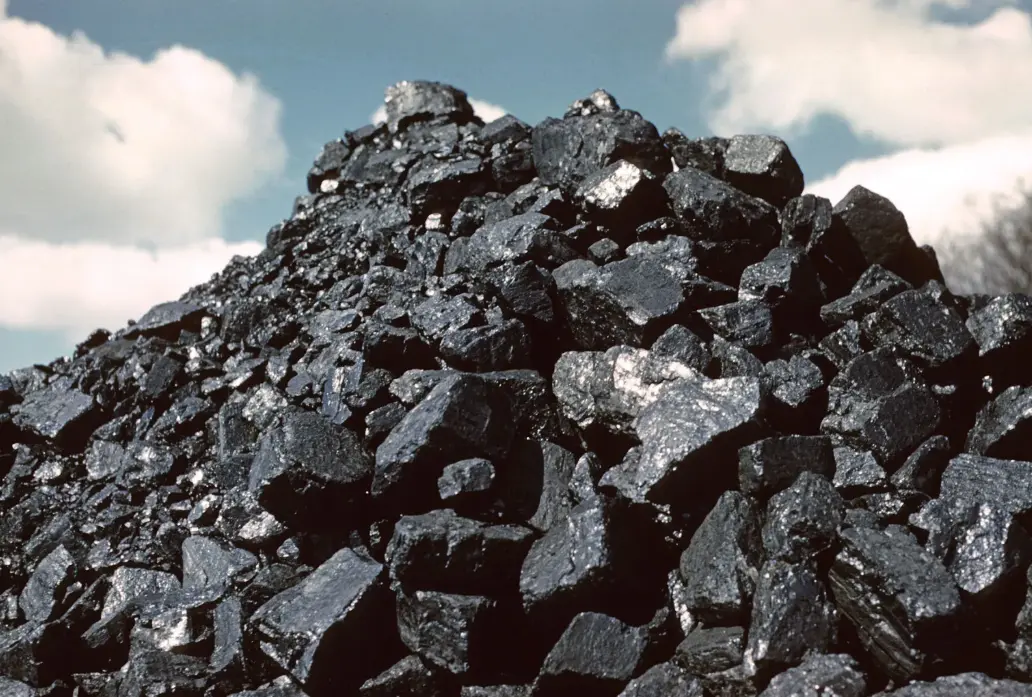
Coal, a fossil fuel formed from the remains of ancient plants buried and subjected to heat and pressure over millions of years, is one of the world’s most abundant energy sources. It is primarily composed of carbon, along with varying amounts of hydrogen, sulfur, oxygen, and nitrogen.
There are four main types of coal, classified by carbon content and energy value: anthracite (highest quality, with over 86% carbon), bituminous (70-86% carbon, widely used for electricity), sub-bituminous (70-76% carbon), and lignite (lowest quality, 25-35% carbon).
Globally, coal is a major energy resource, accounting for about 36% of electricity generation as of 2023. It is burned in power plants to produce steam for turbines and is also essential in industries like steel production, where it serves as a key ingredient in coke manufacturing.
However, coal combustion releases significant greenhouse gases, including carbon dioxide (CO2), contributing to climate change. It also emits pollutants such as sulfur dioxide, nitrogen oxides, and particulate matter, leading to air pollution and health issues. Efforts to mitigate these impacts include cleaner technologies like carbon capture and storage (CCS) and a global shift toward renewable alternatives.
Despite its environmental drawbacks, coal remains crucial in many developing economies due to its affordability and reliability, though its use is declining in favor of cleaner energy sources worldwide.
Table of Contents
- Part 1: Create An Amazing Coal Quiz Using AI Instantly in OnlineExamMaker
- Part 2: 20 Coal Quiz Questions & Answers
- Part 3: Automatically Generate Quiz Questions Using AI Question Generator
Part 1: Create An Amazing Coal Quiz Using AI Instantly in OnlineExamMaker
The quickest way to assess the Coal knowledge of candidates is using an AI assessment platform like OnlineExamMaker. With OnlineExamMaker AI Question Generator, you are able to input content—like text, documents, or topics—and then automatically generate questions in various formats (multiple-choice, true/false, short answer). Its AI Exam Grader can automatically grade the exam and generate insightful reports after your candidate submit the assessment.
Overview of its key assessment-related features:
● Create up to 10 question types, including multiple-choice, true/false, fill-in-the-blank, matching, short answer, and essay questions.
● Automatically generates detailed reports—individual scores, question report, and group performance.
● Instantly scores objective questions and subjective answers use rubric-based scoring for consistency.
● API and SSO help trainers integrate OnlineExamMaker with Google Classroom, Microsoft Teams, CRM and more.
Automatically generate questions using AI
Part 2: 20 Coal Quiz Questions & Answers
or
1. Question: What is coal primarily composed of?
Options:
A) Carbon and hydrocarbons
B) Silicon and oxygen
C) Hydrogen and nitrogen
D) Water and minerals
Answer: A
Explanation: Coal is primarily made up of carbon and hydrocarbons formed from ancient plant remains, which makes it a key fossil fuel for energy production.
2. Question: How is coal formed?
Options:
A) From volcanic activity
B) By compression of plant material over millions of years
C) Through chemical reactions in oceans
D) By erosion of rocks
Answer: B
Explanation: Coal forms from the decomposition and compression of plant material in swampy environments over geological time, typically under heat and pressure.
3. Question: What are the four main types of coal?
Options:
A) Anthracite, bituminous, sub-bituminous, and lignite
B) Graphite, diamond, charcoal, and peat
C) Oil, gas, shale, and tar
D) Limestone, sandstone, shale, and granite
Answer: A
Explanation: The main types of coal, ranked by carbon content and energy value, are anthracite, bituminous, sub-bituminous, and lignite.
4. Question: Which type of coal has the highest carbon content?
Options:
A) Lignite
B) Bituminous
C) Sub-bituminous
D) Anthracite
Answer: D
Explanation: Anthracite has the highest carbon content (about 86-97%), making it the hardest and most energy-dense type of coal.
5. Question: What is the primary use of coal in modern industry?
Options:
A) Manufacturing plastics
B) Generating electricity
C) Producing fertilizers
D) Building roads
Answer: B
Explanation: Coal is mainly used as a fuel for power plants to generate electricity, accounting for a significant portion of global energy production.
6. Question: What environmental issue is most associated with coal burning?
Options:
A) Ocean acidification
B) Air pollution and greenhouse gas emissions
C) Deforestation
D) Soil erosion
Answer: B
Explanation: Burning coal releases carbon dioxide and other pollutants, contributing to air pollution and climate change through greenhouse gas emissions.
7. Question: What is strip mining?
Options:
A) Mining deep underground tunnels
B) Removing surface layers to access coal seams
C) Drilling for oil near coal deposits
D) Extracting coal from riverbeds
Answer: B
Explanation: Strip mining involves removing overburden (soil and rock) from the surface to expose and extract coal, which is often more efficient but environmentally disruptive.
8. Question: Which country is the largest producer of coal?
Options:
A) United States
B) Australia
C) China
D) India
Answer: C
Explanation: China is the world’s largest coal producer, extracting vast amounts to fuel its energy needs, though this has environmental consequences.
9. Question: What is coal gasification?
Options:
A) Converting coal into synthetic gas
B) Burning coal in open pits
C) Mixing coal with water for transport
D) Storing coal underground
Answer: A
Explanation: Coal gasification is a process that converts coal into a synthetic gas (syngas) for use as fuel or in chemical production, offering a cleaner alternative to direct combustion.
10. Question: How does coal contribute to global warming?
Options:
A) By absorbing sunlight
B) Releasing carbon dioxide when burned
C) Causing ocean currents to change
D) Increasing biodiversity
Answer: B
Explanation: Coal combustion releases large amounts of CO2, a greenhouse gas that traps heat in the atmosphere, exacerbating global warming.
11. Question: What is anthracite?
Options:
A) The softest form of coal
B) A hard, high-carbon coal
C) A type of liquid fuel derived from coal
D) Coal mixed with minerals
Answer: B
Explanation: Anthracite is a hard, glossy coal with high carbon content and low impurities, making it ideal for heating and industrial uses.
12. Question: What is bituminous coal?
Options:
A) The lowest rank of coal
B) A medium-rank coal used for steel production
C) A gas formed from coal
D) Coal found only in oceans
Answer: B
Explanation: Bituminous coal is a medium-rank coal with high energy content, commonly used in electricity generation and as a coking coal for steelmaking.
13. Question: What is lignite?
Options:
A) The hardest coal
B) A soft, brown coal with low carbon content
C) A synthetic form of coal
D) Coal used for jewelry
Answer: B
Explanation: Lignite, also known as brown coal, has the lowest carbon content and is often used for power generation in regions where it is abundant.
14. Question: What are common byproducts of coal combustion?
Options:
A) Ash and sulfur dioxide
B) Pure water and oxygen
C) Metals and diamonds
D) Natural gas and oil
Answer: A
Explanation: Coal combustion produces ash and releases sulfur dioxide, which can cause air pollution and acid rain if not properly managed.
15. Question: How is coal primarily transported?
Options:
A) By pipelines
B) Via trains, trucks, and ships
C) Through underground tunnels
D) By air freight
Answer: B
Explanation: Coal is mainly transported by trains, trucks, and ships due to its bulk nature, making logistics a key part of the supply chain.
16. Question: What is the main difference between coal and petroleum?
Options:
A) Coal is a solid fossil fuel, while petroleum is a liquid
B) Coal is renewable, but petroleum is not
C) Petroleum is used for electricity, coal for vehicles
D) There is no difference
Answer: A
Explanation: Coal is a solid fuel derived from plant matter, whereas petroleum is a liquid hydrocarbon formed from ancient marine organisms.
17. Question: What safety measure is crucial in coal mines?
Options:
A) Using explosive materials freely
B) Installing ventilation systems to prevent gas buildup
C) Leaving mines unmonitored
D) Mining without protective gear
Answer: B
Explanation: Ventilation systems are essential in coal mines to remove methane gas and prevent explosions, ensuring worker safety.
18. Question: What is the energy content of coal compared to natural gas?
Options:
A) Coal has higher energy content per unit
B) Natural gas has much higher energy content
C) They are equal
D) Coal has no energy content
Answer: B
Explanation: Natural gas generally has a higher energy content per unit volume than coal, making it more efficient in some applications, though coal is still widely used.
19. Question: How has coal usage changed in recent decades?
Options:
A) It has increased globally due to demand
B) It has declined in many countries due to renewable energy shifts
C) It remains unchanged
D) It is only used in developing nations
Answer: B
Explanation: Coal usage has declined in many regions due to environmental concerns and the rise of renewable energy sources, though it persists in some economies.
20. Question: What are common alternatives to coal for energy production?
Options:
A) Solar, wind, and nuclear power
B) More coal mining
C) Oil and gas only
D) Deforestation for biomass
Answer: A
Explanation: Alternatives like solar, wind, and nuclear energy are increasingly used to replace coal, reducing emissions and promoting sustainability.
or
Part 3: Automatically generate quiz questions using OnlineExamMaker AI Question Generator
Automatically generate questions using AI