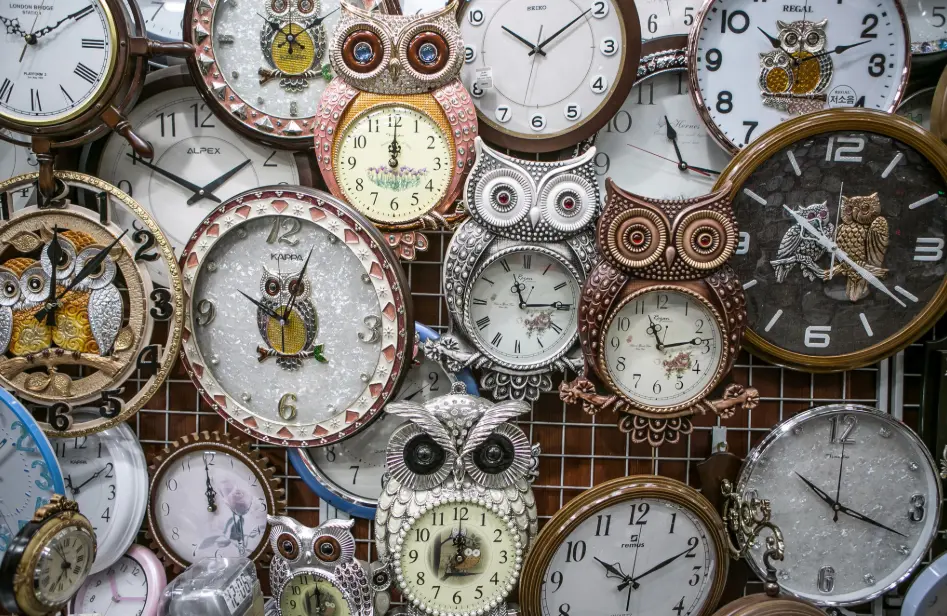
Clocks and watches are timeless instruments that measure the passage of time with remarkable precision, blending artistry and engineering in their design. A clock, often stationary and prominent in homes or public spaces, features mechanisms like pendulums or quartz crystals to display hours, minutes, and sometimes seconds on analog faces or digital screens. Watches, on the other hand, are portable marvels worn on the wrist, evolving from early pocket versions to sleek, modern smartwatches that integrate fitness tracking and notifications. Crafted from materials such as gold, stainless steel, or even ceramic, they showcase intricate details like sweeping second hands, luminous dials, and complications such as chronographs or perpetual calendars. Historically, these devices trace back to ancient sundials and water clocks, advancing through the mechanical innovations of the Renaissance to today’s atomic accuracy, symbolizing not just utility but also status, style, and the human fascination with mastering time. Whether a vintage grandfather clock ticking in a quiet room or a high-tech watch vibrating with alerts, they serve as constant companions, reminding us of life’s fleeting moments.
Table of Contents
- Part 1: Best AI Quiz Making Software for Creating A Clocks And Watches Quiz
- Part 2: 20 Clocks And Watches Quiz Questions & Answers
- Part 3: Save Time and Energy: Generate Quiz Questions with AI Technology
Part 1: Best AI Quiz Making Software for Creating A Clocks And Watches Quiz
OnlineExamMaker is a powerful AI-powered assessment platform to create auto-grading Clocks And Watches skills assessments. It’s designed for educators, trainers, businesses, and anyone looking to generate engaging quizzes without spending hours crafting questions manually. The AI Question Generator feature allows you to input a topic or specific details, and it generates a variety of question types automatically.
Top features for assessment organizers:
● Combines AI webcam monitoring to capture cheating activities during online exam.
● Enhances assessments with interactive experience by embedding video, audio, image into quizzes and multimedia feedback.
● Once the exam ends, the exam scores, question reports, ranking and other analytics data can be exported to your device in Excel file format.
● API and SSO help trainers integrate OnlineExamMaker with Google Classroom, Microsoft Teams, CRM and more.
Automatically generate questions using AI
Part 2: 20 Clocks And Watches Quiz Questions & Answers
or
1. Question: What type of clock uses a pendulum to regulate time?
Options: A) Digital clock
B) Quartz clock
C) Pendulum clock
D) Atomic clock
Answer: C
Explanation: A pendulum clock uses the regular swings of a pendulum to keep accurate time by controlling the gear mechanism.
2. Question: Which movement type in watches uses a battery to power a quartz crystal?
Options: A) Mechanical
B) Automatic
C) Quartz
D) Solar
Answer: C
Explanation: Quartz movements rely on the vibrations of a quartz crystal, powered by a battery, to provide precise timekeeping.
3. Question: What is the primary function of the escapement in a mechanical watch?
Options: A) To store energy
B) To display the time
C) To regulate the release of energy to the gear train
D) To wind the mainspring
Answer: C
Explanation: The escapement controls the release of energy from the mainspring, ensuring the watch’s gears move at a consistent rate.
4. Question: Which clock is known for its extreme accuracy and uses atomic vibrations?
Options: A) Grandfather clock
B) Atomic clock
C) Sundial
D) Cuckoo clock
Answer: B
Explanation: Atomic clocks measure time based on the vibrations of atoms, like cesium, making them the most precise clocks available.
5. Question: What does GMT stand for in the context of watches?
Options: A) Global Mean Time
B) Greenwich Meridian Time
C) Greenwich Mean Time
D) General Meridian Time
Answer: C
Explanation: GMT refers to Greenwich Mean Time, which is the mean solar time at the Royal Observatory in Greenwich, London, and is a standard for world time.
6. Question: In a 12-hour clock, what does the term “AM” indicate?
Options: A) After midnight
B) Ante meridiem
C) Afternoon meridian
D) Absolute morning
Answer: B
Explanation: “AM” stands for ante meridiem, meaning before noon, to distinguish the first 12 hours of the day.
7. Question: Which component of a watch is responsible for winding it automatically through wrist movement?
Options: A) Rotor
B) Balance wheel
C) Mainspring
D) Crown
Answer: A
Explanation: The rotor is a weighted part that swings with the wearer’s motion, winding the mainspring in an automatic watch.
8. Question: What is a chronograph watch primarily used for?
Options: A) Measuring depth underwater
B) Timing events with precision
C) Displaying multiple time zones
D) Indicating lunar phases
Answer: B
Explanation: A chronograph is a stopwatch function integrated into a watch, allowing users to measure elapsed time accurately.
9. Question: Which type of clock uses the position of the sun to tell time?
Options: A) Digital clock
B) Sundial
C) Alarm clock
D) Wall clock
Answer: B
Explanation: A sundial measures time by the shadow cast by the sun on a dial, making it one of the oldest timekeeping devices.
10. Question: What does the term “water resistance” on a watch indicate?
Options: A) It can be submerged indefinitely
B) It is protected against splashes and minor water exposure
C) It only works in dry conditions
D) It is made of waterproof materials
Answer: B
Explanation: Water resistance means the watch can withstand a certain level of water exposure, such as rain or swimming, but not necessarily deep diving without a specified rating.
11. Question: In mechanical watches, what is the role of the balance wheel?
Options: A) To hold the watch hands
B) To oscillate and regulate timekeeping
C) To power the movement
D) To display the date
Answer: B
Explanation: The balance wheel oscillates at a consistent rate, working with the hairspring to keep the watch’s time accurate.
12. Question: Which watch complication shows the phases of the moon?
Options: A) Chronometer
B) Moon phase
C) Perpetual calendar
D) Power reserve indicator
Answer: B
Explanation: A moon phase complication displays the lunar cycle on the watch dial, showing how the moon appears in the sky.
13. Question: What is the difference between a clock and a watch?
Options: A) Clocks are digital, watches are analog
B) Watches are portable and worn, clocks are stationary
C) Clocks use batteries, watches use springs
D) There is no difference
Answer: B
Explanation: Watches are designed to be worn on the body, while clocks are typically larger and fixed in place for time display.
14. Question: Which material is commonly used for the crystal on luxury watches?
Options: A) Glass
B) Sapphire
C) Plastic
D) Metal
Answer: B
Explanation: Sapphire crystal is highly scratch-resistant and durable, making it a popular choice for protecting the watch face in high-end models.
15. Question: What does a tachymeter scale on a watch measure?
Options: A) Speed over a distance
B) Altitude
C) Temperature
D) Heart rate
Answer: A
Explanation: A tachymeter scale allows the user to measure speed based on time traveled over a known distance, often used with the chronograph function.
16. Question: How does a quartz watch maintain accuracy?
Options: A) Through mechanical gears
B) By electronic pulses from a quartz crystal
C) Using solar energy
D) With atomic signals
Answer: B
Explanation: A quartz watch uses the precise vibrations of a quartz crystal, driven by an electronic circuit, to keep time accurately.
17. Question: What is the purpose of a bezel on a diver’s watch?
Options: A) To protect the crystal
B) To measure elapsed time underwater
C) To adjust the time
D) To hold the strap
Answer: B
Explanation: The bezel on a diver’s watch is a rotatable ring that tracks dive time, ensuring safety by monitoring elapsed minutes.
18. Question: Which historical figure is credited with inventing the first mechanical clock?
Options: A) Isaac Newton
B) Leonardo da Vinci
C) Hero of Alexandria
D) None, as it was a collective invention
Answer: D
Explanation: The mechanical clock evolved over centuries with contributions from various inventors, but no single person is universally credited.
19. Question: What is the typical power source for an automatic watch?
Options: A) Battery
B) Mainspring wound by movement
C) Solar cells
D) External charger
Answer: B
Explanation: Automatic watches are powered by a mainspring that is wound through the natural motion of the wearer’s wrist.
20. Question: Why do some watches have a seconds subdial?
Options: A) To show the date
B) To display a separate seconds hand for precision
C) To indicate the battery level
D) To track time zones
Answer: B
Explanation: A seconds subdial provides a dedicated area for the seconds hand, allowing for more accurate time reading without cluttering the main dial.
or
Part 3: Save Time and Energy: Generate Quiz Questions with AI Technology
Automatically generate questions using AI