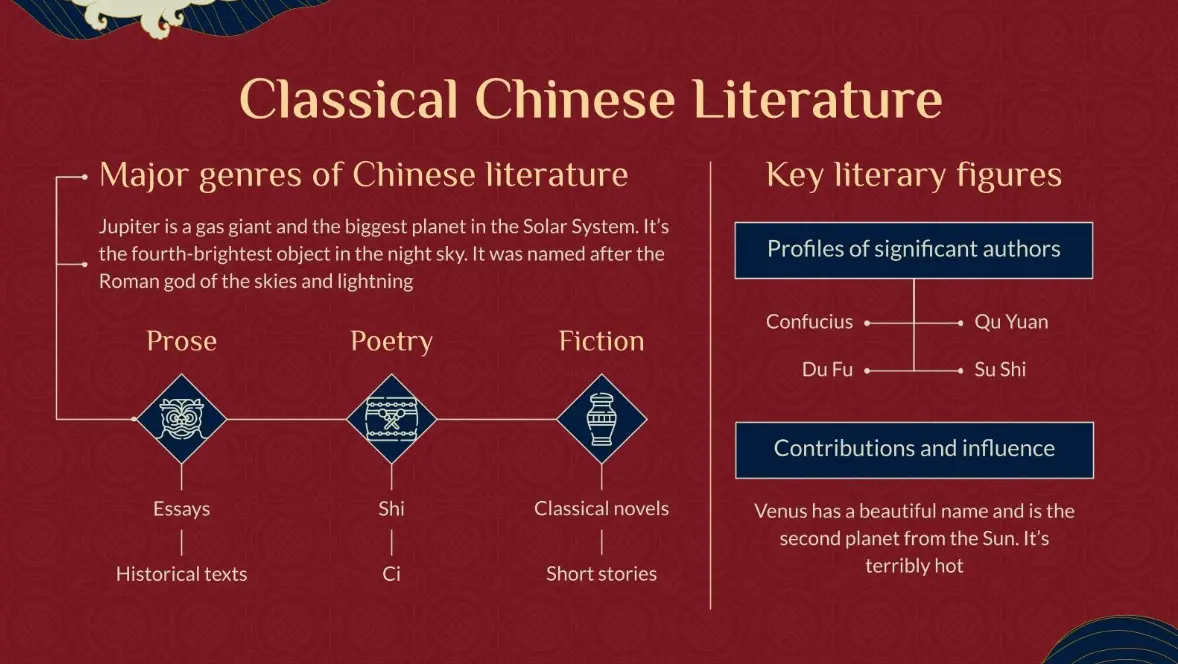
Chinese literature, one of the world’s oldest and most influential traditions, spans over 3,000 years and encompasses a wide array of genres, including poetry, prose, drama, and novels. It reflects the cultural, philosophical, and historical evolution of China, influenced by Confucianism, Taoism, and Buddhism.
Ancient Period (Pre-Qin to Han Dynasties, c. 11th century BC – 220 AD):
Early Chinese literature began with inscriptions on oracle bones and bronze vessels. The foundational texts include the *I Ching* (Book of Changes), *Shijing* (Book of Songs), and Confucian classics like the *Analects*. Historical works such as Sima Qian’s *Records of the Grand Historian* established narrative history as a literary form.
Medieval Period (Tang to Yuan Dynasties, 618–1368 AD):
The Tang Dynasty marked the golden age of poetry, with poets like Li Bai and Du Fu creating lyrical works that explored nature, emotion, and society. Song Dynasty literature featured ci poetry and philosophical essays, exemplified by Su Shi’s writings. The Yuan Dynasty introduced drama and vernacular fiction, with works like the anonymous *Romance of the West Chamber*.
Late Imperial Period (Ming to Qing Dynasties, 1368–1912 AD):
This era saw the rise of the novel, with masterpieces like *Journey to the West* by Wu Cheng’en, *Water Margin* (attributed to Shi Nai’an), and Cao Xueqin’s *Dream of the Red Chamber*, which delved into social critique, human psychology, and family dynamics. Poetry and essays continued to flourish, blending classical forms with personal expression.
Modern and Contemporary Period (1912–Present):
The May Fourth Movement (1919) introduced Western literary styles, promoting vernacular language and realism. Lu Xun’s short stories, such as “A Madman’s Diary,” critiqued traditional society. Modern authors like Mao Dun and Eileen Chang explored urbanization and personal struggles. Contemporary literature, influenced by globalization, includes works by Mo Yan (Nobel laureate) and Yu Hua, addressing themes like cultural identity, revolution, and modernity.
Throughout its history, Chinese literature emphasizes harmony with nature, moral philosophy, and social commentary, with enduring themes of filial piety, governance, and the human condition. Its global impact is seen in translations and adaptations, shaping world literature and cultural exchange.
Table of Contents
- Part 1: Create An Amazing Chinese Literature Quiz Using AI Instantly in OnlineExamMaker
- Part 2: 20 Chinese Literature Quiz Questions & Answers
- Part 3: OnlineExamMaker AI Question Generator: Generate Questions for Any Topic
Part 1: Create An Amazing Chinese Literature Quiz Using AI Instantly in OnlineExamMaker
Nowadays more and more people create Chinese Literature quizzes using AI technologies, OnlineExamMaker a powerful AI-based quiz making tool that can save you time and efforts. The software makes it simple to design and launch interactive quizzes, assessments, and surveys. With the Question Editor, you can create multiple-choice, open-ended, matching, sequencing and many other types of questions for your tests, exams and inventories. You are allowed to enhance quizzes with multimedia elements like images, audio, and video to make them more interactive and visually appealing.
Recommended features for you:
● Prevent cheating by randomizing questions or changing the order of questions, so learners don’t get the same set of questions each time.
● Automatically generates detailed reports—individual scores, question report, and group performance.
● Simply copy a few lines of codes, and add them to a web page, you can present your online quiz in your website, blog, or landing page.
● Offers question analysis to evaluate question performance and reliability, helping instructors optimize their training plan.
Automatically generate questions using AI
Part 2: 20 Chinese Literature Quiz Questions & Answers
or
1. Question: Who is the author of the ancient Chinese text “The Analects”?
Options:
A. Laozi
B. Confucius
C. Sun Tzu
D. Mencius
Answer: B
Explanation: “The Analects” is a collection of sayings and ideas attributed to Confucius, compiled by his disciples, and it forms the foundation of Confucian philosophy.
2. Question: In which dynasty was the poetry collection “Book of Songs” compiled?
Options:
A. Han Dynasty
B. Zhou Dynasty
C. Tang Dynasty
D. Qin Dynasty
Answer: B
Explanation: The “Book of Songs” was compiled during the Zhou Dynasty and is one of the oldest collections of Chinese poetry, reflecting early societal themes.
3. Question: What is the main theme of Du Fu’s poetry?
Options:
A. Romantic love
B. War and social issues
C. Nature and immortality
D. Philosophical debates
Answer: B
Explanation: Du Fu, known as the “Poet Historian,” often wrote about the hardships of war, poverty, and social injustices during the Tang Dynasty.
4. Question: Which novel features the Monkey King Sun Wukong as a main character?
Options:
A. Dream of the Red Chamber
B. Journey to the West
C. Romance of the Three Kingdoms
D. Water Margin
Answer: B
Explanation: “Journey to the West” tells the story of the monk Xuanzang’s pilgrimage to India, accompanied by Sun Wukong and other characters, symbolizing the quest for enlightenment.
5. Question: Who wrote the poem “Quiet Night Thoughts”?
Options:
A. Li Bai
B. Du Fu
C. Wang Wei
D. Li Qingzhao
Answer: A
Explanation: Li Bai’s “Quiet Night Thoughts” is a famous Tang Dynasty poem that evokes a sense of homesickness and tranquility under the moonlight.
6. Question: What philosophical text is attributed to Laozi?
Options:
A. The Art of War
B. Tao Te Ching
C. Zhuangzi
D. I Ching
Answer: B
Explanation: The “Tao Te Ching” is the foundational text of Taoism, written by Laozi, emphasizing harmony with the Tao and living simply.
7. Question: In “Dream of the Red Chamber,” what does the story primarily explore?
Options:
A. Military conquests
B. Family decline and romance
C. Supernatural adventures
D. Political intrigue
Answer: B
Explanation: This Qing Dynasty novel by Cao Xueqin delves into the decline of a wealthy family, focusing on love, societal norms, and human emotions.
8. Question: Which poet is known as the “Poet Immortal”?
Options:
A. Bai Juyi
B. Li Bai
C. Su Shi
D. Tao Yuanming
Answer: B
Explanation: Li Bai is celebrated as the “Poet Immortal” for his free-spirited and imaginative poetry during the Tang Dynasty.
9. Question: What is the central conflict in “Romance of the Three Kingdoms”?
Options:
A. A quest for immortality
B. Power struggles among warlords
C. A family feud
D. Rebellion against an emperor
Answer: B
Explanation: Based on historical events, the novel depicts the power struggles and alliances among warlords during the end of the Han Dynasty.
10. Question: Who authored “The Art of War”?
Options:
A. Confucius
B. Sun Tzu
C. Zhuge Liang
D. Han Fei
Answer: B
Explanation: Sun Tzu’s “The Art of War” is a classic military strategy text that has influenced warfare and business strategies worldwide.
11. Question: What style of poetry is associated with the Tang Dynasty’s Li Shangyin?
Options:
A. Regulated verse
B. Free verse
C. Seven-character quatrains
D. All of the above
Answer: A
Explanation: Li Shangyin is known for his regulated verse, which follows strict rhythmic and tonal rules, often exploring themes of ambiguity and emotion.
12. Question: In which work does the character Jia Baoyu appear?
Options:
A. Water Margin
B. Dream of the Red Chamber
C. Journey to the West
D. The Scholars
Answer: B
Explanation: Jia Baoyu is the protagonist of “Dream of the Red Chamber,” representing youthful idealism and romantic entanglements in a declining aristocratic family.
13. Question: What is the primary focus of Qu Yuan’s “Li Sao”?
Options:
A. Personal exile and loyalty
B. Nature descriptions
C. War victories
D. Daily life
Answer: A
Explanation: “Li Sao” is a long poem by Qu Yuan expressing his sorrow over political exile and his unwavering loyalty to his king.
14. Question: Which dynasty produced the greatest number of ci poetry?
Options:
A. Han Dynasty
B. Song Dynasty
C. Ming Dynasty
D. Yuan Dynasty
Answer: B
Explanation: The Song Dynasty is renowned for the flourishing of ci poetry, a lyrical form often set to music, with poets like Su Shi leading the way.
15. Question: Who is the author of “Strange Stories from a Chinese Studio”?
Options:
A. Wu Cheng’en
B. Pu Songling
C. Cao Xueqin
D. Luo Guanzhong
Answer: B
Explanation: Pu Songling’s collection features supernatural tales and folklore, blending reality with fantasy in Qing Dynasty literature.
16. Question: What does the term “fu” refer to in ancient Chinese literature?
Options:
A. A type of prose poem
B. A short story
C. A philosophical essay
D. A folk song
Answer: A
Explanation: “Fu” is a literary form that combines prose and poetry, often descriptive and rhythmic, popular in the Han Dynasty.
17. Question: In “Water Margin,” what is the main theme?
Options:
A. Outlaws fighting corruption
B. Imperial court life
C. Religious pilgrimages
D. Family sagas
Answer: A
Explanation: The novel portrays a band of outlaws rebelling against corrupt officials, symbolizing justice and heroism in the Song Dynasty setting.
18. Question: Which poet wrote “River Snow”?
Options:
A. Li Bai
B. Du Fu
C. Wang Wei
D. Bai Juyi
Answer: C
Explanation: Wang Wei’s “River Snow” is a concise poem depicting a serene winter scene, exemplifying his style of blending Buddhism and nature.
19. Question: What historical period inspired much of Sima Qian’s “Records of the Grand Historian”?
Options:
A. Tang Dynasty
B. Qin and Han Dynasties
C. Ming Dynasty
D. Zhou Dynasty
Answer: B
Explanation: Sima Qian’s work chronicles Chinese history from the earliest times up to the Han Dynasty, providing a foundational historical narrative.
20. Question: Who is considered the father of Chinese fiction?
Options:
A. Cao Xueqin
B. Luo Guanzhong
C. Shi Nai’an
D. None of the above
Answer: D
Explanation: Chinese fiction evolved collectively, but no single “father” is universally agreed upon; however, early works like those from the Ming and Qing dynasties shaped the genre.
or
Part 3: OnlineExamMaker AI Question Generator: Generate Questions for Any Topic
Automatically generate questions using AI