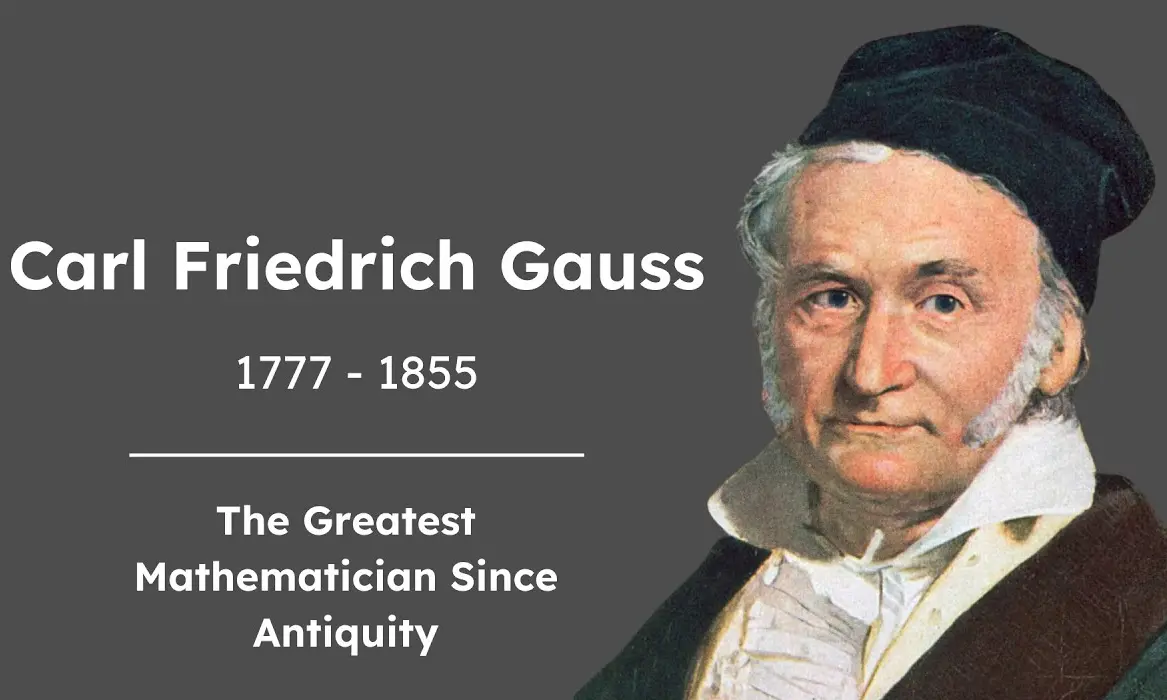
Carl Friedrich Gauss (1777–1855) was a German mathematician, astronomer, and physicist widely regarded as one of the greatest minds in history. Born in Brunswick, Germany, as the son of a modest gardener, Gauss displayed extraordinary mathematical talent from a young age, reportedly correcting his father’s arithmetic at just three years old. He made groundbreaking contributions across multiple fields: in mathematics, he advanced number theory with works like “Disquisitiones Arithmeticae” (1801), proved the fundamental theorem of algebra, and developed the Gaussian distribution, which forms the basis of statistics. His innovations in geometry included explorations of non-Euclidean spaces, and he introduced the method of least squares for data fitting.
In astronomy, Gauss predicted the orbit of the asteroid Ceres in 1801, cementing his reputation. He also contributed to physics, particularly electromagnetism, through his work on potential theory and collaboration with Wilhelm Weber on the first electromagnetic telegraph. Despite his prolific output, Gauss published only a fraction of his ideas, earning him the nickname “the prince of mathematicians” for his depth and precision.
Throughout his career, he held positions at the University of Göttingen, where he influenced generations of scholars. Gauss’s legacy endures in modern science, with his name attached to concepts like Gaussian curvature, the gauss unit in magnetism, and the Gaussian integers. His work bridged pure and applied mathematics, shaping fields from statistics to telecommunications.
Table of Contents
- Part 1: Create A Carl Friedrich Gauss Quiz in Minutes Using AI with OnlineExamMaker
- Part 2: 20 Carl Friedrich Gauss Quiz Questions & Answers
- Part 3: Save Time and Energy: Generate Quiz Questions with AI Technology
Part 1: Create A Carl Friedrich Gauss Quiz in Minutes Using AI with OnlineExamMaker
Are you looking for an online assessment to test the Carl Friedrich Gauss skills of your learners? OnlineExamMaker uses artificial intelligence to help quiz organizers to create, manage, and analyze exams or tests automatically. Apart from AI features, OnlineExamMaker advanced security features such as full-screen lockdown browser, online webcam proctoring, and face ID recognition.
Recommended features for you:
● Includes a safe exam browser (lockdown mode), webcam and screen recording, live monitoring, and chat oversight to prevent cheating.
● Enhances assessments with interactive experience by embedding video, audio, image into quizzes and multimedia feedback.
● Once the exam ends, the exam scores, question reports, ranking and other analytics data can be exported to your device in Excel file format.
● Offers question analysis to evaluate question performance and reliability, helping instructors optimize their training plan.
Automatically generate questions using AI
Part 2: 20 Carl Friedrich Gauss Quiz Questions & Answers
or
1. What was Carl Friedrich Gauss’s birth year?
A. 1775
B. 1777
C. 1780
D. 1765
Answer: B
Explanation: Gauss was born on April 30, 1777, in Brunswick, Germany, marking the beginning of his extraordinary life in mathematics.
2. In which field did Gauss make significant contributions by developing the method of least squares?
A. Algebra
B. Statistics
C. Geometry
D. Astronomy
Answer: B
Explanation: Gauss’s work on the method of least squares in statistics helped in minimizing errors in observations, which he applied to various scientific problems.
3. What is the name of the theorem that states the sum of the angles in a triangle is less than 180 degrees in certain geometries, which Gauss explored?
A. Pythagorean theorem
B. Euler’s theorem
C. Gaussian curvature theorem
D. None of the above
Answer: D
Explanation: Gauss contributed to differential geometry, but the specific theorem mentioned is more associated with non-Euclidean geometry; he privately explored it without publishing.
4. Gauss is credited with which major achievement in number theory?
A. Proving Fermat’s Last Theorem
B. Developing the Gaussian integers
C. Inventing calculus
D. Discovering pi
Answer: B
Explanation: Gaussian integers are complex numbers of the form a + bi where a and b are integers, which Gauss used to extend the concept of unique factorization.
5. What astronomical body did Gauss help calculate the orbit for in 1801?
A. Halley’s Comet
B. The Moon
C. Ceres
D. Mars
Answer: C
Explanation: Gauss used his mathematical skills to predict the position of the asteroid Ceres, demonstrating the practical application of his theories.
6. Which distribution in probability theory is named after Gauss?
A. Poisson distribution
B. Normal distribution
C. Binomial distribution
D. Exponential distribution
Answer: B
Explanation: The normal distribution, also known as the Gaussian distribution, describes data near the mean in a bell curve, based on Gauss’s work on error analysis.
7. What was Gauss’s profession for most of his career?
A. University professor
B. Director of an observatory
C. Private tutor
D. Government official
Answer: B
Explanation: Gauss served as the director of the Göttingen Observatory, where he combined his interests in mathematics and astronomy.
8. In what year did Gauss die?
A. 1855
B. 1830
C. 1815
D. 1870
Answer: A
Explanation: Gauss died on February 23, 1855, in Göttingen, Germany, after a prolific career that influenced many fields.
9. Which of the following is a famous quote attributed to Gauss about mathematics?
A. “God created the integers; all else is the work of man.”
B. “Mathematics is the queen of sciences.”
C. “I think, therefore I am.”
D. “E=mc²”
Answer: A
Explanation: This quote reflects Gauss’s deep appreciation for number theory and the fundamental nature of integers in mathematics.
10. Gauss developed a method for solving systems of linear equations, known as:
A. Cramer’s rule
B. Gaussian elimination
C. Matrix inversion
D. Determinant method
Answer: B
Explanation: Gaussian elimination is a systematic way to solve linear equations by transforming matrices into row echelon form, a technique widely used today.
11. What was the title of Gauss’s doctoral thesis?
A. On the Theory of Numbers
B. A Demonstration of the Fundamental Theorem of Algebra
C. Disquisitiones Arithmeticae
D. Principles of Geometry
Answer: B
Explanation: In 1799, Gauss proved the Fundamental Theorem of Algebra, which states that every non-constant polynomial has at least one complex root.
12. Gauss contributed to the development of which branch of mathematics through his work on surfaces?
A. Topology
B. Differential geometry
C. Abstract algebra
D. Calculus
Answer: B
Explanation: His concept of Gaussian curvature helped lay the foundations for differential geometry, analyzing the intrinsic properties of curved surfaces.
13. Which prime number theorem did Gauss conjecture based on his observations?
A. The distribution of prime numbers
B. Fermat primes
C. Mersenne primes
D. Twin primes
Answer: A
Explanation: Gauss hypothesized the prime number theorem, which describes the asymptotic distribution of prime numbers among the integers.
14. What invention did Gauss create to measure angles accurately for surveying?
A. Telescope
B. Heliotrope
C. Compass
D. Barometer
Answer: B
Explanation: The heliotrope, a device using mirrors to reflect sunlight, allowed Gauss to make precise measurements for geodetic surveys.
15. Gauss was a child prodigy; at what age did he correct his father’s arithmetic?
A. 3 years old
B. 5 years old
C. 10 years old
D. 15 years old
Answer: A
Explanation: Legends say Gauss corrected his father’s payroll calculations at age 3, showcasing his early mathematical talent.
16. In which publication did Gauss present his work on complex numbers?
A. Disquisitiones Arithmeticae
B. Theoria Motus Corporum Coelestium
C. Investigations of Higher Arithmetic
D. Geometric Investigations
Answer: A
Explanation: In Disquisitiones Arithmeticae (1801), Gauss introduced the concept of Gaussian integers and advanced number theory.
17. Gauss’s work in physics included contributions to:
A. Electromagnetism
B. Quantum mechanics
C. Relativity
D. Thermodynamics
Answer: A
Explanation: He collaborated with Wilhelm Weber on experiments in electromagnetism, including the invention of the electromagnetic telegraph.
18. What is the significance of the number 17 in Gauss’s early life?
A. It was his favorite prime number
B. He constructed a 17-sided polygon with compass and straightedge
C. It was his age when he published his first paper
D. It represented his family size
Answer: B
Explanation: At age 19, Gauss proved that a regular 17-sided polygon could be constructed using only a compass and straightedge, a major breakthrough.
19. Gauss declined an invitation to become the director of which institution?
A. The Royal Society in London
B. The University of Berlin
C. The French Academy of Sciences
D. The Russian Academy
Answer: B
Explanation: Gauss turned down the position at the University of Berlin in 1825, preferring to stay in Göttingen.
20. Which of Gauss’s works is considered foundational for modern statistics?
A. His error function
B. The normal curve
C. Bayesian inference
D. Hypothesis testing
Answer: B
Explanation: Gauss’s development of the normal curve provided the basis for probability distributions used in statistical analysis today.
or
Part 3: Save Time and Energy: Generate Quiz Questions with AI Technology
Automatically generate questions using AI