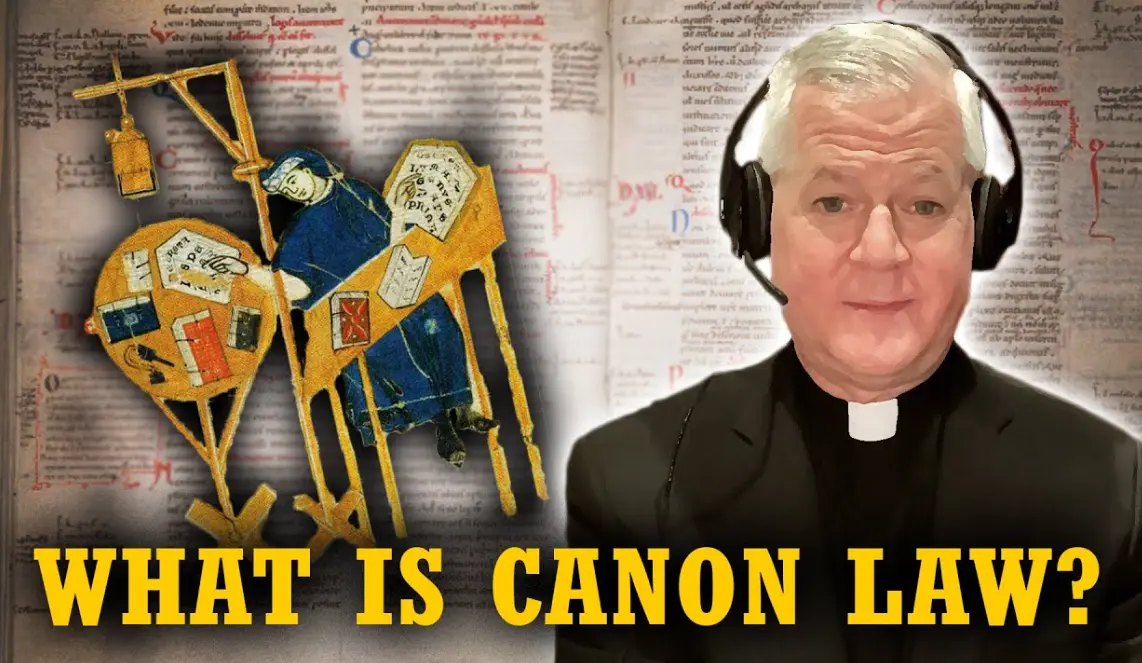
Canon Law is the body of laws and regulations established by the Catholic Church to govern its internal affairs, faith, sacraments, and members. It serves as the ecclesiastical equivalent of civil law, ensuring the orderly administration of the Church.
## Historical Development
– Origins: Canon Law traces back to the early Christian communities in the 1st century, drawing from apostolic traditions, biblical teachings, and decisions of early councils.
– Evolution: It developed through centuries of papal decrees, synods, and ecumenical councils. Key milestones include the Decretum Gratiani (12th century), the Corpus Juris Canonici (14th century), and modern codifications.
– Modern Codes: The 1917 Code of Canon Law was the first comprehensive codification, followed by the 1983 Code under Pope John Paul II, which reflects updates from the Second Vatican Council (1962–1965).
## Structure and Key Elements
Canon Law is organized into a systematic code, primarily the 1983 Code, which is divided into seven books:
1. General Norms: Covers basic principles, such as the application of laws, customs, and the Church’s hierarchy.
2. The People of God: Addresses the rights and obligations of the faithful, including laity, clergy, and religious.
3. The Teaching Function of the Church: Deals with doctrine, catechesis, and the missions.
4. The Sanctifying Function of the Church: Regulates sacraments, liturgy, and worship.
5. The Temporal Goods of the Church: Manages Church property, finances, and contracts.
6. Sanctions in the Church: Outlines penalties for offenses, including excommunication and other censures.
7. Processes: Covers legal procedures, trials, and administrative acts.
## Sources and Authority
– Primary Sources: Divine law (from Scripture and tradition), ecclesiastical laws (promulgated by popes and bishops), and universal customs.
– Authority: The Pope holds supreme legislative power, with bishops governing their dioceses under canon norms. Ecumenical councils, like those in history, have also shaped Canon Law.
## Purpose and Application
Canon Law aims to promote the salvation of souls, maintain ecclesiastical discipline, and foster unity within the Church. It applies to all Catholics and Church institutions worldwide, balancing spiritual guidance with practical governance. While it influences canonists, tribunals, and Vatican operations, it also intersects with civil law in matters like marriage and education.
This overview highlights the essential aspects of Canon Law, emphasizing its role in sustaining the Church’s mission. For detailed study, refer to official texts like the 1983 Code.
Table of Contents
- Part 1: OnlineExamMaker – Generate and Share Canon Law Quiz with AI Automatically
- Part 2: 20 Canon Law Quiz Questions & Answers
- Part 3: Try OnlineExamMaker AI Question Generator to Create Quiz Questions
Part 1: OnlineExamMaker – Generate and Share Canon Law Quiz with AI Automatically
OnlineExamMaker is a powerful AI-powered assessment platform to create auto-grading Canon Law skills assessments. It’s designed for educators, trainers, businesses, and anyone looking to generate engaging quizzes without spending hours crafting questions manually. The AI Question Generator feature allows you to input a topic or specific details, and it generates a variety of question types automatically.
Top features for assessment organizers:
● Prevent cheating by randomizing questions or changing the order of questions, so learners don’t get the same set of questions each time.
● AI Exam Grader for efficiently grading quizzes and assignments, offering inline comments, automatic scoring, and “fudge points” for manual adjustments.
● Embed quizzes on websites, blogs, or share via email, social media (Facebook, Twitter), or direct links.
● Handles large-scale testing (thousands of exams/semester) without internet dependency, backed by cloud infrastructure.
Automatically generate questions using AI
Part 2: 20 Canon Law Quiz Questions & Answers
or
1. Question: What is the primary source of Canon Law in the Catholic Church?
A. The Bible
B. The Code of Canon Law
C. Papal encyclicals
D. Ecumenical councils’ decrees
Answer: B
Explanation: The Code of Canon Law is the official compilation of laws governing the Catholic Church, first promulgated in 1917 and revised in 1983.
2. Question: Who is considered the supreme legislator of the Catholic Church?
A. The College of Cardinals
B. The Pope
C. Ecumenical councils
D. Bishops’ conferences
Answer: B
Explanation: According to Canon 331, the Pope possesses supreme, full, immediate, and universal ordinary power in the Church, making him the supreme legislator.
3. Question: What is required for a baptism to be valid in the Catholic Church?
A. The use of holy water
B. The pouring of water and the Trinitarian formula
C. Parental consent only
D. A church building
Answer: B
Explanation: Canon 849 states that the essential elements for a valid baptism are the pouring of water and the invocation of the Trinity, as these constitute the sacrament.
4. Question: Under Canon Law, who can validly confer the sacrament of Confirmation?
A. Any baptized Catholic
B. A priest
C. A bishop or one delegated by him
D. The parish pastor
Answer: C
Explanation: Canon 882 specifies that the ordinary minister of Confirmation is a bishop, though priests can be delegated in certain circumstances.
5. Question: What is the minimum age for a person to receive the sacrament of Marriage according to Canon Law?
A. 14 for males and 12 for females
B. 16 for males and 14 for females
C. 18 for both
D. There is no minimum age
Answer: A
Explanation: Canon 1083 sets the minimum age for marriage at 16 for males and 14 for females, though local ordinaries may require a higher age.
6. Question: In Canon Law, what constitutes a diriment impediment to marriage?
A. A temporary illness
B. Prior valid marriage
C. Financial instability
D. Lack of parental approval
Answer: B
Explanation: Canon 1085 declares that a prior valid marriage is a diriment impediment, rendering any new marriage attempt invalid until the impediment is removed.
7. Question: Who may celebrate the Eucharist according to Canon Law?
A. Any ordained deacon
B. A priest or bishop
C. A layperson in emergencies
D. The Pope only
Answer: B
Explanation: Canon 900 states that the ministerial priesthood, held by priests and bishops, is required for the valid celebration of the Eucharist.
8. Question: What is the role of a diocesan bishop as per Canon Law?
A. To govern a parish
B. To oversee a diocese and its faithful
C. To advise the Pope
D. To manage global Church finances
Answer: B
Explanation: Canon 381 defines the diocesan bishop as the principal moderator of the diocese, responsible for the spiritual and administrative governance of his territory.
9. Question: Under Canon Law, when can a priest be dispensed from celibacy?
A. Never
B. For Eastern Catholic priests
C. Only for Latin Rite priests over 60
D. In cases of marriage annulment
Answer: B
Explanation: Canon 3 allows for married priests in the Eastern Catholic Churches, as per their traditions, though Latin Rite priests generally must observe celibacy per Canon 1037.
10. Question: What is required for a valid confession in Canon Law?
A. A private room
B. Contrition, confession, and absolution by a priest
C. A written statement of sins
D. Witness by another person
Answer: B
Explanation: Canon 959 outlines that the sacrament of Penance requires the penitent’s contrition, confession of sins, and absolution by a validly ordained priest.
11. Question: According to Canon Law, what is the process for excommunication?
A. Automatic for certain sins
B. Only by papal decree
C. Requires a church trial
D. Decided by local parishes
Answer: A
Explanation: Canon 1331 states that excommunication can be latae sententiae (automatic) for grave offenses like apostasy, as specified in the law.
12. Question: Who can grant an annulment in the Catholic Church?
A. Any priest
B. A diocesan tribunal
C. The married couple themselves
D. The Pope alone
Answer: B
Explanation: Canon 1671-1691 details that declarations of nullity (annulments) are handled by ecclesiastical tribunals, typically at the diocesan level.
13. Question: In Canon Law, what is apostolic succession?
A. The line of bishops from the apostles
B. Missionary work abroad
C. Succession of popes
D. Inheritance of church property
Answer: A
Explanation: Canon 375 emphasizes that bishops succeed to the apostolic college, ensuring the continuity of the Church’s teaching and sacramental authority.
14. Question: What must be observed for the valid ordination of a priest?
A. The candidate’s age only
B. Imposition of hands and the prayer of consecration by a bishop
C. A public vote in the parish
D. Financial contributions to the diocese
Answer: B
Explanation: Canon 1002 requires the essential rite of ordination, which includes the bishop’s imposition of hands and the consecratory prayer.
15. Question: Under Canon Law, how is the Catholic Church structured globally?
A. As independent national churches
B. Under the authority of the Pope as the visible head
C. Through democratic elections
D. By regional alliances
Answer: B
Explanation: Canon 331 establishes the Pope as the supreme pastor, with the Church structured in a hierarchical communion under his authority.
16. Question: What is the fasting requirement before receiving Holy Communion?
A. No fasting required
B. One hour for solids and liquids, except water and medicine
C. 24 hours
D. Three days
Answer: B
Explanation: Canon 919 mandates a one-hour fast from food and drink (except water and medicine) before receiving the Eucharist.
17. Question: In Canon Law, what is the purpose of an ecclesiastical tribunal?
A. To handle financial disputes
B. To adjudicate matters of faith and discipline
C. To organize parish events
D. To educate the laity
Answer: B
Explanation: Canon 1400-1445 outlines that ecclesiastical tribunals are courts for resolving canonical issues, such as marriage cases and penalties.
18. Question: Who can be a godparent in a Catholic baptism according to Canon Law?
A. Any baptized Christian
B. A confirmed Catholic who is practicing the faith
C. A non-believer
D. A married couple
Answer: B
Explanation: Canon 874 requires that a godparent be a confirmed and practicing Catholic, capable of performing the role.
19. Question: What does Canon Law say about the indissolubility of marriage?
A. Marriages can be dissolved by civil divorce
B. A ratified and consummated sacramental marriage is indissoluble
C. All marriages end at death
D. Marriages can be annulled for any reason
Answer: B
Explanation: Canon 1141 affirms that a valid sacramental marriage, once consummated, cannot be dissolved by any human power.
20. Question: Under Canon Law, what is the significance of an ecumenical council?
A. It is a meeting of local bishops
B. It assembles bishops from around the world for doctrinal decisions
C. It handles daily church administration
D. It is optional for Church governance
Answer: B
Explanation: Canon 749 notes that ecumenical councils, convened by the Pope, have supreme authority in defining doctrines and laws for the universal Church.
or
Part 3: Try OnlineExamMaker AI Question Generator to Create Quiz Questions
Automatically generate questions using AI