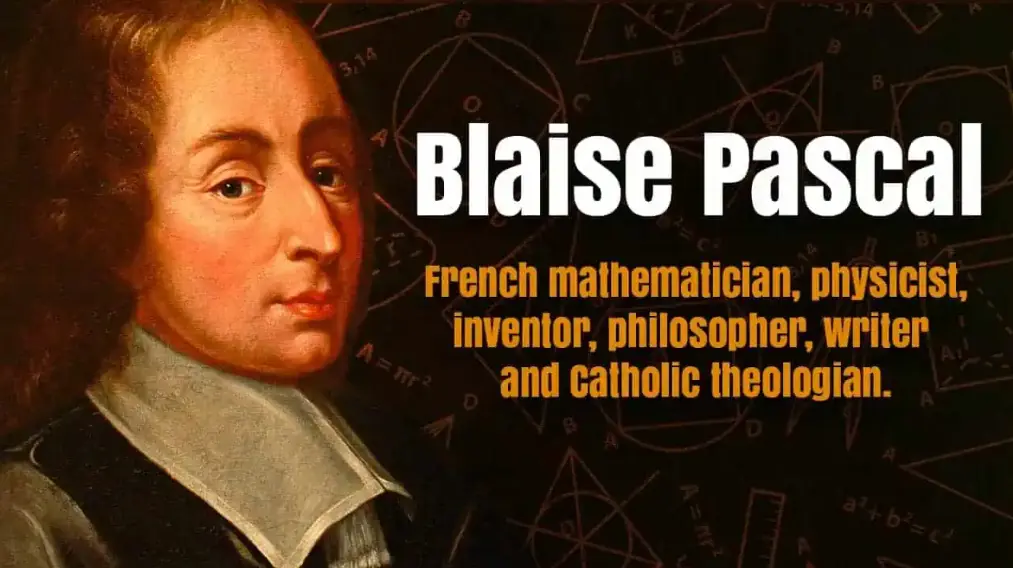
Blaise Pascal (1623–1662) was a French polymath renowned for his contributions to mathematics, physics, philosophy, and theology. Born in Clermont-Ferrand, France, he demonstrated extraordinary intellect from a young age, publishing his first work on geometry at 16. In mathematics, Pascal is celebrated for inventing Pascal’s triangle, a triangular array used in binomial expansions and probability calculations, and for co-founding probability theory with Pierre de Fermat. His work in physics includes Pascal’s law, which states that pressure applied to a confined fluid is transmitted equally in all directions, foundational to hydraulics and the invention of the syringe. Pascal also created the Pascaline, an early mechanical calculator, advancing early computing devices.
Beyond science, Pascal’s philosophical and religious writings, particularly in his posthumous collection “Pensées,” explore human existence, faith, and reason. His famous “Pascal’s Wager” argues that believing in God is a rational bet, even if God’s existence is uncertain, due to the potential infinite rewards. Despite his short life, marked by health struggles and a profound conversion to Jansenism—a rigorous form of Catholicism—Pascal’s ideas influenced Enlightenment thinkers and modern philosophy. His interdisciplinary legacy bridges science and spirituality, making him a pivotal figure in Western intellectual history.
Table of Contents
- Part 1: OnlineExamMaker AI Quiz Maker – Make A Free Quiz in Minutes
- Part 2: 20 Blaise Pascal Quiz Questions & Answers
- Part 3: Save Time and Energy: Generate Quiz Questions with AI Technology
Part 1: OnlineExamMaker AI Quiz Maker – Make A Free Quiz in Minutes
Still spend a lot of time in editing questions for your next Blaise Pascal assessment? OnlineExamMaker is an AI quiz maker that leverages artificial intelligence to help users create quizzes, tests, and assessments quickly and efficiently. You can start by inputting a topic or specific details into the OnlineExamMaker AI Question Generator, and the AI will generate a set of questions almost instantly. It also offers the option to include answer explanations, which can be short or detailed, helping learners understand their mistakes.
What you may like:
● Automatic grading and insightful reports. Real-time results and interactive feedback for quiz-takers.
● The exams are automatically graded with the results instantly, so that teachers can save time and effort in grading.
● LockDown Browser to restrict browser activity during quizzes to prevent students searching answers on search engines or other software.
● Create certificates with personalized company logo, certificate title, description, date, candidate’s name, marks and signature.
Automatically generate questions using AI
Part 2: 20 Blaise Pascal Quiz Questions & Answers
or
1. Question: What is Blaise Pascal’s most famous contribution to mathematics?
A) The development of calculus
B) Pascal’s triangle
C) The invention of algebra
D) The theory of relativity
Answer: B
Explanation: Pascal’s triangle is a triangular array of binomial coefficients that Pascal described in his treatise on figurate numbers, which has applications in probability and combinatorics.
2. Question: In which year was Blaise Pascal born?
A) 1623
B) 1596
C) 1642
D) 1707
Answer: A
Explanation: Blaise Pascal was born on June 19, 1623, in Clermont-Ferrand, France, and he went on to make significant contributions in multiple fields during his lifetime.
3. Question: What invention is Blaise Pascal credited with creating?
A) The telescope
B) The Pascaline
C) The steam engine
D) The printing press
Answer: B
Explanation: The Pascaline was an early mechanical calculator invented by Pascal in 1642 to help his father with tax calculations, marking an important step in the history of computing.
4. Question: Which field did Pascal contribute to with his work on probability?
A) Astronomy
B) Optics
C) Fluid mechanics
D) Gambling and games of chance
Answer: D
Explanation: Pascal, along with Pierre de Fermat, laid the foundations of probability theory through their correspondence on problems related to gambling, such as dividing stakes in an unfinished game.
5. Question: What is Pascal’s principle in physics?
A) The law of gravity
B) Pressure applied to a confined fluid is transmitted equally
C) The speed of light in a vacuum
D) The conservation of energy
Answer: B
Explanation: Pascal’s principle states that any change in pressure applied at any given point of a confined fluid is transmitted undiminished throughout the fluid, which is fundamental to hydraulics.
6. Question: Which of Pascal’s works is a collection of philosophical reflections?
A) Discourse on Method
B) Pensées
C) The Elements of Geometry
D) Opticks
Answer: B
Explanation: Pensées, published posthumously in 1670, is a collection of Pascal’s unfinished notes on theology, philosophy, and human nature, emphasizing the human condition and belief in God.
7. Question: What religious event profoundly influenced Pascal’s later life?
A) His conversion to Islam
B) The Night of Fire
C) His pilgrimage to Rome
D) The Edict of Nantes
Answer: B
Explanation: In 1654, Pascal experienced a profound religious vision known as the “Night of Fire,” which led him to devote much of his life to Jansenism and religious writing.
8. Question: In what language did Pascal primarily write his works?
A) Latin
B) English
C) French
D) German
Answer: C
Explanation: As a French philosopher and scientist, Pascal wrote most of his works, including his mathematical treatises and Pensées, in French, making them accessible to a wider audience in his time.
9. Question: What mathematical concept did Pascal develop related to conic sections?
A) The Pythagorean theorem
B) The binomial theorem
C) Pascal’s theorem
D) Euler’s formula
Answer: C
Explanation: Pascal’s theorem describes a relationship between points on a conic section and the lines connecting them, which he explored in his early work on geometry as a teenager.
10. Question: Which organization did Pascal join that influenced his religious views?
A) The Jesuits
B) The Jansenists
C) The Freemasons
D) The Royal Society
Answer: B
Explanation: Pascal was associated with the Jansenists, a Catholic sect that emphasized predestination and Augustinian theology, which shaped his later philosophical and theological writings.
11. Question: What did Pascal use to demonstrate the existence of a vacuum?
A) A barometer
B) A microscope
C) A thermometer
D) An electromagnet
Answer: A
Explanation: Pascal’s experiments with the mercury barometer helped prove the existence of a vacuum above the mercury column, challenging the prevailing Aristotelian views of the time.
12. Question: In which century did Blaise Pascal live?
A) 15th century
B) 16th century
C) 17th century
D) 18th century
Answer: C
Explanation: Pascal lived from 1623 to 1662, placing him in the 17th century, a period of significant scientific advancement known as the Scientific Revolution.
13. Question: What is the name of Pascal’s famous wager?
A) The lottery paradox
B) Pascal’s wager
C) The infinite monkey theorem
D) The prisoner’s dilemma
Answer: B
Explanation: Pascal’s wager is an argument in the philosophy of religion that posits believing in God is a rational “bet” because the potential infinite reward outweighs the finite costs of belief.
14. Question: Which of these did Pascal not contribute to?
A) Hydrostatics
B) Electricity
C) Probability
D) Geometry
Answer: B
Explanation: While Pascal made contributions to hydrostatics, probability, and geometry, he did not work extensively on electricity, which was more developed by later scientists like Benjamin Franklin.
15. Question: What health issue plagued Pascal throughout his life?
A) Tuberculosis
B) Poor health and intense pain
C) Blindness
D) Mental illness
Answer: B
Explanation: Pascal suffered from various health problems, including severe pain possibly from tuberculosis or other conditions, which affected his productivity and led to his early death at age 39.
16. Question: Who collaborated with Pascal on probability theory?
A) Isaac Newton
B) Pierre de Fermat
C) Gottfried Leibniz
D) René Descartes
Answer: B
Explanation: Pascal and Fermat exchanged letters in the 1650s to solve problems of probability, such as the division of stakes in games, founding modern probability theory.
17. Question: What is the primary theme of Pascal’s “Provincial Letters”?
A) Mathematical proofs
B) Criticism of Jesuit casuistry
C) Astronomical observations
D) Political philosophy
Answer: B
Explanation: The Provincial Letters, written in 1656-1657, satirize the moral theology of the Jesuits, defending Jansenism and highlighting ethical issues in religious practice.
18. Question: How old was Pascal when he wrote his essay on conic sections?
A) 16
B) 12
C) 25
D) 30
Answer: A
Explanation: At the age of 16, Pascal wrote “Essay pour les coniques,” demonstrating his prodigious talent in geometry and establishing his reputation as a young genius.
19. Question: What did Pascal’s law lead to the invention of?
A) The airplane
B) Hydraulic presses
C) The compass
D) The clock
Answer: B
Explanation: Pascal’s law is the basis for hydraulic systems, such as hydraulic presses and lifts, which use fluid pressure to multiply force.
20. Question: Why is Pascal considered a precursor to modern computing?
A) He invented the first programmable language
B) His Pascaline was an early mechanical calculator
C) He developed binary code
D) He created the first algorithm
Answer: B
Explanation: The Pascaline, as one of the first mechanical devices for addition and subtraction, foreshadowed the development of modern computers by demonstrating automated calculation.
or
Part 3: Save Time and Energy: Generate Quiz Questions with AI Technology
Automatically generate questions using AI