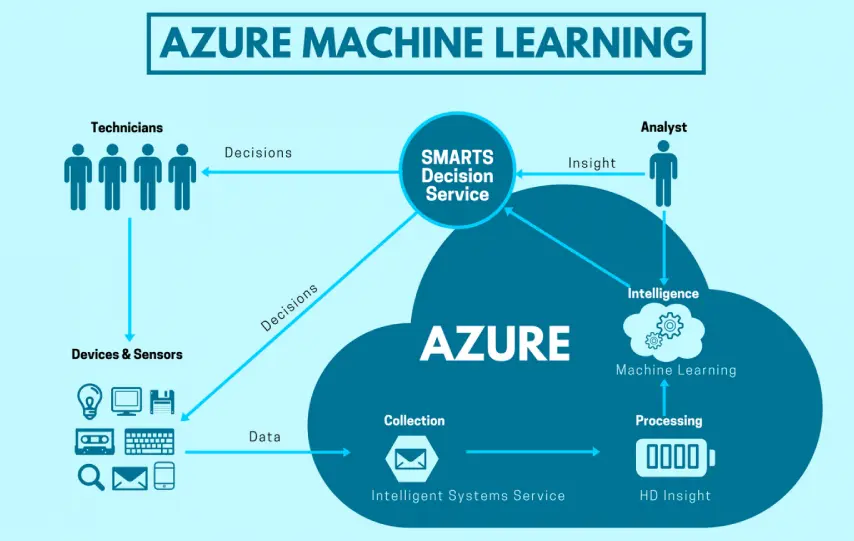
Azure Machine Learning is a cloud-based service provided by Microsoft Azure that enables data scientists and developers to build, train, and deploy machine learning models at scale. It streamlines the entire machine learning lifecycle, from data preparation and experimentation to model deployment and monitoring.
Key features include:
– Automated Machine Learning (AutoML): Simplifies model selection and hyperparameter tuning by automatically trying multiple algorithms and configurations to find the best-performing model.
– Machine Learning Pipelines: Allows users to create reusable workflows for data processing, training, and deployment, ensuring reproducibility and efficiency.
– Model Management and Deployment: Offers tools to register, version, and deploy models to various endpoints, such as Azure Kubernetes Service (AKS) or Azure Container Instances, with built-in support for A/B testing and monitoring.
– Integration and Scalability: Seamlessly integrates with other Azure services like Azure Databricks, Azure Synapse Analytics, and Azure Storage. It supports distributed training on GPUs and scales resources based on demand to handle large datasets.
Benefits of Azure Machine Learning include accelerated development cycles, enhanced collaboration through shared workspaces, and robust security features like role-based access control and encryption. It’s particularly useful for businesses looking to implement AI solutions for predictive analytics, computer vision, natural language processing, and more, with support for popular languages like Python and R.
Table of Contents
- Part 1: Create A Azure Machine Learning Quiz in Minutes Using AI with OnlineExamMaker
- Part 2: 20 Azure Machine Learning Quiz Questions & Answers
- Part 3: OnlineExamMaker AI Question Generator: Generate Questions for Any Topic
Part 1: Create A Azure Machine Learning Quiz in Minutes Using AI with OnlineExamMaker
When it comes to ease of creating a Azure Machine Learning skills assessment, OnlineExamMaker is one of the best AI-powered quiz making software for your institutions or businesses. With its AI Question Generator, just upload a document or input keywords about your assessment topic, you can generate high-quality quiz questions on any topic, difficulty level, and format.
Overview of its key assessment-related features:
● AI Question Generator to help you save time in creating quiz questions automatically.
● Share your online exam with audiences on social platforms like Facebook, Twitter, Reddit and more.
● Instantly scores objective questions and subjective answers use rubric-based scoring for consistency.
● Simply copy and insert a few lines of embed codes to display your online exams on your website or WordPress blog.
Automatically generate questions using AI
Part 2: 20 Azure Machine Learning Quiz Questions & Answers
or
1. What is the primary purpose of an Azure Machine Learning workspace?
A. To store raw data files
B. To provide a centralized environment for managing ML projects
C. To run virtual machines for computation
D. To deploy web applications
Answer: B
Explanation: An Azure Machine Learning workspace serves as a central hub for organizing resources, experiments, and models, making it easier to collaborate and manage machine learning workflows.
2. Which Azure service is used to create and manage datasets in Azure Machine Learning?
A. Azure Blob Storage
B. Azure Databricks
C. Azure Machine Learning studio
D. Azure SQL Database
Answer: C
Explanation: Azure Machine Learning studio allows users to create, register, and manage datasets directly, integrating them into ML experiments and pipelines.
3. What does Automated Machine Learning (AutoML) in Azure primarily automate?
A. Data cleaning processes
B. Model deployment
C. Hyperparameter tuning and algorithm selection
D. Hardware provisioning
Answer: C
Explanation: AutoML automates the end-to-end process of applying various algorithms and tuning hyperparameters to find the best model for a given dataset.
4. In Azure Machine Learning, what is a compute target?
A. A storage location for models
B. A resource that provides the computing power for running experiments
C. A type of dataset
D. A visualization tool
Answer: B
Explanation: Compute targets, such as Azure ML Compute or virtual machines, are used to execute code and run ML workloads, allowing scalable computation.
5. Which component is essential for tracking metrics and parameters in Azure Machine Learning experiments?
A. Azure Monitor
B. MLflow
C. Azure DevOps
D. Power BI
Answer: B
Explanation: MLflow integration in Azure Machine Learning helps track experiments by logging metrics, parameters, and artifacts, enabling reproducibility.
6. What is the role of a datastore in Azure Machine Learning?
A. To store trained models
B. To provide access to data storage services like Azure Blob Storage
C. To run inference on models
D. To visualize data
Answer: B
Explanation: Datastores act as abstractions for data storage accounts, allowing secure and managed access to data sources for ML workflows.
7. How can you deploy a machine learning model in Azure?
A. Using Azure Functions only
B. Via Azure App Service or Azure Kubernetes Service
C. Directly in Excel
D. Through Azure Active Directory
Answer: B
Explanation: Models can be deployed as web services using Azure App Service for simple deployments or Azure Kubernetes Service for scalable, containerized options.
8. What is the purpose of the Azure Machine Learning designer?
A. To write custom code in Python
B. To create visual pipelines for ML workflows without coding
C. To manage user permissions
D. To analyze cost reports
Answer: B
Explanation: The designer provides a drag-and-drop interface to build, test, and deploy ML models using pre-built components, making it accessible for non-coders.
9. In Azure Machine Learning, what is a pipeline?
A. A sequence of steps for data processing and model training
B. A type of compute instance
C. A storage container
D. A visualization dashboard
Answer: A
Explanation: Pipelines define reusable workflows that include data preparation, training, and evaluation steps, automating the ML lifecycle.
10. Which feature helps ensure fairness in Azure Machine Learning models?
A. Azure Cost Management
B. Responsible AI dashboard
C. Azure Security Center
D. Azure Backup
Answer: B
Explanation: The Responsible AI dashboard provides tools to assess and mitigate biases, ensuring models are fair and ethical.
11. What is the benefit of using Azure Machine Learning environments?
A. They allow unlimited storage
B. They define dependencies and configurations for reproducible experiments
C. They automate billing
D. They replace data sources
Answer: B
Explanation: Environments specify packages, scripts, and settings needed for experiments, ensuring consistency across runs.
12. How does Azure Machine Learning integrate with Azure Databricks?
A. For data visualization only
B. To run Spark-based ML workloads and share resources
C. To manage user identities
D. For hardware upgrades
Answer: B
Explanation: Integration allows seamless use of Databricks for big data processing within Azure ML, enhancing scalability for large datasets.
13. What is hyperparameter tuning in the context of Azure Machine Learning?
A. Manually adjusting model parameters
B. Automatically searching for optimal settings using tools like HyperDrive
C. Deleting unused parameters
D. Converting data types
Answer: B
Explanation: HyperDrive automates the process of tuning hyperparameters to improve model performance through parallel trials.
14. Which Azure service is commonly used for real-time scoring of ML models?
A. Azure Logic Apps
B. Azure Machine Learning endpoints
C. Azure Virtual Network
D. Azure IoT Hub
Answer: B
Explanation: Endpoints in Azure Machine Learning enable real-time inference by deploying models as web services for immediate predictions.
15. What does the term “model registry” refer to in Azure Machine Learning?
A. A list of available datasets
B. A centralized repository for versioning and managing ML models
C. A compute resource
D. A logging tool
Answer: B
Explanation: The model registry allows users to register, version, and track models, facilitating collaboration and deployment.
16. In Azure Machine Learning, how are experiments organized?
A. By random file names
B. Using runs and artifacts to track iterations
C. Through email notifications
D. Via external databases
Answer: B
Explanation: Experiments are structured with runs that log metrics and artifacts, allowing users to compare and reproduce results.
17. What is the key advantage of using Azure Machine Learning for enterprise users?
A. Free unlimited credits
B. Integration with other Azure services for end-to-end AI solutions
C. No need for data security
D. Automatic code generation
Answer: B
Explanation: It provides seamless integration with services like Azure Storage and Azure Synapse, enabling comprehensive AI workflows.
18. Which tool in Azure Machine Learning is used for drift detection?
A. Azure Monitor
B. Data drift monitoring in ML studio
C. Azure Advisor
D. Azure Policy
Answer: B
Explanation: Data drift monitoring helps detect changes in data distribution over time, ensuring model accuracy and reliability.
19. What is the purpose of Azure Machine Learning SDK?
A. To create graphical user interfaces
B. To provide libraries for building and managing ML solutions programmatically
C. To handle network configurations
D. To generate reports
Answer: B
Explanation: The SDK allows developers to write custom code in Python or R for tasks like training and deploying models.
20. How does Azure Machine Learning support collaborative work?
A. Through shared Excel files
B. Via workspaces that enable team access and version control
C. By using personal emails
D. With standalone virtual machines
Answer: B
Explanation: Workspaces support role-based access, shared resources, and integration with Git for version control, fostering team collaboration.
or
Part 3: OnlineExamMaker AI Question Generator: Generate Questions for Any Topic
Automatically generate questions using AI