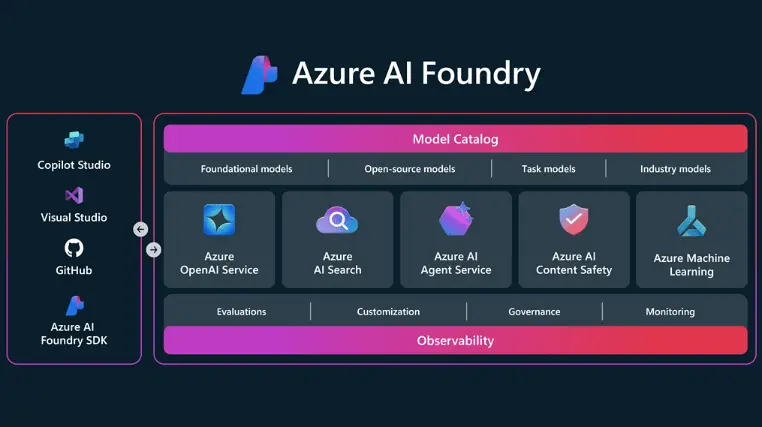
Azure AI is a comprehensive suite of artificial intelligence services offered by Microsoft through its Azure cloud platform. It empowers developers, data scientists, and businesses to build, deploy, and manage AI solutions at scale.
Key Components:
– Azure Cognitive Services: Pre-built AI models for tasks like vision, speech, language understanding, and decision-making. Examples include Computer Vision for image analysis, Speech-to-Text for audio processing, and Language Understanding (LUIS) for natural language processing.
– Azure Machine Learning: A cloud-based platform for building, training, and deploying machine learning models. It supports automated machine learning (AutoML), custom model development, and integration with tools like Jupyter Notebooks.
– Azure Bot Service: Enables the creation of intelligent chatbots that can interact via text or voice, leveraging AI to handle conversations and integrate with other services.
– Azure OpenAI Service: Provides access to advanced AI models like GPT, allowing for generative AI applications such as content creation, summarization, and code generation.
– Azure AI Services for Data and Analytics: Includes tools like Azure Synapse Analytics for integrating AI with big data, and Azure Databricks for collaborative data science.
Benefits:
– Scalability and Security: Azure AI scales effortlessly with cloud resources and offers enterprise-grade security features, including compliance with global standards.
– Ease of Use: No-code and low-code options make it accessible for non-experts, while advanced tools cater to seasoned AI professionals.
– Integration: Seamlessly integrates with other Azure services, Microsoft 365, and third-party applications, enhancing productivity.
– Cost-Effective: Pay-as-you-go pricing models help optimize costs based on usage.
Use Cases:
– Healthcare: Analyzing medical images for diagnostics or predicting patient outcomes.
– Retail: Personalizing customer recommendations or optimizing inventory with predictive analytics.
– Finance: Detecting fraud through anomaly detection or automating customer service with chatbots.
– Manufacturing: Enabling predictive maintenance to reduce downtime and improve efficiency.
Azure AI continues to evolve with regular updates, incorporating ethical AI practices like transparency and bias mitigation, making it a leading choice for organizations embracing digital transformation.
Table of Contents
- Part 1: Best AI Quiz Making Software for Creating A Azure AI Quiz
- Part 2: 20 Azure AI Quiz Questions & Answers
- Part 3: OnlineExamMaker AI Question Generator: Generate Questions for Any Topic
Part 1: Best AI Quiz Making Software for Creating A Azure AI Quiz
OnlineExamMaker is a powerful AI-powered assessment platform to create auto-grading Azure AI skills assessments. It’s designed for educators, trainers, businesses, and anyone looking to generate engaging quizzes without spending hours crafting questions manually. The AI Question Generator feature allows you to input a topic or specific details, and it generates a variety of question types automatically.
Top features for assessment organizers:
● Combines AI webcam monitoring to capture cheating activities during online exam.
● Enhances assessments with interactive experience by embedding video, audio, image into quizzes and multimedia feedback.
● Once the exam ends, the exam scores, question reports, ranking and other analytics data can be exported to your device in Excel file format.
● API and SSO help trainers integrate OnlineExamMaker with Google Classroom, Microsoft Teams, CRM and more.
Automatically generate questions using AI
Part 2: 20 Azure AI Quiz Questions & Answers
or
1. Question: What is Azure Cognitive Services primarily used for?
A. Managing virtual machines
B. Adding AI capabilities to applications via APIs
C. Storing large datasets
D. Running containerized applications
Correct Answer: B
Explanation: Azure Cognitive Services provides pre-built AI models and APIs for tasks like vision, speech, and language processing, allowing developers to integrate AI without building models from scratch.
2. Question: Which Azure service is best for building, training, and deploying machine learning models?
A. Azure Bot Service
B. Azure Machine Learning
C. Azure Cognitive Search
D. Azure Synapse Analytics
Correct Answer: B
Explanation: Azure Machine Learning offers tools for the entire ML lifecycle, including automated machine learning, model deployment, and monitoring.
3. Question: What does Azure OpenAI Service enable?
A. Custom computer vision models
B. Access to advanced language models like GPT
C. Speech-to-text conversion only
D. Data warehousing
Correct Answer: B
Explanation: Azure OpenAI Service integrates OpenAI’s models, such as GPT, into Azure, allowing for natural language processing and generation capabilities.
4. Question: In Azure AI, what is the purpose of Azure Form Recognizer?
A. Translating languages
B. Extracting information from documents
C. Generating images
D. Analyzing video content
Correct Answer: B
Explanation: Azure Form Recognizer uses AI to identify and extract key-value pairs and structures from forms and documents, automating data entry processes.
5. Question: Which feature of Azure AI helps in detecting and moderating content?
A. Azure Speech Services
B. Azure Content Moderator
C. Azure Computer Vision
D. Azure Language Understanding
Correct Answer: B
Explanation: Azure Content Moderator scans text, images, and videos for inappropriate content, helping enforce policies and ensure compliance.
6. Question: What is Azure Custom Vision?
A. A service for pre-built vision models
B. A tool for creating custom image classification models
C. A database for storing images
D. A service for text analytics
Correct Answer: B
Explanation: Azure Custom Vision allows users to build, train, and deploy custom computer vision models tailored to specific image recognition needs.
7. Question: How does Azure AI ensure data privacy in its services?
A. By not encrypting data
B. Through features like data residency and compliance certifications
C. By making all data public
D. By limiting AI to on-premises use
Correct Answer: B
Explanation: Azure AI services include options for data residency, encryption, and adherence to standards like GDPR, ensuring user data is protected and compliant.
8. Question: What is the main benefit of using Azure Bot Service?
A. Hosting web applications
B. Creating intelligent chatbots for conversational AI
C. Managing network security
D. Analyzing financial data
Correct Answer: B
Explanation: Azure Bot Service provides tools to build, test, and deploy bots that can interact with users via text, speech, or other channels using AI.
9. Question: Which Azure AI service is ideal for speech recognition and synthesis?
A. Azure Cognitive Search
B. Azure Speech Services
C. Azure Translator
D. Azure Anomaly Detector
Correct Answer: B
Explanation: Azure Speech Services offers capabilities for converting speech to text and text to speech, supporting multiple languages and accents.
10. Question: What role does Azure ML Studio play in Azure AI?
A. It is a data storage solution
B. It is a web-based interface for drag-and-drop machine learning experiments
C. It handles email services
D. It is for virtual network setup
Correct Answer: B
Explanation: Azure ML Studio provides a no-code/low-code environment for building, testing, and deploying machine learning models quickly.
11. Question: In Azure, how can you deploy a trained AI model?
A. Only through Azure Functions
B. Using Azure Kubernetes Service or Azure Container Instances
C. Via email attachments
D. By printing it out
Correct Answer: B
Explanation: Azure allows deployment of AI models to scalable environments like Azure Kubernetes Service, ensuring high availability and performance.
12. Question: What is Azure Immersive Reader?
A. A service for 3D modeling
B. A tool for reading assistance with features like text-to-speech and language translation
C. A video editing platform
D. A search engine
Correct Answer: B
Explanation: Azure Immersive Reader enhances accessibility by providing features for reading comprehension, including highlighting and audio playback.
13. Question: Which Azure AI component helps in anomaly detection?
A. Azure Metrics Advisor
B. Azure Cognitive Services for Language
C. Azure Bot Framework
D. Azure Synapse
Correct Answer: A
Explanation: Azure Metrics Advisor uses AI to detect anomalies in metrics and logs, helping identify issues in real-time for proactive monitoring.
14. Question: What does Azure Personalizer do?
A. Manages user identities
B. Provides content recommendations based on user behavior
C. Handles database queries
D. Processes payments
Correct Answer: B
Explanation: Azure Personalizer uses machine learning to deliver personalized experiences by ranking content or actions based on user preferences.
15. Question: How does Azure AI integrate with Power BI?
A. It does not integrate
B. Through AI-powered visuals and insights in reports
C. Only for email integration
D. Via physical hardware connections
Correct Answer: B
Explanation: Azure AI enhances Power BI with features like automated insights, anomaly detection, and predictive analytics in dashboards.
16. Question: What is the key advantage of Azure AI’s responsible AI tools?
A. Faster processing speeds
B. Ensuring fairness, transparency, and accountability in AI models
C. Reducing storage costs
D. Automating office tasks
Correct Answer: B
Explanation: Azure provides tools for responsible AI, including interpretability and bias detection, to promote ethical AI development.
17. Question: Which service in Azure AI is used for natural language understanding?
A. Azure Computer Vision
B. Azure Language Understanding (LUIS)
C. Azure Speech Services
D. Azure Form Recognizer
Correct Answer: B
Explanation: Azure Language Understanding (LUIS) enables apps to understand user intent from conversational language, powering chatbots and assistants.
18. Question: In Azure Machine Learning, what is a pipeline?
A. A physical data cable
B. A series of steps for data processing and model training
C. A type of virtual machine
D. A security protocol
Correct Answer: B
Explanation: Pipelines in Azure Machine Learning automate workflows, including data ingestion, training, and deployment, for efficient ML operations.
19. Question: What does Azure Video Analyzer enable?
A. Text editing
B. Analyzing video streams for insights like object detection
C. Managing emails
D. Creating spreadsheets
Correct Answer: B
Explanation: Azure Video Analyzer processes live or recorded video to detect events, objects, and anomalies, useful for security and monitoring.
20. Question: How can Azure AI be scaled?
A. It cannot be scaled
B. Through auto-scaling features in services like Azure Machine Learning
C. Only manually via code
D. By adding physical servers
Correct Answer: B
Explanation: Azure AI services support auto-scaling, allowing resources to adjust based on demand, ensuring cost-effective and performant operations.
or
Part 3: OnlineExamMaker AI Question Generator: Generate Questions for Any Topic
Automatically generate questions using AI