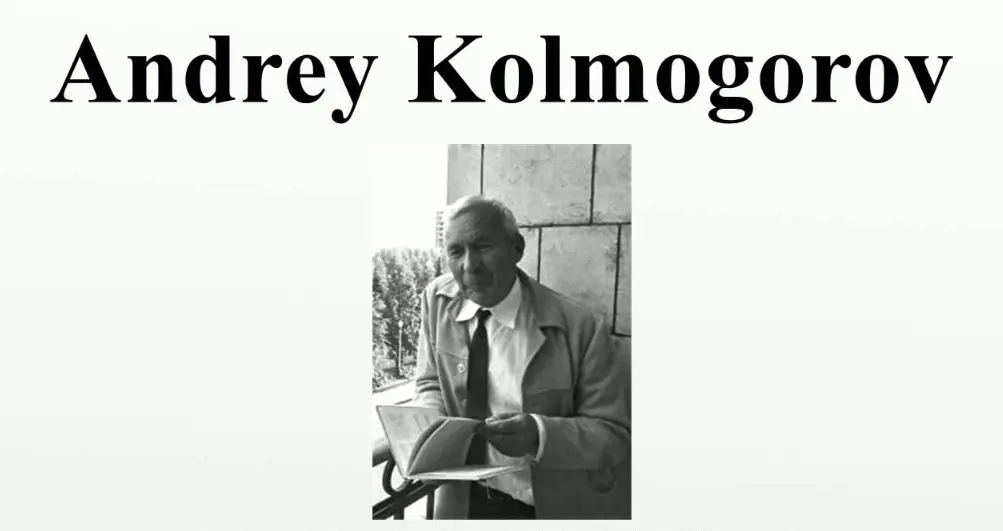
Andrey Nikolaevich Kolmogorov (1903–1987) was a preeminent Russian mathematician whose work profoundly influenced multiple fields of science. Born in Tambov, Russia, he demonstrated exceptional talent early, graduating from Moscow State University in 1925 and earning his doctorate shortly after. Kolmogorov’s contributions to probability theory are foundational; he axiomatized probability in 1933, providing a rigorous framework that underpins modern statistics and stochastic processes.
In turbulence, his 1941 theory—known as Kolmogorov’s theory of turbulence—remains a cornerstone of fluid dynamics, describing the statistical properties of turbulent flows. He also advanced topology with his work on metric spaces and functional analysis, and extended his influence to information theory through the concept of Kolmogorov complexity, which measures the computational resources needed to describe an object.
Kolmogorov’s interdisciplinary reach included logic, where he contributed to intuitionistic logic, and algorithms, impacting computer science. He held a professorship at Moscow State University for over 50 years, mentoring numerous students and fostering mathematical education. Among his honors were the Lenin Prize (1965) and the Order of Lenin, reflecting his stature in the Soviet scientific community. His legacy endures in mathematics, physics, and beyond, with applications in data science, finance, and engineering.
Table of Contents
- Part 1: Create An Amazing Andrey Kolmogorov Quiz Using AI Instantly in OnlineExamMaker
- Part 2: 20 Andrey Kolmogorov Quiz Questions & Answers
- Part 3: Save Time and Energy: Generate Quiz Questions with AI Technology
Part 1: Create An Amazing Andrey Kolmogorov Quiz Using AI Instantly in OnlineExamMaker
The quickest way to assess the Andrey Kolmogorov knowledge of candidates is using an AI assessment platform like OnlineExamMaker. With OnlineExamMaker AI Question Generator, you are able to input content—like text, documents, or topics—and then automatically generate questions in various formats (multiple-choice, true/false, short answer). Its AI Exam Grader can automatically grade the exam and generate insightful reports after your candidate submit the assessment.
Overview of its key assessment-related features:
● Create up to 10 question types, including multiple-choice, true/false, fill-in-the-blank, matching, short answer, and essay questions.
● Automatically generates detailed reports—individual scores, question report, and group performance.
● Instantly scores objective questions and subjective answers use rubric-based scoring for consistency.
● API and SSO help trainers integrate OnlineExamMaker with Google Classroom, Microsoft Teams, CRM and more.
Automatically generate questions using AI
Part 2: 20 Andrey Kolmogorov Quiz Questions & Answers
or
1. What year was Andrey Kolmogorov born?
A. 1900
B. 1903
C. 1910
D. 1895
Answer: B
Explanation: Andrey Kolmogorov was born on April 25, 1903, in Tambov, Russia, marking the beginning of his influential career in mathematics.
2. Which field is Andrey Kolmogorov most renowned for his contributions in?
A. Algebra
B. Probability theory
C. Geometry
D. Number theory
Answer: B
Explanation: Kolmogorov is best known for establishing the foundations of modern probability theory through his axioms, which provided a rigorous framework for the subject.
3. What is the name of the set of axioms that Kolmogorov developed for probability?
A. Bayes’ Axioms
B. Kolmogorov’s Axioms
C. Bernoulli’s Principles
D. Poisson’s Rules
Answer: B
Explanation: Kolmogorov’s Axioms, published in 1933, define probability as a measure on a sigma-algebra, ensuring consistency in probability calculations.
4. In which country did Andrey Kolmogorov spend most of his professional life?
A. United States
B. Germany
C. Soviet Union
D. France
Answer: C
Explanation: As a Soviet mathematician, Kolmogorov lived and worked primarily in the Soviet Union, contributing to its academic institutions like Moscow State University.
5. What is Kolmogorov complexity primarily concerned with?
A. The length of the shortest computer program that can produce a given string
B. The speed of algorithms
C. Graph theory applications
D. Quantum mechanics
Answer: A
Explanation: Kolmogorov complexity measures the resources required to describe an object, introduced as a way to quantify information content in strings.
6. Which of the following awards did Andrey Kolmogorov receive?
A. Fields Medal
B. Nobel Prize in Physics
C. Lenin Prize
D. Turing Award
Answer: C
Explanation: Kolmogorov was awarded the Lenin Prize in 1965 for his outstanding contributions to mathematics and science in the Soviet Union.
7. What major work did Kolmogorov publish in 1933?
A. Foundations of the Theory of Probability
B. General Topology
C. Turbulence Theory
D. Intuitionistic Logic
Answer: A
Explanation: In “Foundations of the Theory of Probability,” Kolmogorov formalized probability theory, making it a branch of measure theory.
8. In what year did Andrey Kolmogorov die?
A. 1980
B. 1987
C. 1975
D. 1990
Answer: B
Explanation: Kolmogorov passed away on October 20, 1987, leaving a legacy in various fields of mathematics and beyond.
9. Which area of mathematics did Kolmogorov contribute to with his work on turbulence?
A. Fluid dynamics
B. Algebraic geometry
C. Differential equations
D. All of the above
Answer: A
Explanation: Kolmogorov’s 1941 theory of turbulence in fluid dynamics provided statistical models for energy dissipation in turbulent flows.
10. What is the Kolmogorov-Sinai entropy used for?
A. Measuring chaos in dynamical systems
B. Solving linear equations
C. Graph coloring
D. Prime number distribution
Answer: A
Explanation: The Kolmogorov-Sinai entropy quantifies the complexity and unpredictability in ergodic theory and dynamical systems.
11. Was Andrey Kolmogorov involved in founding any educational institutions?
A. Yes, he helped establish a school for gifted children
B. No, he focused only on research
C. Yes, he founded Moscow State University
D. Yes, he created the Soviet Academy of Sciences
Answer: A
Explanation: Kolmogorov played a key role in establishing the Kolmogorov School, a specialized program for mathematically gifted students in Moscow.
12. Which of Kolmogorov’s works influenced modern information theory?
A. His axioms of probability
B. Theory of algorithms and randomness
C. Turbulence models
D. Intuitionistic logic
Answer: B
Explanation: Kolmogorov’s ideas on algorithmic information theory, including complexity, laid the groundwork for concepts like randomness in computing.
13. What type of logic did Kolmogorov contribute to?
A. Classical logic
B. Intuitionistic logic
C. Fuzzy logic
D. Modal logic
Answer: B
Explanation: Kolmogorov worked on intuitionistic logic, providing a formal system that aligns with constructive mathematics, contrasting with classical logic.
14. In which decade did Kolmogorov make his most significant contributions to probability?
A. 1920s
B. 1930s
C. 1940s
D. 1950s
Answer: B
Explanation: The 1930s saw Kolmogorov publish his foundational work on probability, including his axioms, which became standard in the field.
15. What is a key feature of Kolmogorov’s continuity theorem?
A. It relates to the uniform convergence of functions
B. It proves the existence of random variables
C. It deals with the law of large numbers
D. It describes Brownian motion paths
Answer: D
Explanation: Kolmogorov’s continuity theorem ensures that Brownian motion paths are almost surely continuous, a cornerstone in stochastic processes.
16. How did Kolmogorov’s work impact computer science?
A. Through the development of algorithms for sorting
B. Via concepts of computational complexity
C. By inventing programming languages
D. Through database theory
Answer: B
Explanation: Kolmogorov’s ideas on complexity influenced computational theory, particularly in defining the inherent difficulty of problems.
17. Which mathematician did Kolmogorov collaborate with on ergodic theory?
A. Alan Turing
B. John von Neumann
C. Andrey Markov
D. Yakov Sinai
Answer: D
Explanation: Kolmogorov collaborated with Yakov Sinai on ergodic theory, leading to advancements in the study of dynamical systems.
18. What is the Kolmogorov circle theorem related to?
A. Circle packing in geometry
B. Probability distributions
C. Topological spaces
D. Fluid dynamics
Answer: C
Explanation: The Kolmogorov circle theorem addresses properties of compact subsets in topology, contributing to the study of metric spaces.
19. During which historical period was Kolmogorov most active?
A. World War I
B. The Cold War
C. The Renaissance
D. The Industrial Revolution
Answer: B
Explanation: Kolmogorov was active during the Cold War era, working in the Soviet Union and contributing to mathematics amid global tensions.
20. What did Kolmogorov’s 1931 paper on the three-series theorem address?
A. Convergence of series in probability
B. Algebraic structures
C. Quantum probability
D. Graph theory
Answer: A
Explanation: The three-series theorem, published in 1931, provides conditions for the almost sure convergence of series of independent random variables.
or
Part 3: Save Time and Energy: Generate Quiz Questions with AI Technology
Automatically generate questions using AI