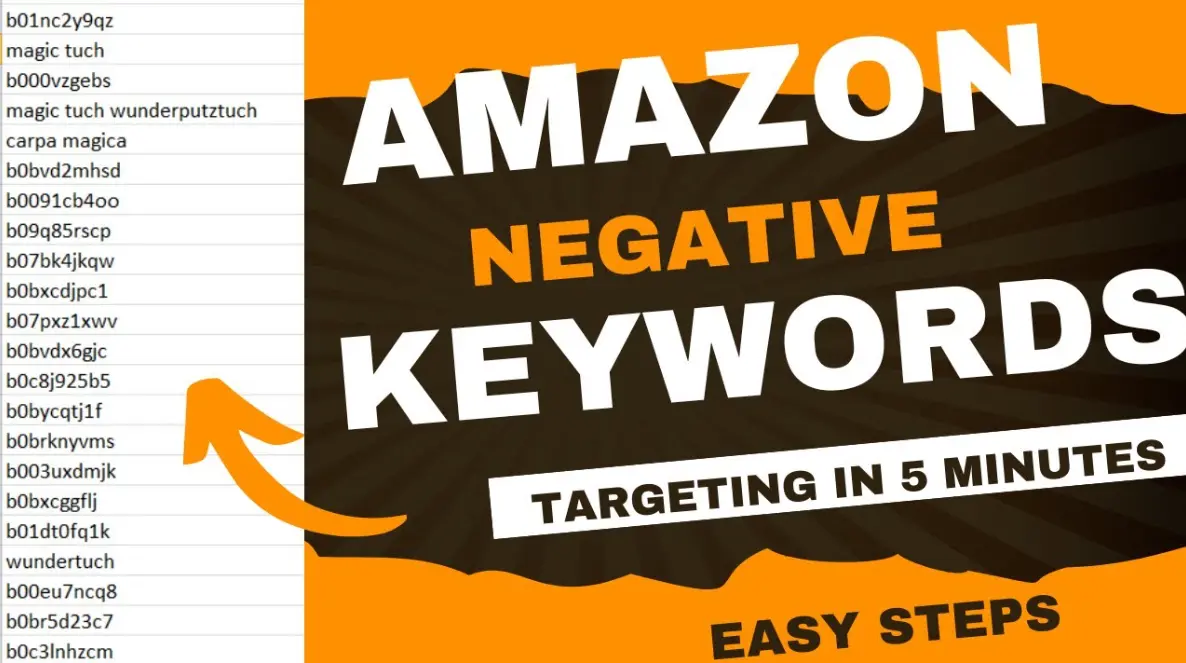
Amazon Negative Keyword Strategy is a targeted approach in Amazon advertising that helps sellers optimize their ad campaigns by excluding irrelevant search terms. By identifying and adding negative keywords—such as words that do not align with your product offerings—you prevent your ads from appearing in unrelated searches, reducing wasted spend and improving overall efficiency.
For instance, if you sell high-end electronics, adding “cheap” or “budget” as negative keywords ensures your ads don’t show for price-sensitive queries, focusing instead on users likely to convert. This strategy enhances ad relevance, boosts click-through rates, and maximizes return on investment (ROI) by aligning your campaigns with your target audience’s intent.
To implement it effectively:
– Conduct keyword research: Use Amazon’s tools like the Search Term Report to analyze which terms trigger your ads but don’t lead to sales.
– Categorize negatives: Group them into broad match (for general exclusions) or phrase/exact match (for specific phrases) based on your needs.
– Regularly review and update: Monitor performance metrics and refine your list seasonally or with product changes to maintain campaign accuracy.
Ultimately, a well-executed negative keyword strategy streamlines your advertising budget, minimizes competition for irrelevant traffic, and drives higher-quality leads, making it essential for long-term success on Amazon.
Table of Contents
- Part 1: Best AI Quiz Making Software for Creating A Amazon Negative Keyword Strategy Quiz
- Part 2: 20 Amazon Negative Keyword Strategy Quiz Questions & Answers
- Part 3: Save Time and Energy: Generate Quiz Questions with AI Technology
Part 1: Best AI Quiz Making Software for Creating A Amazon Negative Keyword Strategy Quiz
Nowadays more and more people create Amazon Negative Keyword Strategy quizzes using AI technologies, OnlineExamMaker a powerful AI-based quiz making tool that can save you time and efforts. The software makes it simple to design and launch interactive quizzes, assessments, and surveys. With the Question Editor, you can create multiple-choice, open-ended, matching, sequencing and many other types of questions for your tests, exams and inventories. You are allowed to enhance quizzes with multimedia elements like images, audio, and video to make them more interactive and visually appealing.
Take a product tour of OnlineExamMaker:
● Create a question pool through the question bank and specify how many questions you want to be randomly selected among these questions.
● Build and store questions in a centralized portal, tagged by categories and keywords for easy reuse and organization.
● Simply copy a few lines of codes, and add them to a web page, you can present your online quiz in your website, blog, or landing page.
● Randomize questions or change the order of questions to ensure exam takers don’t get the same set of questions each time.
Automatically generate questions using AI
Part 2: 20 Amazon Negative Keyword Strategy Quiz Questions & Answers
or
1. Question: What is the primary purpose of negative keywords in Amazon advertising?
A) To increase the bid on specific search terms
B) To prevent ads from showing for irrelevant search terms
C) To automatically expand ad reach to similar keywords
D) To boost the visibility of sponsored products
Answer: B
Explanation: Negative keywords help advertisers exclude irrelevant search queries, ensuring ads are only displayed for targeted terms, which improves campaign efficiency and relevance.
2. Question: How do negative keywords impact the cost of Amazon ad campaigns?
A) They increase costs by limiting ad impressions
B) They have no effect on costs
C) They can reduce costs by avoiding bids on irrelevant traffic
D) They always lead to higher click-through rates
Answer: C
Explanation: By excluding non-converting search terms, negative keywords prevent wasteful spending on clicks that are unlikely to result in sales, thereby lowering overall campaign costs.
3. Question: In Amazon advertising, what match type is typically recommended for negative keywords to ensure broad exclusion?
A) Exact match
B) Phrase match
C) Broad match
D) Negative broad match
Answer: C
Explanation: Broad match negative keywords block a wider range of related terms, providing comprehensive protection against irrelevant traffic while allowing for easier management of exclusions.
4. Question: What is a key benefit of using negative keywords in an Amazon campaign?
A) Increasing the number of ad impressions
B) Improving ad relevance and quality score
C) Reducing the need for keyword research
D) Automatically generating new keywords
Answer: B
Explanation: Negative keywords enhance ad relevance by filtering out unrelated searches, which can lead to a higher quality score and better performance in Amazon’s advertising algorithm.
5. Question: When should you add negative keywords to an Amazon ad campaign?
A) Only after the campaign has run for several months
B) At the beginning, based on initial keyword research
C) Never, as they limit potential exposure
D) Only for high-traffic keywords
Answer: B
Explanation: Adding negative keywords early, informed by research, helps prevent irrelevant impressions from the start, optimizing the campaign’s effectiveness right away.
6. Question: How do negative keywords interact with positive keywords in Amazon ads?
A) They override positive keywords completely
B) They work together to refine ad targeting
C) Positive keywords automatically negate negative ones
D) They have no interaction
Answer: B
Explanation: Negative keywords complement positive keywords by excluding unwanted terms, allowing ads to focus on high-intent searches and improving overall targeting precision.
7. Question: What is a common mistake when implementing negative keywords on Amazon?
A) Adding too few negative keywords
B) Overusing negative keywords and blocking relevant traffic
C) Ignoring match types entirely
D) Both A and B
Answer: B
Explanation: Overusing negative keywords can unintentionally exclude valuable search terms, reducing ad visibility and potential sales, so balance is essential.
8. Question: In Amazon Seller Central, where can you manage negative keywords for a campaign?
A) In the product listing section
B) Under the campaign settings in Advertising Console
C) In the order management tab
D) Through Amazon’s customer review section
Answer: B
Explanation: The Advertising Console in Amazon Seller Central provides dedicated tools to add and manage negative keywords at the campaign or ad group level for precise control.
9. Question: How can negative keywords help improve conversion rates in Amazon advertising?
A) By increasing the frequency of ad displays
B) By ensuring ads only appear for high-intent searches
C) By lowering the minimum bid requirements
D) By automatically retargeting lost customers
Answer: B
Explanation: Negative keywords filter out low-intent queries, directing ads toward users more likely to convert, which boosts the overall conversion rate.
10. Question: What tool in Amazon can help identify potential negative keywords?
A) Amazon Search Terms Report
B) Amazon Sales Rank Analyzer
C) Product Variation Tool
D) Inventory Management Dashboard
Answer: A
Explanation: The Search Terms Report shows actual search queries triggering ads, allowing advertisers to spot irrelevant terms and convert them into negative keywords for better optimization.
11. Question: Why might an Amazon advertiser use phrase match for negative keywords?
A) To block exact phrases only
B) To exclude phrases containing specific words in any order
C) To allow for broader exclusions without specifics
D) To target competitor brand names
Answer: A
Explanation: Phrase match negative keywords block ads for exact phrases, providing targeted exclusion while avoiding overly broad restrictions that could impact relevant traffic.
12. Question: What effect do negative keywords have on Amazon’s ACoS (Advertising Cost of Sales)?
A) They increase ACoS by reducing sales
B) They decrease ACoS by improving ad efficiency
C) They have no direct impact on ACoS
D) They only affect ACoS during peak seasons
Answer: B
Explanation: By minimizing wasteful ad spend on non-converting clicks, negative keywords lower the cost per sale, resulting in a reduced ACoS.
13. Question: In Amazon advertising, can negative keywords be added at the ad group level?
A) No, only at the campaign level
B) Yes, for more granular control
C) Only for sponsored brands
D) Never, as it’s not a feature
Answer: B
Explanation: Adding negative keywords at the ad group level allows for finer targeting, enabling advertisers to tailor exclusions based on specific product groups within a campaign.
14. Question: How do negative keywords contribute to better ROI in Amazon ads?
A) By increasing overall ad spend
B) By focusing budget on high-performing keywords
C) By eliminating the need for A/B testing
D) By automatically pausing low-impression ads
Answer: B
Explanation: Negative keywords optimize budget allocation by avoiding irrelevant impressions, ensuring more funds are directed toward keywords that drive sales and improve ROI.
15. Question: What is an example of an effective negative keyword for a campaign selling premium electronics?
A) “Cheap”
B) “Fast”
C) “New”
D) “Review”
Answer: A
Explanation: Words like “cheap” attract budget-conscious shoppers who may not convert for premium products, so using it as a negative keyword prevents mismatched traffic.
16. Question: Should negative keywords be reviewed and updated regularly in Amazon campaigns?
A) No, once set, they don’t need changes
B) Yes, to adapt to changing search trends
C) Only during holiday seasons
D) Never, as they are permanent
Answer: B
Explanation: Regular reviews of search term reports allow advertisers to add new negative keywords, adapting to evolving consumer behavior and maintaining campaign performance.
17. Question: How do negative keywords differ from positive keywords in Amazon advertising strategy?
A) They are the same and interchangeable
B) Positive keywords attract traffic, while negative ones repel it
C) Negative keywords cost more to implement
D) They both increase ad impressions equally
Answer: B
Explanation: Positive keywords draw in relevant traffic, whereas negative keywords block irrelevant ones, working together to refine and focus the ad strategy.
18. Question: What potential risk comes with improperly using negative keywords on Amazon?
A) Increased competition from other sellers
B) Missing out on potential sales from relevant searches
C) Higher Amazon fees
D) Faster ad approval times
Answer: B
Explanation: If negative keywords are too aggressive, they might exclude legitimate search terms, leading to lost opportunities and reduced sales potential.
19. Question: In Amazon, how can negative keywords help with brand protection?
A) By promoting only branded searches
B) By blocking searches related to competitors or misspellings
C) By increasing brand visibility automatically
D) By reducing the need for trademark registrations
Answer: B
Explanation: Negative keywords can exclude competitor names or irrelevant terms, protecting the brand from association with low-quality or unrelated searches.
20. Question: What is the best practice for testing negative keywords in an Amazon campaign?
A) Add them all at once and monitor for a week
B) Test in small batches and analyze performance metrics
C) Avoid testing and rely on defaults
D) Remove them after the first day
Answer: B
Explanation: Testing negative keywords in small batches allows advertisers to assess their impact on impressions, clicks, and conversions, enabling data-driven adjustments for optimal results.
or
Part 3: Save Time and Energy: Generate Quiz Questions with AI Technology
Automatically generate questions using AI